Home

Main navigation

  • home
  • slides
  • essays
  • articles
  • books
  • video
  • q & a
  • blog
Secondary menu
  • about us
    • scholars
    • privacy
    • support
    • image rights
    • credits
    • contact us
  • resources

Secondary menu

  • about us
    • scholars
    • privacy
    • support
    • image rights
    • credits
    • contact us
  • resources

Ancient Indus Valley Civilization Articles

371 peer-reviewed articles from leading journals about the latest discoveries about the ancient Indus civilization, its antecedents and contemporaries in the Persian Gulf and Mesopotamia, during the Bronze Age 3500-1700 BCE by the world's ancient Indus archaeologists and scholars.
First Evidence of Cotton at Neolithic Mehrgarh, Pakistan

Christophe Moulherat

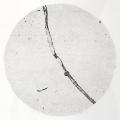
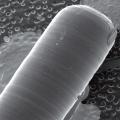
Mehrgarh is the gift that keeps on giving to archaeologists, this time as the location with the oldest known cotton in the Indian subcontinent. Pushing back the origin of major crops, like rice recently, or silk previously, suggests that while some agricultural practices may have spread east to the Indus valley, others, like rice and perhaps cotton and crops that could rotate with other crops may have spread westwards from the Indus region. >

In quest of a piece of cotton unearthed from Mohenjo Daro

Chitra Balasubramaniam

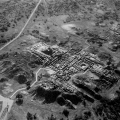
This article is a great example of the investigative work that is required when archaeological evidence and its analysis face mysterious disappearances. Chitra Balasubramaniam has written about how she followed the case of a piece of cotton cloth that "came wrapped around a silver perfume jar and a… >

Cracking the Indus Script

Andrew Robinson

In this concise article in the journal Nature from October 2015, Andrew Robinson reflects on the history of attempts to decipher the Harappan script. More than 500 distinct Indus symbols have so far been identified, and it is now generally believed that the script was read from right to left. >

Associations and Ideologies in the Locations of Urban Craft Production at Harappa, Pakistan (Indus Civilization)

  • Bridging crafts - faience
Heather M.L. Miller

In this article, Heather Miller explains how looking at craft production location with respect to civic organization provides insights into possible associations between crafts, as well as general Indus attitudes toward the placement of manufacturing within city centers. >

Etched (carnelian) beads from northeast and southeast Arabia

  • Beads from Harappa
An De Waele

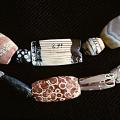
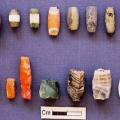
The authors look at the evidence of approximately 70 etched/bleached carnelian beads found from sites along the Arabian shores of the Persian Gulf (in Bahrain, Oman and the UAE) and hypothesize that these beads were imported from workshops on the Indian subcontinent, whether through direct or indir… >

Ancient Skeletal Evidence for Leprosy in India (2000 B.C.)

  • Skeletal remains from Balithal, Rajasthan
Gwen Robbins Schug

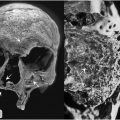
In this article, the authors report on skeletal evidence from 2000 BCE at the site of Balathal, in Rajasthan, India, in an attempt to document the oldest evidence for leprosy. Balithal has two phases of occupation - a small occupation in the Early Historic period (cal. BCE 760 - CE 380) and a l… >

Bead Technologies at Harappa, 3300-1900 BCE: A Comparative Summary

Jonathan Mark Kenoyer

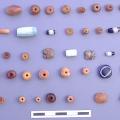
The analysis of beads from different periods and areas of Harappa have made it possible to define specific trade networks and the organization of production as well as changing patterns of interaction over the history of a site. >

Chariots in the Chalcolithic Rock Art of India

  • Rock paintings from Madhya Pradesh
Erwin Neumayer

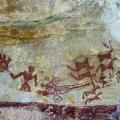
In this article Erwin Neumayer studies the rock paintings from sites in Madhya Pradesh, Karnataka, Uttar Pradesh and Rajasthan to investigate the role and types of the chariot. Based on writing and other artefacts (such as the copper hoard) he offers a date between 1800-1200 BC for these paintings,… >

Women in Ancient Sindh: Bronze Age Figurines of the Indus Valley Civilization

Paolo Biagi

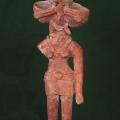
In this 2004 article from the quarterly publication Sindh Watch, Paolo Biagi synthesizes the evidence of female clay figurines from Bronze Age sites in the Indus Valley to highlight the social and cultural roles of women in that society. He draws on earlier evidence from the neolithic site of Mehrgarh, in Balochistan, as well as that from mature Harappan sites like Mohenjodaro and Harappa. Based on this analysis he offers the insights into the role of women as depicted in the figurines. >

Crocodile in the Indus Civilization and later South Asian traditions

Asko Parpola

Asko Parpola presents a wide-ranging investigation of the evidence of crocodiles in the Indus Civilization and later traditions. He draws on zoological, material, ethnographic, epigraphic, etymological and historical evidence to offer an impressively detailed narrative on the role of the crocodile … >

Iconography of the Indus Unicorn: Origins and Legacy

Jonathan Mark Kenoyer

A detailed look at the unicorn icon on Indus objects, incorporating the latest findings, even incomplete ones like the unicorn figurines shown from Ganweriwala. >

Marine Exploitation in the Third Millennium BC - The Eastern Coast of Pakistan

William R. Belcher

This article focuses on subsistence changes by reconstructing the role of fishing during the Indus Valley Tradition (ca. 6500 to 1300 BC), located in the area of modern Pakistan and western India. Analytical results from two marine coastal archaeological sites, Balakot and Allahdino, in Pakistan ar… >

Multiple Approaches towards Reconstruction of Fishing Technology: Net Making and the Indus Valley Tradition

William R. Belcher

This article undertakes to identify methods of fishing in the the Harappan Phase of the Indus Civilization. Given the perishable nature of fishing nets in the archaeological record, the author uses four sets of data to infer the presence of netting as a fishing technology. >

Towards a Geo-Archaeology of Craft at Moenjo-daro

Massimo Vidale

This paper studies the formation of craft activity areas in Mohenjodaro. Since 1981, one of the key lines of research carried out by German and Italian archaeologists at Moenjodaro has been the surface evaluation of the craft activity areas of the archaeological complex. >

Bronze Age Salūt (ST1) and the Indus Civilization: recent discoveries and new insights on regional interaction

  • Carnelian beads
Dennys Frenez

"The discovery of Indus seals manufactured with non-Indus raw materials, but with tools and techniques associated with Indus productions, further supports the idea that merchants and craftsmen from the greater Indus Valley were living and working at interior settlements in the Oman peninsula." >

The Decline of the Harappans

George F. Dales

The archaeologist George F. Dales, who excavated at Mohenjo-daro in 1964, and hydrologist Robert L. Raikes propose a theory around the decline of the Indus civilization which involves large flooding and a back-up of the Indus for perhaps a century in ancient times. While not much evidence for this … >

Interpreting the Indus Script: The Dravidian Solution

Iravatham Mahadevan

The Convocation Address of February 26, 2015 at the Dravidian University in Kuppam reflects on similarities between the Indus script and later Dravidian culture. With a number of illustrations and discussions of recent finds in south India. >

The Lady of the Spiked Throne

Massimo Vidale

The Power of a Lost Ritual. An exceptional and controversial recent find in a private collection is analyzed by a leading Italian archaeologist in this fully illustrated complete online volume with many potential implications for understanding ancient Indus culture. >

Shu-ilishu's Cylinder Seal

Gregory L. Possehl

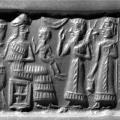
A Mesopotamian cylinder seal referring to the personal translator of the ancient Indus or Meluhan language, Shu-ilishu, who lived around 2020 BCE during the late Akkadian period. >

The Lothal Revisitation Project. A Fine Thread Connecting Ancient India to Contemporary Raveena

  • Lothal Conception
Dennys Frenez

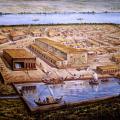
The full story of excavations at Lothal, including the 2008-2009 revisitation project which included satellite imagery and magnetic surveys indicating the presence of interesting structures for a future excavation project. The author, at the University of Bologna in Italy, wrote his thesis on the m… >

Excavations at Shikarpur 2007-2008: A Costal Port and Craft Production Center of the Indus Civilization in Kutch, India

Kuldeep Bhan

Results from the exciting and continuing excavations on the Rann of Kutch in Gujarat. >

Infection, Disease, and Biosocial Processes at the End of the Indus Civilization

  • Infection Disease and Biological Processes at the End of the Indus Civilization
Gwen Robbins Schug

A paper assessing evidence for paleopathology to infer the biological consequences of climate change and socio-economic disruption in the post-urban period at Harappa, one of the largest urban centers in the Indus Civilization. >

The Tiny Steatite Seals of Harappa

Richard H. Meadow

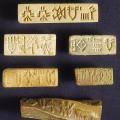
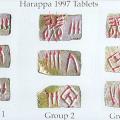
A closer look at the tablets discovered at Harappa during HARPS excavations and the locations where they were discovered at the site. >

Materials used in the Bronze Age

Shereen Ratnagar

A discussion of some of the approaches meta-issues that arise when investigating raw materials, their locations and histories of their exploitation and how these can be interpreted. Particular attention is paid to carnelian and the history of possible sources in Gujarat. The point of the article is… >

Beginnings of Indian Astronomy with Reference to a Parallel Development in China

Asko Parpola

An impressive paper by one of the Indus script's most important interpreters and theorists looks at the origins of astronomy in the subcontinent. >

New Evidence for Early Silk in the Indus Civilization

  • New Evidence for Early Silk in the Indus Civilization
Irene Good

Recent work at Harappa by the Harappa Archaeological Research Project shows that a new study of artifacts recovered from the 1999 and 2000 seasons at the site has revealed the presence of silk. >

Celebrating the Life of Muhammad Nawaz, World Famous Potter from Harappa

Jonathan Mark Kenoyer

An obituary for an extraordinary artist who helped to replicate the exquisite painted ceramics and figurines that were made at the ancient site of Harappa. >

The Origin, Context and Function of the Indus Script: Recent Insights from Harappa

Jonathan Mark Kenoyer

Based on recent excavations at Harappa, it is possible to determine that square seals with animal motifs (such as the elephant) and possibly the short horned bull are among the earliest form of seal with writing. >

Is the Indus script indeed not a writing system?

  • Is the Indus Script Indeed Not a Writing System?
Asko Parpola

In 2008, Dr. Parpola published an updated 2nd paper addressing the controversial Farmer thesis Is the Indus script indeed not a writing system? It originally appeared as part of a felicitations volume in honor of Iravatham Mahadevan published in Chennai, India. >

The Aryan Homeland Debate in India

Shereen Ratnagar

An incisive look at the debate around this issue by one of India's foremost archaeological thinkers. Ratnagar looks at the issue in light of Indian Independence and the various political issues and currents that affect archaeological discourse and interpretations. She explains what the word "Aryan"… >

Pagination

  • First page
  • Previous page
  • …
  • Page 3
  • Page 4
  • Page 5
  • Page 6
  • Page 7
  • Page 8
  • Page 9
  • Page 10
  • Page 11
  • …
  • Next page
  • Last page

follow us

Follow us on Facebook, Twitter and Instagram.
Videos on YouTube.
Occasional Newsletter.

Articles by Subject (48)
  • Agriculture
  • Animals
  • Archaeological History
  • Archaeologists
  • Architecture
  • Beads
  • Cemeteries and Burials
  • Ceramics
  • Crafts
  • Culture
  • Decline
  • Dilmun
  • Environment
  • Evolution
  • Excavations
  • Figurines
  • Fishing
  • Flint
  • Food
  • Games
  • Gender
  • Harappa
  • Kulli Culture
  • Manufacture
  • Mesolithic Period
  • Music
  • Nal
  • Natural Resources
  • Neolithic
  • New Discoveries
  • Ornaments
  • Pottery
  • Raw Materials
  • Religion
  • Rock Art
  • Script
  • Seals
  • Steatite
  • Stoneware
  • Technology
  • Textiles
  • Tools
  • Toys
  • Trade
  • Unicorn
  • Urbanism
  • Water
  • Writing

Q and A

Questions and Answers from our site visitors to Indus scholars like Iravatham Mahadevan, Richard H. Meadow, Shereen Ratnagar, Jane McIntosh, Asko Parpola and Rita P. Wright.

Articles by Place (54)
  • Afghanistan
  • Ahar Banas [Rajasthan]
  • Allahdino
  • Amri
  • Arabia
  • Bagasra
  • Balakot
  • Balathal
  • Balochistan
  • Binjor
  • BMAC
  • Central Asia
  • Chanhu-daro
  • Dholavira
  • Dilmun
  • Dilmun (Bahrain)
  • Farmana
  • Gujarat
  • Halil Rud
  • Harappa
  • Haryana
  • Iran
  • Kalibangan
  • Karanpura
  • Kashmir
  • Khambat
  • KPK (NWFP)
  • Lakhan Jo Daro
  • Lothal
  • Madhya Pradesh
  • Margiana
  • Mehrgarh
  • Mesopotamia
  • Mitathal
  • Mohenjo-daro
  • Mundigak
  • Oman
  • Oxus
  • Pak
  • Punjab
  • Rajasthan
  • Rakigarhi
  • Rohri Mines
  • Rojdi
  • Sanauli
  • Shahr-i Sokhta
  • Shikarpur
  • Shortugai
  • Sindh
  • Sonari
  • Sutkagen Dor
  • Tamil Nadu
  • Trade
  • Uttar Pradesh
Articles by Author (300)
  • F. A. Khan
  • Iqtedar Alam
  • Abe, Yoshinari
  • Adhikari, Ronojoy
  • Ajithprasad, P.
  • Al-Jahwari, Nasser S.
  • Ameri, Marta
  • Amundson, Ronald
  • Arbuckle, Benjamin S.
  • Aruz, Joan
  • Ashraf, Md. Izhar
  • Atturu, Deva
  • Baidya, Abu Saeed
  • Bakry, A.
  • Balakrishnan, R.
  • Balasubramaniam, Chitra
  • Balista, Claudio
  • Baqri, Syed Rafiqul Hassan
  • Barba, Federica
  • Basak, Shubjam
  • Bates, Jennifer
  • Beaubien, Harriet F.
  • Beaudry, Marilyn P.
  • Belcher, Wayne R.
  • Belcher, William R.
  • Betts, Alison
  • Bhan, Kuldeep
  • Bhaskar, M. V.
  • Bhattacharya, Ujjwal
  • Biagi, Paolo
  • Blevins, K. Elaine
  • Bolger, Diane
  • Bondioli, Luca
  • Bosch, David
  • Bosch, Leslie
  • Bryson, Reid A.
  • Burton, James H.
  • Buylaert, Jan-Pieter
  • Cable, Charlotte M.
  • Cárdenas, Marc
  • Carter, Alison
  • Carter, Andrew
  • Carter, R. A.
  • Carter, Savannah
  • Caspers, Elisabeth C.L. During
  • Cattani, Maurizio
  • Ceccarelli, Alessandro
  • Chakrabarti, Dilip K.
  • Chase, Brad
  • Chatterjee, Malavika
  • Chattopadhyay, Pranab K.
  • Choi, Jungwoo
  • Clark, J. Desmond
  • Clark, Sharri R.
  • Conesa, Francesc C.
  • Coningham, Robin
  • Coppa, Alfredo
  • Cork, Edward
  • Cortesi, E.
  • Cox, Brett
  • Craig, Oliver E.
  • Cremaschi, Mauro
  • Cubas, Miriam
  • Dales, George F.
  • Dangi, Vivek
  • Daniell, Rachel
  • Dave, Vasant
  • David-Cuny, Helene
  • Davis, Mary A.
  • Decaix, Alexia
  • Densmore, Alexander L.
  • Desset, Francois
  • Didier, Aurore
  • Dixit, Vaishnavi
  • Dixit, Yama
  • Douglas, Khaled A.
  • Dubova, Nadezhda A.
  • Dupree, Louis
  • Esposti, Michele Degli
  • Fantuzzi, Tiziano
  • Franco, Carlo
  • Franke, Ute
  • French, Charly A. I.
  • Frenez, Dennys
  • Fuller, Dorian Q.
  • Gadekar, Charusmita
  • Garbe, Lisa
  • Garcia, Arnau
  • García-Granero, Juan José
  • Garrett, Zenobie S.
  • Gasparotto, Giorgio
  • Ghauri, Zubair Shafi
  • Giesche, Alena
  • Giosan, Liviu
  • Girod, Alberto
  • Glascock, Michael D.
  • Good, Irene
  • Gray, Kelsey
  • Green, Adam S.
  • Jade d'Alpoim Guedes
  • Guha, Sudeshna
  • Guida, Giuseppe
  • Gupta, Ekta
  • Gupta, Sanjeev
  • Haerinck, Ernie
  • Haider, Romana
  • Haquet, Jerome F.
  • Hemphill, Brian E.
  • Henny, A. S.
  • Heron, Carl P.
  • Hesein, Mohammed
  • Heydari, M.
  • Higham, T.
  • Hobbs, Franklin
  • Hoddell, David A.
  • Hoffman, Brett C.
  • Hong, Jong Ha
  • Hritz, Carrie
  • Hussain, Nushrat
  • Jadhav, Nilesh
  • Jain, Mayank
  • Jain, Vikrant
  • James, Nathaniel
  • Jamison, Gregg M.
  • Jarrige, Jean-François
  • Jogelkar, P. P.
  • Joglekar, Hrishikesh
  • Jones, Penelope J.
  • Kamenov, George D.
  • Kashyap, Arunima
  • Kazi, M. Mukhtiar
  • Kennedy, K.A.R.
  • Kenoyer, Jonathan Mark
  • Khan, Aurangzeb
  • Kim, Yong Jun
  • Kimbrough, C. K.
  • Kingwell-Banham, Eleanor
  • Knox, J. Robert
  • Krigbaum, John
  • Krishnan, K.
  • Kumar, Manmohan
  • Lancelotti, Carla
  • Laursen, Steffen Terp
  • Law, Randall
  • Lazzari, A.
  • Leach, Alexandra
  • Lee, , W. J.
  • Lemmen, Carsten
  • Lentz, David L.
  • Lightfoot, E.
  • Lombardo, Giovanni
  • Lovell, Nancy
  • Lukacs, John R.
  • Mackay, Dorothy
  • Mackay, Ernest
  • Madella, Marco
  • Mahadevan, Iravatham
  • Mahajan, Sangeeta
  • Majid, Jaseera C.
  • Malik, Arun
  • Mandal, D.
  • Manjul, Arvin
  • Manjul, Sanjay Kumar
  • Manuel, Mark
  • Mariottini, Maurizio
  • Mark, Darren F.
  • Mason, Philippa J.
  • Mazuy, Arnaud
  • Meadow, Richard H.
  • Meiggs, David
  • Mery, Sophie
  • Michniak, Ryszard
  • Mille, Benoit
  • Miller, Heather M.L.
  • Miller, Heidi J.
  • Mishra, Vimal
  • Misra, V. D.
  • Misra, V. N.
  • Mitra, Debasis
  • Mohanty, R. K.
  • Moraleda-Cibrián, Nuria
  • Moulherat, Christophe
  • Mughal, M. Rafique
  • Mukhopadhyay, Bahata Ansumali
  • Muller, Wolfgang
  • Munshi, Avadreep
  • Murray, Andrew S.
  • Mushrif-Tripathy, V.
  • Mutin, Benjamin
  • Nakai, Izumi
  • Narasimhan, Vagheesh M
  • Nava, Allessia
  • Negrino, Fabio
  • Neumayer, Erwin
  • News, Dawn
  • Nisbet, Renato
  • T. C. O'Connell
  • Tamsin C. O'Connell
  • Oh, Chang Seok
  • Oldijam, Eric
  • Orengo, Hector A.
  • Otarola-Castillo, Erik
  • Pal, Dipak C.
  • Pal, J.N.
  • Pandey, Lalit
  • Panyam, Amrithavalli
  • Parikh, Danika
  • Parpola, Asko
  • Patel, Ambika
  • Patterson, Nick J
  • Paul, Debajyoti
  • Pendall, Elise
  • Petrie, Cameron A.
  • Pisan, Alessandra
  • Possehl, Gregory L.
  • Prabhakar, V. N.
  • Pracejus, Bernhard
  • Price, T. Douglas
  • Priori, Gianfranco
  • Quinn, P. S.
  • Quivron, Gonzague
  • Raczek, Teresa R.
  • Rahmstorf, Lorenz
  • Rajagopalan, Balaji
  • Rajesh, S.V.
  • Rao, Rajesh P. N.
  • Ratnagar, Shereen
  • Reade, Julian
  • Reddy, Seetha N.
  • Regert, Martine
  • Rizvi, Uzma Z.
  • Robinson, Andrew
  • Rogersdotter, Elke
  • Roux, P. le
  • Salvatori, Sandro
  • Sankhyan, A. R.
  • Schug, Gwen Robbins
  • Schug, Malcolm
  • Schuldenrein, Joseph
  • Sengupta, Shamashis
  • Sharma, Bhanu Prakash
  • Sharma, G.R.
  • Sher, G. M.
  • Shin, Dong Hoon
  • Shinde, Vasant
  • Shirataki, Junko
  • Shirvalkar, Prabodh
  • Sidoti, Giancarlo
  • Singh, Ajit
  • Singh, Ravindra N.
  • Sinha, Rajiv
  • Sinha, Sitabhra
  • Siviero, Anna
  • Smith, Monica L.
  • Solanki, Hiren
  • Sonawane, V. H.
  • Spataro, Michela
  • Spate, Michael
  • Starnini, Elisabetta
  • Strolin, Laura
  • Sucuoglu, Can
  • Sugandhi, Namita S.
  • Suryanarayan, Akshyeta
  • Tengberg, Margareta
  • Thirumalai, Kaustubh
  • Thomsen, Kristina J.
  • Thornton, Christopher P.
  • Tombret, Olivier
  • Tosi, M.
  • Toyoma, Kanac
  • Tufail, Kaiser
  • Turner, A. Keith
  • Uesugi, Akinori
  • Vahia, Mayank
  • Valentine, Benjamin
  • Varma, Supriya
  • Veesar, G. Mohiuddin
  • Verardi, Giovanni
  • Vermaak, Petrus S.
  • Vidale, Massimo
  • Villanueva, Joan
  • Villasana, Isabell
  • Vreeze, Michel de
  • Waele, An De
  • Waghmare, Pranjali
  • Walker, Joanna R.
  • Wankowski, Jacek
  • Weber, Steve
  • Weeks, Lloyd
  • Williams, Kimberly D.
  • Woo, Eun Jin
  • Wright, Rita P.
  • Xu, Huifang
  • Yadav, Nisha
  • Yadav, Yogesh
  • Yamahana, Kyoko
  • Yatoo, Mumtaz
  • Zahir, Muhammad
  • Zazzo, Antoine
  • Zhang, Guilin
© Harappa.com 1995-2026 31