
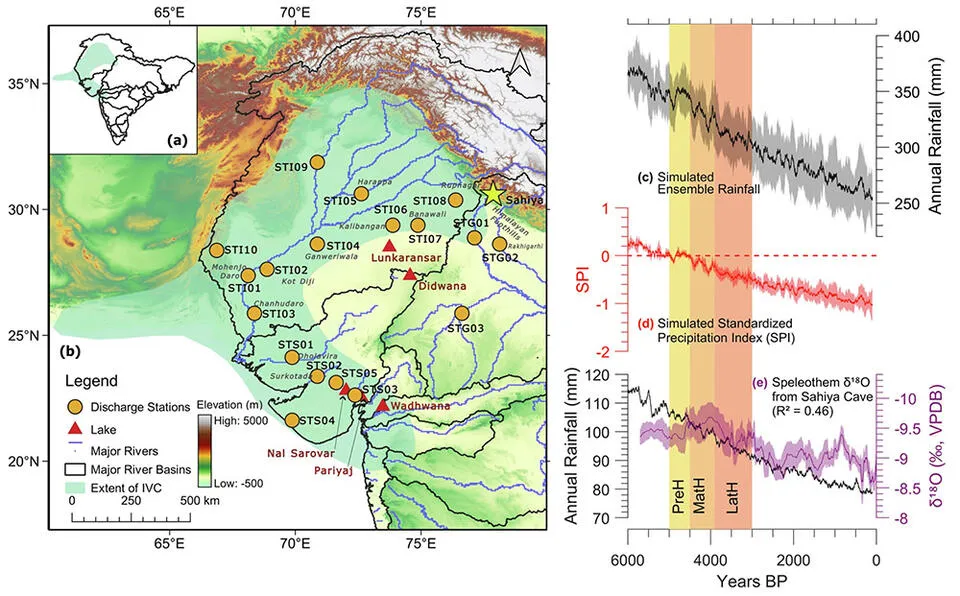
This article, which has received widespread press coverage, provides a detailed climate and hydrological reconstruction of the Indus (Harappan) civilization, focusing on how cycles of river drought and fluctuating monsoon rainfall influenced its trajectory. It demonstrates that severe, long-lasting droughts—especially between about 4400 and 3400 years before present (roughly 2450-1450 BCE)—were a major stressor that coincided with key episodes of population dispersal and cultural change. By integrating high-resolution paleoclimate data and hydrological modeling, the study identifies four major multiple decade droughts during the Mature and Late Harappan periods. These droughts were associated with substantial reductions in river flow, annual rainfall (up to 20%), and summer and winter rainfall across much of the Indus domain. The most severe drought lasted over 160 years and coincided with widespread urban decline and settlement abandonment in the central Indus region. The research links these events to the dynamics of the Indian summer and winter monsoons, as well as to global climate drivers (e.g., ENSO, Atlantic Multidecadal Oscillation) that influenced broader hydroclimatic trends.
The decline of the Indus Civilisation, based on this collection of evidence, was not an abrupt collapse but rather a protracted transformation, with urban centers fragmenting and populations migrating eastward and southward to regions with more stable water supply, such as the Ganga Plains and Saurashtra. Nonetheless, what this study highlights, as have others beforehand like the Two Rains Project (see for example ). Recurring summer and winter droughts from 4.2-3.97 thousand years ago in north India, is that societal resilience and adaptation are critical: the inhabitants adopted new agricultural practices (including drought-resistant crops like millets), moved toward trade networks, and decentralized into smaller settlements during periods of water scarcity. People adapted. While aridity and hydrological stress were central factors, the study cautions that the decline was shaped by an interplay of environmental, economic, social, and possibly political pressures, rather than a single, deterministic climate event. Thus some of the simplified headlines about the research in the popular press, like "How centuries of drought doomed the Indus Valley Civilization" are simplifications of a far more complex process that may have led to a dispersal of people to other parts of the subcontinent, slowly, in waves.
There are two key lines that need to be grasped at the same time: ancient societies were sensitive to climate variability and that hydrological changes can have major consequences for civilization trajectories and that this evidence supports a nuanced view of the Harappan “decline,” favoring models of gradual transformation and adaptation rather than abrupt societal collapse.
Nonetheless, we cannot underestimate the power of climate change, in this case the variability of monsoon rains, on a society. The first part of Amitav Ghosh's wonderful recent book Wild Fictions (2025) describes how climate change, in connection with other factors, helps drive people's movements across the globe. Some adapt, some move, some may return. The impact on a society like those of ancient Indus cities, where religious beliefs and social structures around rivers, crops and wildlife were likely highly important to growth (the charts seem to indicate a significant uptick in rainfall during the rise of the civilization) would have been substantial. A decline in rainfall and river flows for decades would have created some turmoil in belief systems and social structures. It will take much more research, not to mention being able to read the script, to understand how these effects unfolded in the body politic and dispersed people over centuries. Studies like this show that the answers are likely to be multi-dimensional and vary greatly over time and space.
The other thing that is striking about this study is that whereas earlier research and speculations had centered around a single persistent drought, say around 2000 BCE, the four significant declines in rainfall described here suggest that the whole of the ancient Indus civilization's roughly 700 year existence was not tranquil. Memories of water scarcity and variation would have been recent, in the memories and stories of generations current in cities and villages at all times. Adaptation may have been built into social and cultural systems, there was probably a lot of innovation around crops and the use of resources, but life would also have been uncertain, shadowed by the possibility of catastrophe and loss. We have glimpses of that in skeletal remains as Gwen Robbins Schug has shown. Belief systems would have been subject to change and re-assessment, new religious or social movements were probably spawned frequently as promises and prophecies were fulfilled or not. Perhaps there was always a slow trickle of people to the east and south. We cannot be sure of course, but certainly a picture is beginning to emerge of more turbulent times during the ancient Indus civilization than we may have thought previously. A turbulent instead of peaceful civilization?
Image: a Inset tile showing location of the study area (shaded in blue) with the major river basins of Indian subcontinent. b Study Area indicating discharge stations considered in this study near Major Harappan sites (Yellow circles) with major river basins of Indian subcontinent. Red triangles indicate location of lake proxies, while yellow start denotes the location of Sahiya Cave. Shaded background shows elevation data (in m) from USGS GTOPO30. c Simulated ensemble rainfall with associated uncertainty, calculated as ± 1 standard deviation derived from three transient climate simulations (TraCE-21ka, MPI, and TR6AV) spanning from 6000 years BP to present (1850 CE). d Similar to (c) but for Standardized precipitation Index (SPI) computed with respect to the Pre Harappan period. e Simulated ensemble rainfall over the grid encompassing Sahiya cave, alongside its validation (R2 = 0.46) with speleothem data. Three bands from 5000 to 3000 years BP show the distinct periods of the Indus Valley Civilization: Pre-Harappan (PreH), Mature Harappan (MatH), and Late Harappan (LatH).