
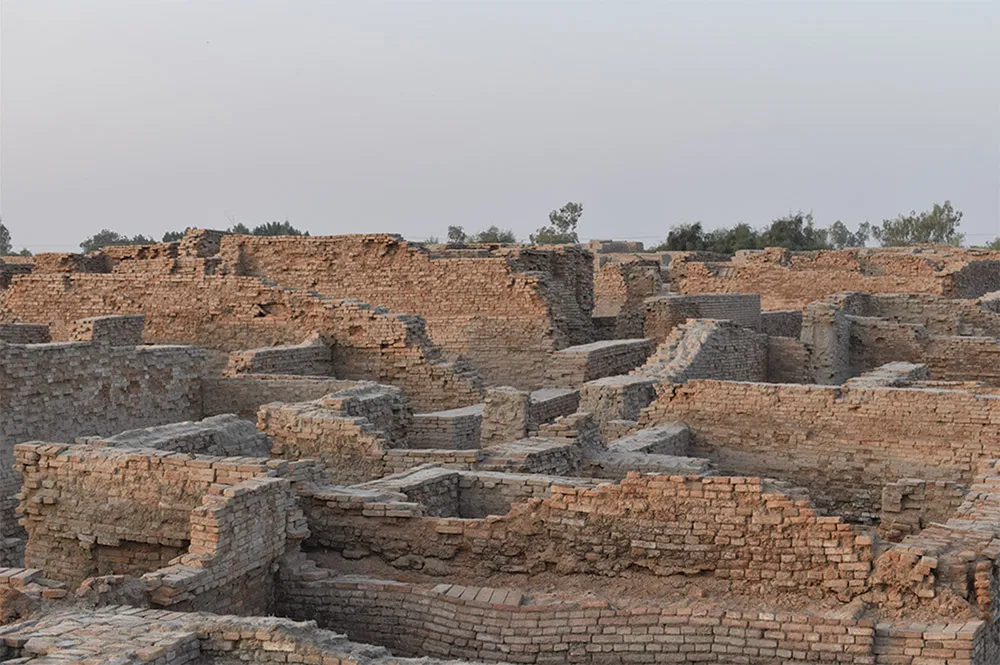
The case for Indus egalitarianism has rested on apparent absences: no palaces, no royal tombs, no exclusionary temples, no individual-aggrandizing art. Adam Green, who already argued in Killing the Priest-King that we should perhaps retire the assumption of Indus elites altogether, has long pushed us to take those absences seriously rather than explain them away. The new paper in Antiquity, written with Iqtedar Alam and Cameron Petrie, tries something the qualitative arguments never could. Drawing on the residence-area data assembled for the global GINI (Global Dynamics of Inequality Project) project, the authors calculate GINI coefficients for Mohenjo-daro and arrive at a striking claim: inequality there did not merely stay low, it declined over the centuries, even as the city grew more prosperous and its streets more orderly.
The strengths of the study are worth dwelling on. The most valuable move is methodological. By converting Marshall’s and Mackay’s century-old house plans into geo-referenced polygons and feeding them into a standardized comparative database, the authors examine Mohenjo-daro's structures in the same statistical terms as Knossos in ancient Greece, Ur in ancient Sumer, or a even Neolithic village. The comparison is interesting. Mohenjo-daro’s overall GINI score of 0.44 sits well below the 0.6-plus scores of contemporary Bronze Age Ur and Ugarit, and far beneath the 0.86 of Knossos with its palace. (A GINI score of 0 is perfect equality, 1 absolute inequality.)
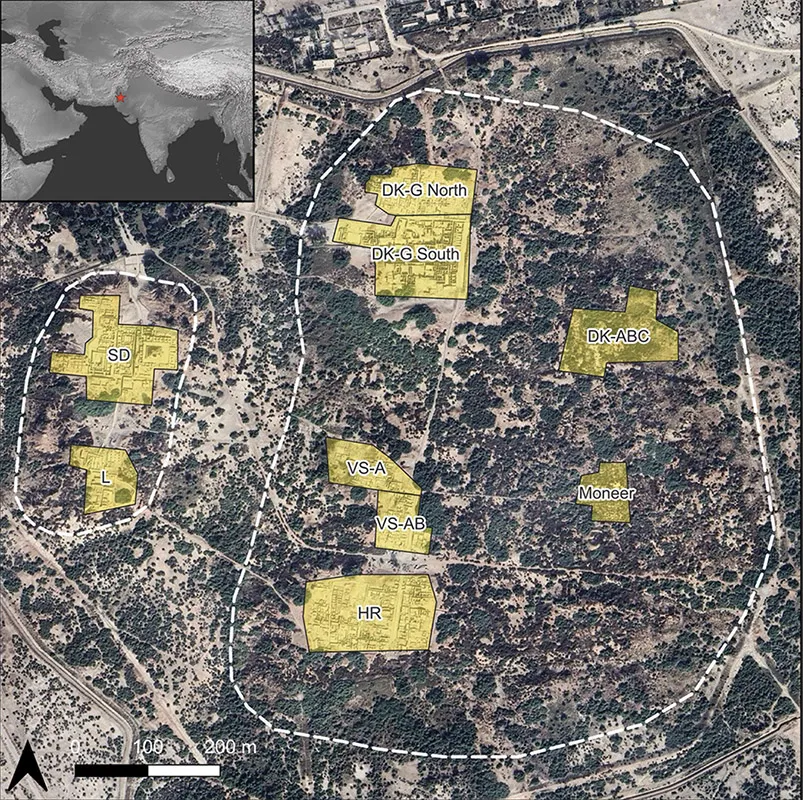
The authors focus on the DK-G South area of Mohenjo-daro, where Mackay’s use of fixed datums allows the team to track change through time (this is very difficult to do in other areas of Mohenjo-daro given early excavation procedures). There the coefficient falls from 0.39 around 2500 BC to a more egalitarian 0.23 by roughly 2100 BC. To watch inequality shrink rather than swell as a city matures is the opposite of what neo-evolutionary theory predicts. The standardized weights, the covered drains, the shared protocols for seal-making that Green elsewhere ties to distributed economic power, all point to governance that apparently spread its resources more widely across a community rather than primarily to its ruling class. The authors admit the productivity-equality relationship is “not statistically robust” and rests on a fleetingly small number of points, given the lack of precise diachronic data from the early excavations at Mohenjo-daro.
This diachronic trend, which is the headline finding, depends entirely on a single excavation area and on sample sizes that are small. The clean 0.23 figure for the latest period rests on thirty-five houses, the earliest on just twelve. The decline-over-time story is then quietly extrapolated to the whole city on the presumption that earlier large houses elsewhere are inflating the aggregate, a presumption the authors cannot test because everywhere outside DK-G South is dated only by Marshall’s crude three-period scheme of construction quality. The data, in other words, are doing a great deal of inferential work. That said, the authors do provide GINI coefficients for other areas of the site, despite the lack of similarly diachronic data from those areas; DK-G North for example, has a GINI coefficient almost twice that of DK-G South.
In short, the data to make larger claims about inequality or not at Mohenjo-daro, not to mention it changing over time, is limited. Residence area is a only one measure of wealth. A rich Indus household need not have built a larger house, and inequality famously hides in things that do not necessarily turn into floor plans: gold, carnelian, faience, access to labor, gender, kinship. Indeed, Indus peoples, at least many of them, seem to have preferred small, highly manufactured goods like stone bangles. This is not even to consider population pressures or other factors we may not know about yet that could have led to different residential sizes over time.
Dr. Massimo Vidale’s argument that some of Mohenjo-daro’s larger buildings could have been palaces for a heterarchical elite is mentioned and then largely set aside rather than confronted (see Aspects of Palace Life at Mohenjo-Daro). Vidale argues that the areas excavated so far at Mohenjo-daro are the elevated mounds, which were the elite districts, while the ordinary population lived in suburbs now buried under roughly eight meters of silt. On that view, the apparent equality is a sampling artifact: the authors of this paper are largely measuring variation among elite houses and missing the poor entirely. Vidale's alternative, developed in his Palace Life article is that some of the larger structures were effectively palaces for competing elite groups in a heterarchical (rather than flat) society. A heterarchy is an organizational structure where elements, units, or ideas are unranked or possess the potential to be ranked in multiple, shifting ways; authority and leadership in a heterarchy are distributed and change depending on the context, task, or situation.
What the paper ultimately offers is less a proof than a well-built invitation. It tries to reframe Indus equality not as a primitive starting condition but as something a city might actively achieve and maintain. Whether that achievement holds once the chronologies of HR, VS and Moneer are properly disentangled is the obvious next question. The M-LAB project led by Dr. Uzma Z. Rizvi at the Pratt Institute in New York which is trying to use legacy datasets from Mohenjo-daro to better examine different areas over time may provide more data in the future, but even so, much more data in other spheres and reasoning would be needed before one can claim that Mohenjo-daro was increasingly, or more egalitarian than, other cities. The magnitude of the claim seems out of proportion to the nature and extent of the evidence.