
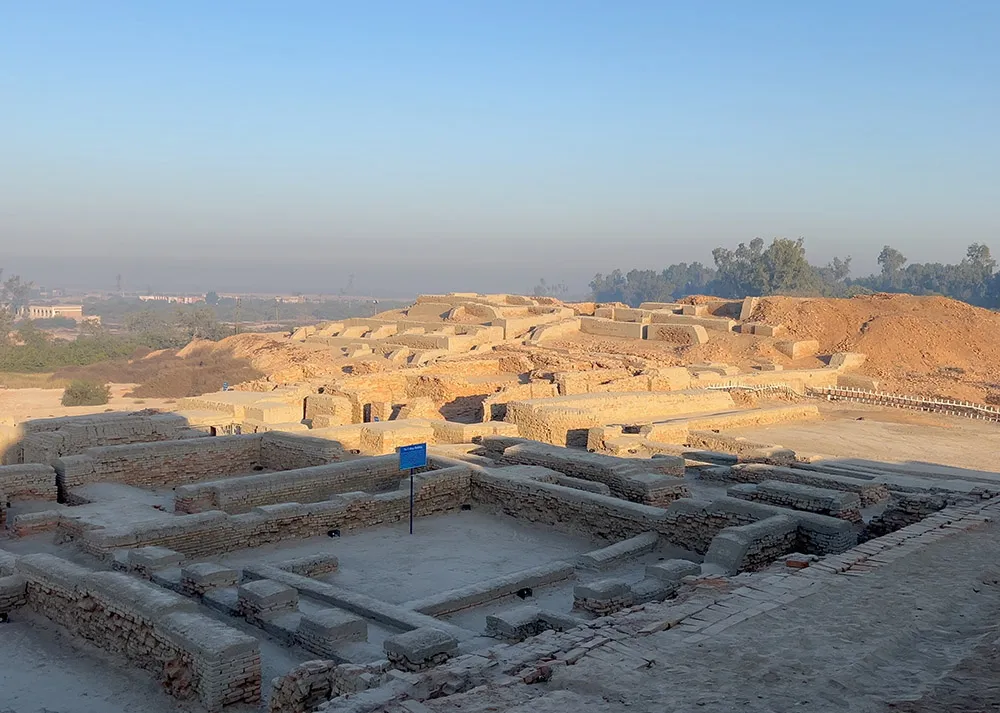
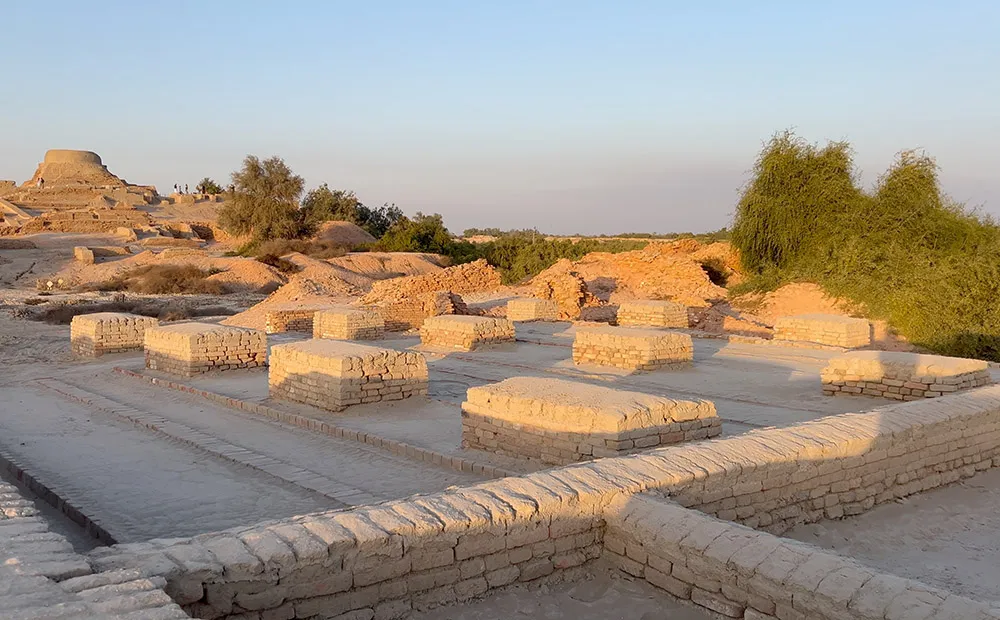
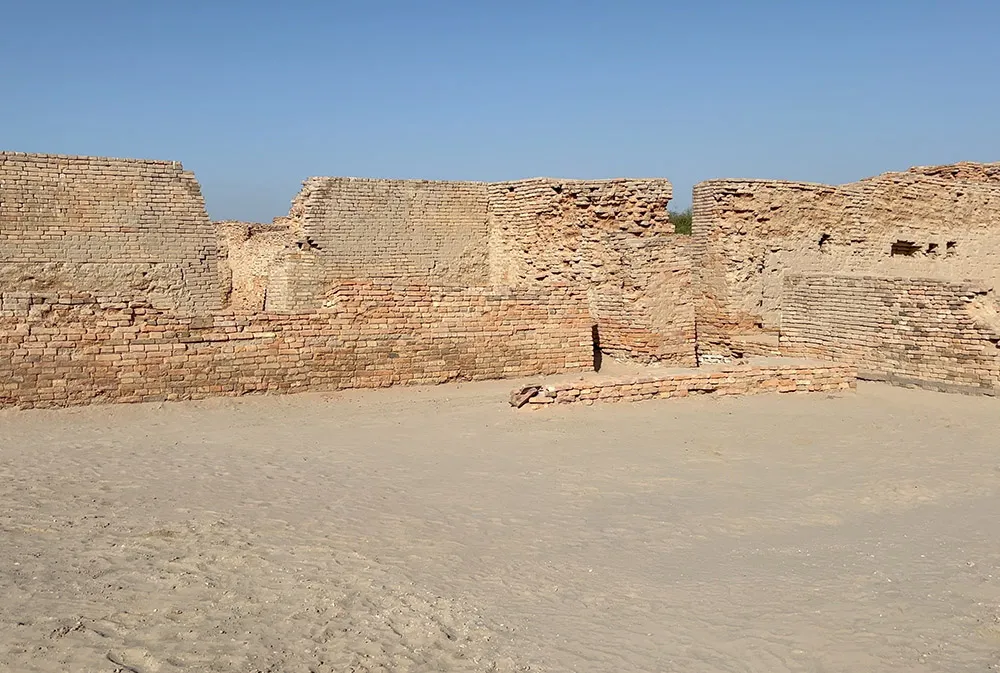
Were there palaces at Mohenjo-daro? A recent visit to Mohenjo-daro, where I observed a number of larger buildings (see Images 1-3) led me to re-read an article by Massimo Vidale, where he directly asks this very question. Dr. Vidale, at the University of Padua in Italy, has never shied away from big thinking, whether about the so-called priest-king or short-horned bull seals. His forays into speculation are often convincing and based on a solid re-examination of archaeological discoveries. This foray into the possibility of palaces or large structures dotting the walled sectors of Mohenjo-daro is no less bold, given all the discussion about the ancient Indus having been an egalitarian polity, with little distinctions between classes, what some have called a “peaceful realm” unlike other Bronze Age civilizations. As he puts it, “many accept the absence of palaces in the Indus cities as fact,” he writes, “and as evidence of the absence of kings or well identifiable outstanding figures ruling the political system,” (p. 59).
Dr. Vidale’s article is an antidote to that sort of thinking, and after having spent some days wandering the site, I cannot help but find myself tending to support with his observations.
He defines “palace” broadly “as a synonym of ‘large urban residence of an elite group’,” (p. 1), and helpfully discusses these structures in light of what we know of other third millennium BCE Eurasian civilizations. He argues for a reinterpretation of the monumental architecture at Mohenjo-Daro, claiming that palace-like complexes did exist in the Indus Civilization despite previous scholarly skepticism. He draws on his firsthand excavation experience at the site to challenge both historical excavation methods and prevailing theories about Indus urban organization. In his reading, the HR area of Mohenjo-Daro contained a substantial palace complex (Block 2), complete with a previously unrecognized "Little Bath" modeled after the famous Great Bath of the Citadel. He proposes that Indus cities were governed not by a single centralized authority, but by heterarchic elites who competed for power from separate fortified compounds, using monumental architecture—particularly ring-stone columns, ritual baths, and elaborate gates—to display status and control access to their sections of the city. In other words, he tries to show that there were “palaces” of sorts in areas of Mohenjo-daro. He does a detailed examination of one structure in the HR area, and then tries to show more widely that these “palaces,” in other area as well show evidence of ring-stone columns based on what was found near them and how these stones may have been used to reinforce their role as dominant structures.
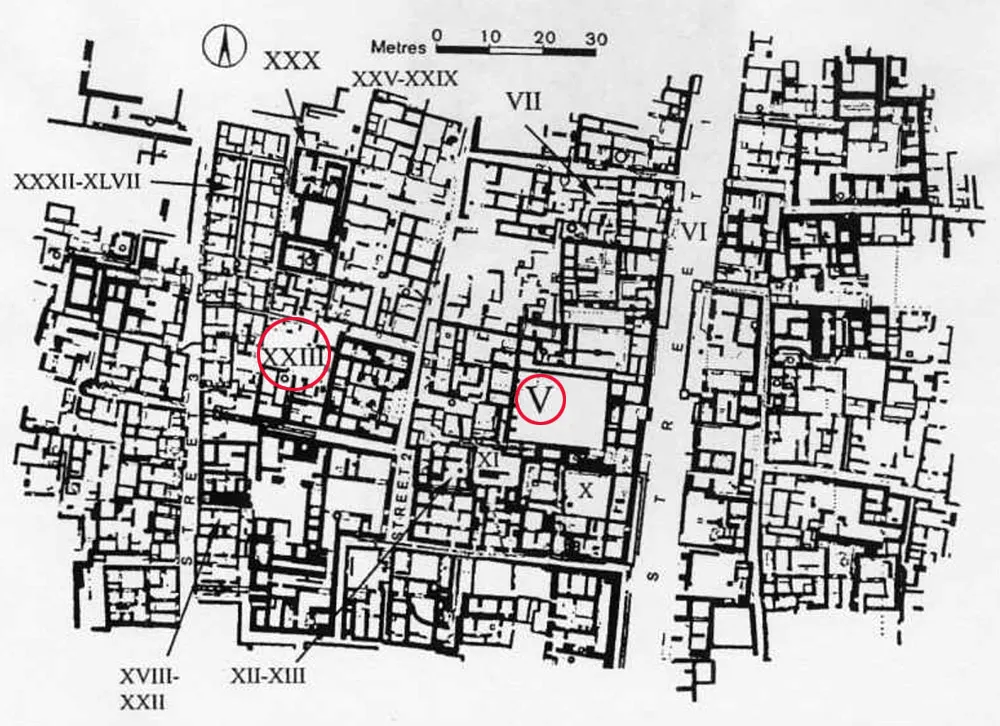
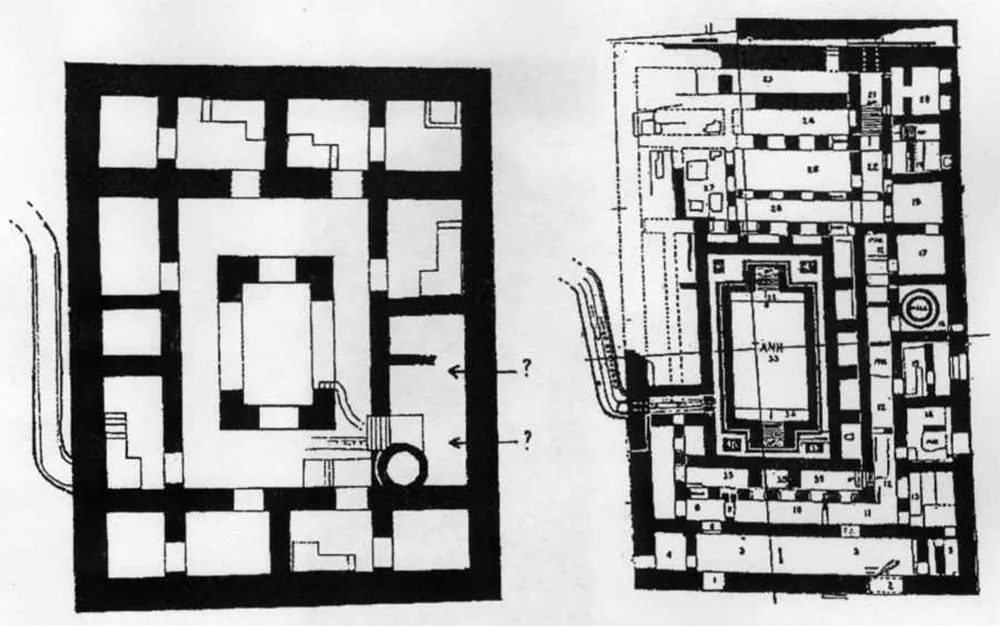
The article’s most provocative claim is that House XXIII in the HR area was actually a small ritual “Little Bath” analogous to the Great Bath in the “Stupa Mound” area. He does make good points as to why this might be the case. There are architectural similarities: a concentric plan with a central rectangular court surrounded by rooms matches the Great Bath's layout. Similar to the larger structure, there is a well similarly positioned massive drain. Four L-shaped brick piers in the center, found nowhere else at Mohenjo-Daro except around the Great Bath, could have supported columns around a tank. Small stepped platforms in surrounding rooms could have been used for ritual bathing, with servants pouring water onto kneeling individuals. Vidale admits excavators Sahni and Marshall recognized the inner space as a porch but didn't excavate deeper, possibly because they were influenced by the "rising paradigm of the opposition between citadels and lower towns” (p. 61). If the Great Bath was deemed to be unique, they couldn't recognize a similar structure elsewhere. The discussion is interesting and not implausible. It points towards the importance, the greater the complexity of archaeological finds, of the paradigms archaeologists bring to bear on what they find.
Indeed, a significant portion of the article critiques the early 20th-century excavations conducted by Sir John Marshall, E.J.H. Mackay, and their teams. Vidale identifies several methodological failures including misinterpretation of architectural phases: excavators mapped structures at similar elevations as single-phase buildings, failing to recognize that Mohenjo-Daro was continuously rebuilt for centuries with constantly changing interior layouts. Workers likely missed or removed mud brick walls, wooden elements, and small finds due to excavation with picks and without sieves, losing architectural evidence. He quotes Sir Mortimer Wheeler’s admission that "in most Indus buildings...architectural history has never been worked out and the published plans are inadequate." Nonetheless, Vidale admits that his interpretation of the “Little Bath” is not shared by many others, and “After decades of decay and reconstructions of the excavated architecture, there is no way of ascertaining who was right. Any interpretation has a halo of arbitrariness,” (p. 61). It will take new excavations to possibly settle the issue, as Vidale frankly admits.
A “Little Bath” aside, there is clear evidence for fortified citadels, platforms and walled areas of town, like at Harappa, with gates that must have separated the people in those areas from others and possibly led to taxation and the control of entrances. Vidale writes:
“The detailed architectural studies of Mohenjo-Daro by M. Jansen and his team showed that the city was constructed with a threefold system of massive platforms and artificial fillings: imposing monumental foundations, often protected by massive perimeter walls, for the main urban insulas: large foundations supporting individual buildings; and fillings and smaller-scale platforms for single rooms and courtyards. The platforms of the main insulas and their outer walls doubtless acted as protections from floods, but also as defences and symbols of power reinforcing the social distance between local elites and commoners, low-status groups and outsiders,” (p. 61).
He also points out that we often forget that the modern site is much higher than it was four thousand years ago. The Citadel probably towered some 20 metres above the today’s ground level. The HR area (where the “Little Bath” is said to be) was like other major areas, “planned and simultaneously built onto a system of platforms,” (p. 62).
Indeed, he calls Indus cities, primarily using evidence from Harappa and Mohenjo-daro, as “clusters of citadels” (p. 63), a nice phrase that relates to urban formation in other parts of the world, like the Near East, where we think urban areas formed as people from different areas came together and settled areas to trade goods with each other, whether made on site or brought from their original “hinterlands.” “Chiefs and rulers of each community might have negotiated power by controlling and restricting access to the fortified enclosures and to important ritual buildings, as well as to the services and craft resources they contained. Socio-economical control might have been indirect – if granted, for example, by the manipulation of family ties, ethnic or kinship affiliation, or ritual activities – or direct, if exerted by taxation and restriction of access. At any rate, it was pursued from different urban seats whose walls were a powerful symbol of separated identity,” (p. 63).
He also draws on Dr. Jonathan Mark Kenoyer’s work showing how competition among groups for status led to similar goods make in different materials which represented status, like similar beads made from different materials, to argue for stratification and elites.
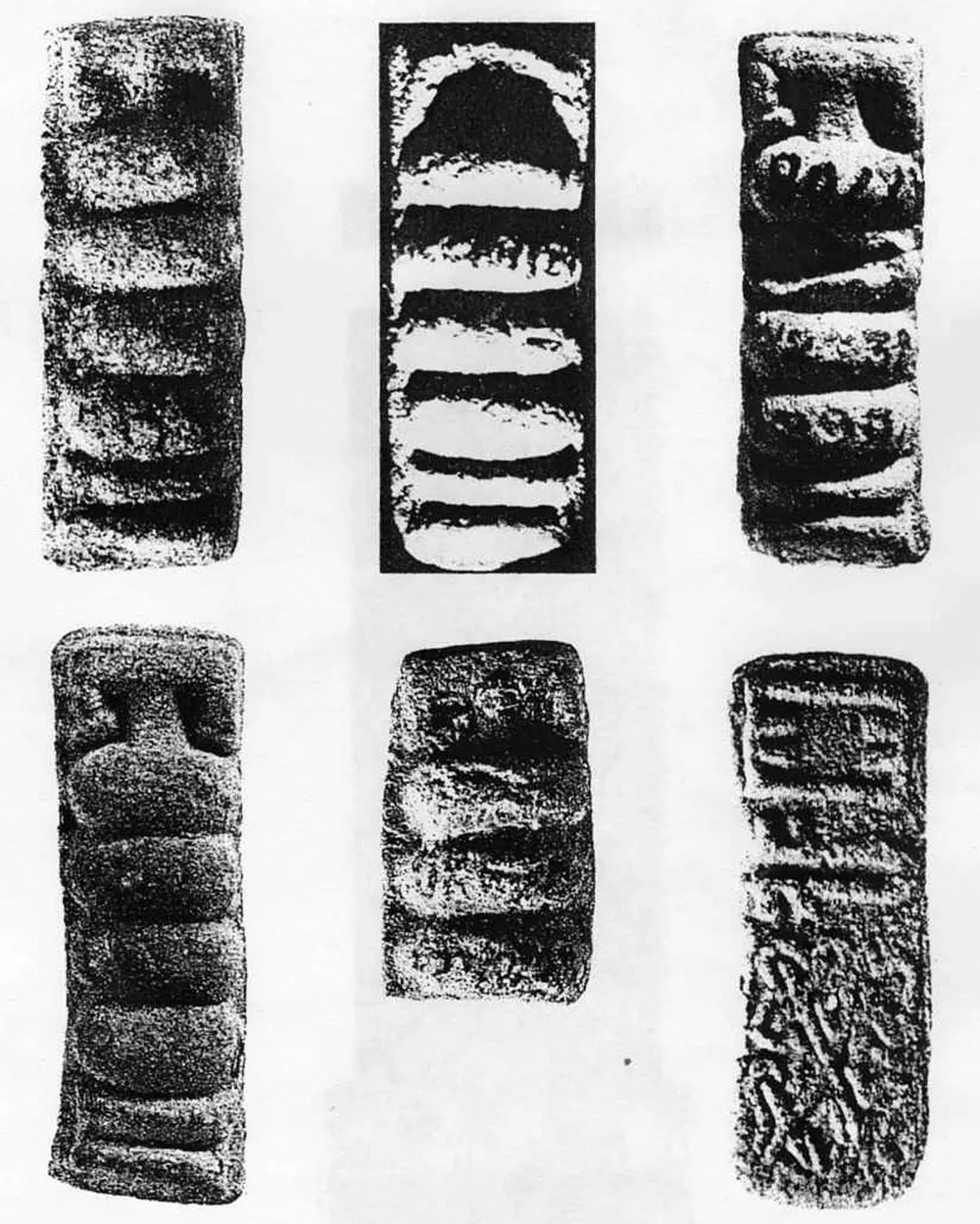
A second equally powerful line of argument made by Vidale concern the mysterious limestone "ring-stones" found at Indus sites which he uses to offer further proof of palace-like, elite structures. While Marshall interpreted them as religious symbols (yoni-lingam representations), Vidale supports the interpretation proposed by Henry Cousens and Mackay at the time that they were segments of composite monumental columns threaded onto wooden shafts, symbols of power as it were. Evidence supporting this interpretation includes later excavations at Dholavira which revealed fallen columns with ring-stones at monumental gates, rare tablets from Mohenjo-Daro depicting columns made of superimposed ring-stones with volute capitals. A small tablet found more recently at Lakhanjo-daro (the modern city of Sukkur north of Mohenjo-daro) seems to show just such columns (though this is not discussed in Vidale’s paper). Vidale also points to the ring-stones size gradations, cup-marks for assembly, and dowel-holes for fastening to wooden cores. Ring-stones were also often made from banded limestone quarried 500-1000 km away at Khadir island near Dholavira at Harappa, indicating their high value. According to Vidale, these ring-stone studded gates or entrances were part of the projection of elite residences as centers of authority and power, an idea was also proposed by E.J.H. Mackay and G. Possehl.
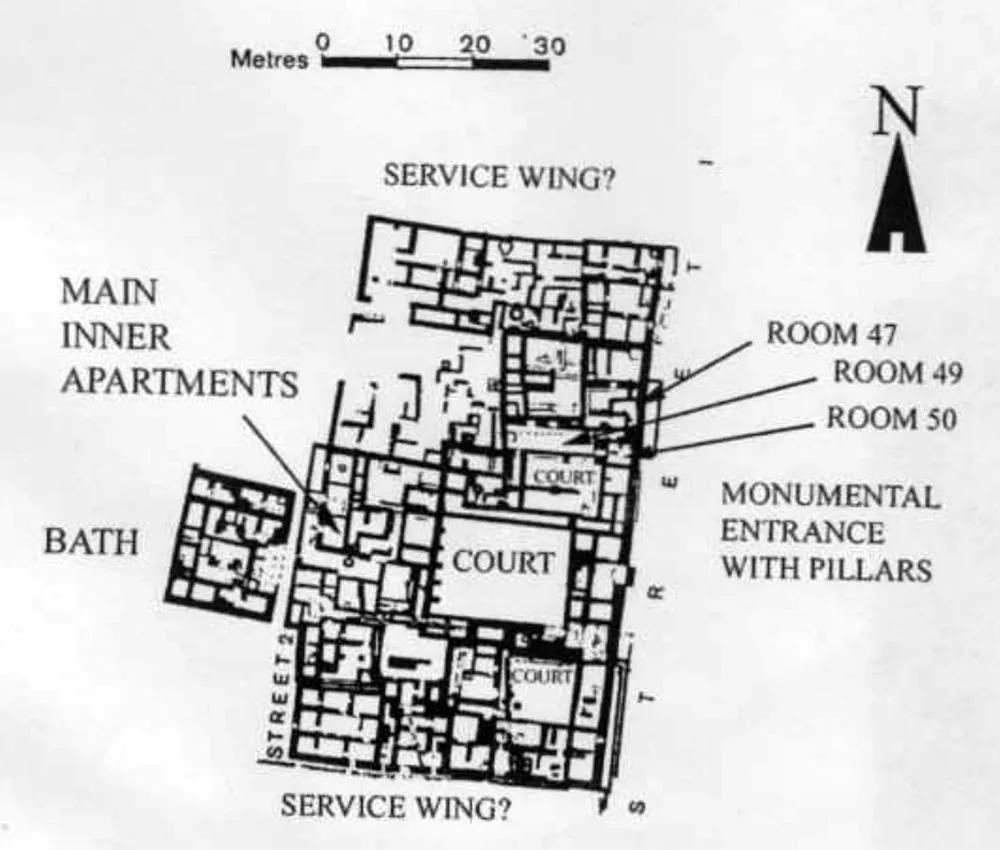
Vidale focusses on House V in the HR area, adjacent to “First Street” which connected different sections of Mohenjo-daro, with an enormous 14 x 19 meter wide-open courtyard of fired-brick. It was connected to two smaller courtyards and most importantly, no less than 18 ring-stones were found along its northern wall. Stone caps “resembling Ionic capitals (!)” (p. 65) were found nearby as well. In the same block, jewelry hoards, bathing platforms, and other evidence for the whole block being an elite area were found, not to mention smaller structures that could have been used by people who served the inhabitants of the larger residences. His re-imagining of the entire Block 2, with the large court and “Little Bath” is shown in Image X. Surmises Vidale:
“Such residences were settled by independent elite groups, which shared the same ideology and on this basis competed for prominence and political power. Gates monumental entrances with composite pillars and ritual baths were built on as many 'architectural interfaces' between external public spaces and palatial interiors. While gates allowed physical control and security, the columns were powerful symbols of the superior social status of the residents. Tanks, finally, might have granted the ritual purity required to those who entered the restricted spaces of the palaces,” (p. 71-2).
Though he does not go into great detail, Vidale mentions that on the Stupa Mound, the Great Bath is similarly near a large building called the “Priest College,” by early excavators, with about 80 rooms (see Image 1). The whole edifice could have served as a conceptual model for the analogous structures in other areas, and the way these seem to have come into prominence at different times may indicate the vagaries of power and prominence of different groups and their areas in the city’s seven hundred years of history. He also discusses the three complete ring-stones found next to the so-called (by early excavators) "Assembly Hall" in L-Area (Image 2), where "the rings lay near a double line of identical brick piers . . .. The central pier might have supported a ring-stone column in the centre of a wide gate, flanked by a badly preserved set of small rooms. The headless statue of a kneeling figure was found was found near one of the brick bases," (p. 70).
Building on these discussions, Vidale proposes a radical reinterpretation of Indus urbanism. At both Mohenjo-Daro and Harappa, elite residences and public buildings occupied northwestern sectors, while craft workshops and industrial activities were concentrated in southeastern districts. This pattern reflects "functional segregation along a north-west to south-east axis." Rather than a single citadel opposed to a lower town, Indus cities consisted of "a cluster of citadels or, better, walled compounds separately rising around the traditional fortified seats of urban settlement." New elite groups built their own walled compounds to emulate and compete with established elites, creating what Vidale calls a "heterarchic" power structure rather than a single hierarchical authority. The Little Bath exemplifies this emulation—a private version of the Great Bath for a rival elite group. Monumental gates with columns and ritual baths served as "architectural interfaces between external public spaces and palatial interiors," restricting access and symbolizing the superior status of residents. “In summary,” writes Vidale, “ring-stones at Mohenjo-Daro were found in front of streets of passages and in relation to monumental accesses or gates, and the evidence at Harappa does not contradict this view,” (p. 70).
Vidale suggests this emphasis on "social discrimination, classification and eventually symbolic inclusion" might indicate "an incipient caste system developing with the Indus civilization in the fourth-third millennium BCE". He references – without endorsing – Indian archaeologist B.B. Lal's proposal that citadels housed priestly classes (precursors to Brahmins), lower towns housed craftsmen and traders (Vaisyas), and peripheral settlements housed workers and marginalized groups (Shudras). Projecting a caste-like system onto 3rd millennium BCE Indus society based on architectural segregation is highly speculative, as Vidale himself admits. This interpretation risks reading later South Asian social structures backward into prehistory. The evidence for "ritual purity" concerns is particularly tenuous—bathing facilities might serve hygiene, comfort, or many other functions besides caste-based purity concepts. Nonetheless, Vidale’s interpretations do point towards segregations of some sort even if they might not actually be familiar to us.
This article represents a shift in Indus archaeology toward recognizing social complexity and hierarchy, moving away from earlier views of the Indus Civilization as uniquely egalitarian among Bronze Age “states,” if that is the right word – and it probably isn’t. Vidale's work reflects broader trends in archaeological theory emphasizing heterarchy (multiple overlapping hierarchies) rather than simple pyramidal power structures which may have been prevalent as the first urban civilizations were forming. Not only were the “city-states” at the time rather independent, but within these urban centers, there were diverse, separated groups that competed and interacted and may have had some sort of hierarchical relationship between each other.
Walking through Mohenjo-daro earlier this year, I could not help but think that Vidale is on to something right. Looking at other structures like the “Assembly Hall,” in L-Area south of the Stupa Mound (Image 2), or the “College of Priests” on it (Image 1) certainly suggest monumental architecture. Vidale points out, as have others before him, that there is extensive evidence of wooden construction and super-structures everywhere that could have, as it is now the case in the entire region, been elaborate and evidence of wealth and distinction. There is the enormous “Chief’s House,” in DK-G area (Image 3, though Vidale does not address this possibly residential structure). There are many large thick walls still partially visible throughout the site, within and around areas. Finally, the very vastness of the whole site, whether from the stupa mound or various edges made me think that this could hardly have been managed as an egalitarian polity, without elites or the expressions of their authority through the presence of buildings, as has been the case throughout history in the subcontinent and outside of it. The mere presence of such a large urban center, with high mounds and fortified walls would have inspired awe and spelled to the visitor and inhabitant’s mind, authority. Networks of power must have permeated the space. Vidale suggests that these forces were real in certain kinds of structures and layouts and he thinks he has the archaeological evidence to prove this. His article, eagerly reread when I got home, is a splendid piece of archaeological sleuthing, and welcome correction to imagining that this was so different a civilization from those around it and in the subcontinent since. Discussion, analysis and the gathering of evidence is by no means over, but his work, with those of other archaeologists, opens intriguing and encouraging ways of thinking about these issues that takes us away from earlier fanciful beliefs about the Indus civilization.
- Omar Khan, November 2025
Images:
1. So-called "College Building" in the Stupa Mound Area, 2025.
2. So-called "Assembly Hall," L-Area adjacent to the Stupa Mound, 2025.
3. So-called "Chief's House," DK-G Area, 2025.
4. Mohenjo-Daro, HR area: map of the excavated architecture. Roman numbers indicate the main buildings discussed in the text. House XXIII is in the centre, to the rear of Block 2.
5. Block 2 in HR-B interpreted as single palace. Its various quarters might have had different functions: the central location of the 'Little Bath (House XXIII), behind the main residential apartments, provides an example of how various buildings in the most important walled compounds of the Indus cities might have been functionally correlated. The location of ring-stones and capitals, although in secondary contexts, suggests that they came from one or more monumental entrances facing First Street. (Roman numeral V in Image 4 above)
6. The layout of House XXIII, which appears as a very simplified version of the Great Bath on the Mohenjo-Daro Citadel. (Roman numeral XXIII in Image 4, above)
7. A few terracotta tablets found in DK area, Mohenjo-Daro, bear the image of a composite column made with superimposed ring stones apparently threaded on a wooden tapering axis The column is evidently capped by a capital with strongly curved volutes and perhaps rises above two thinner basal segments. The second from the bottom might be a concave drum, like those found as column bases in the Castle at Dholavira. These images of ring-stone columns were impressed from the same seal or matrix. The rear always shows two Indus signs and a labyrinth-like cross design. After S. G. M. Shah and A. Parpola, Corpus of Indus Seals and Inscriptions, Vol. 2, 'Collections in Pakistan' (Helsinki: Suomalainen Tiedeakatemia, 1991).