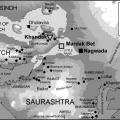
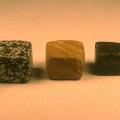
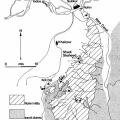
"Geologically speaking," write the authors, "agate is not a particularly uncommon rock . . .. However, good agate – i.e, that which ancient lapidaries would have found suitable for beadmaking – is not widely available. Nodules of the size and quality required to make Harappan-style long-barrel carnelian beads are, in fact, extremely rare" (p. 177). >
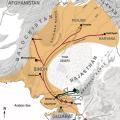
The exchange and communication systems that connected distant parts of the Indus Civilization (c. 2600 to 1900 BC) and beyond had roots beginning in the early Neolithic period. >
One of the first articles to explore the significance of the Rohri flint mines near Mohenjo-daro, who use reaches back hundreds of thousands of years and which played an important role in the ancient Indus civilization as well. >
"In the year 2000," writes the author, "I initiated a large‐scale effort to identify the geologic sources from which peoples of the Indus Civilization (ca. 2600 to 1900 BC) acquired rock and mineral resources." >
The origins of manufacturing debris recovered from different periods of occupation between 3300 BCE and 1700 BCE at Harappa can now be identified with a high degree of certainty thanks to geologic source provenance studies. >
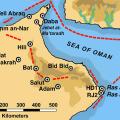
A look at shell-midden and cemetery sites discovered in Oman that date back to the fifth millenium BCE, testifying to the levels of development in areas around the Indus Valley civilization thousands of years before it reached its peak. >
A detailed look at carnelian and agate sources and manufacture throughout the Gulf region, and how many of the beads found show clear evidence of ancient Indus manufacturing techniques. As the authors write: "Recent studies using more refined techniques of morphological and technological analysis c… >