
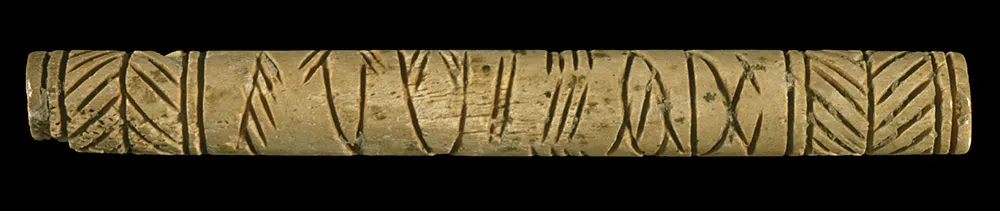
Dr. Heidi J. Miller discusses 18 previously unpublished ivory rods from Dr. George F. Dales's 1964–65 joint Pakistan Department of Archaeology/University of Pennsylvania season, excavated from a 20-meter square in the southwest corner of the HR mound. This is a large amount to have been discovered in such a small area of the site, but she does not discuss more about find location. Her source is not the objects but the excavation records donated by Barbara Dales to the Peabody Museum at Harvard, catalogued with Richard Meadow's help (Dales' records at the Peabody presumably contain locus and level data for all 18 rods).
The 18 rod assemblage breaks down as ten rectilinear, five triangular, two round, and one semi-circular rod in cross-section. Dr. Miller tabulates motifs (Indus signs, concentric circle variants, verticals, obliques, crescents, cross-hatching, herringbone) against section shapes and finds essentially no clean typology — no two rods share the same overall patterning, and the only correlation that survives is that Indus signs cluster primarily on round-sectioned rods. These are indeed fascinating objects, and Miller's singling them out for analysis is an inspired way to ask questions and possibly cast some light on what Indus people spent their time doing, including possibly one of the ways the navigated decisions about the future.
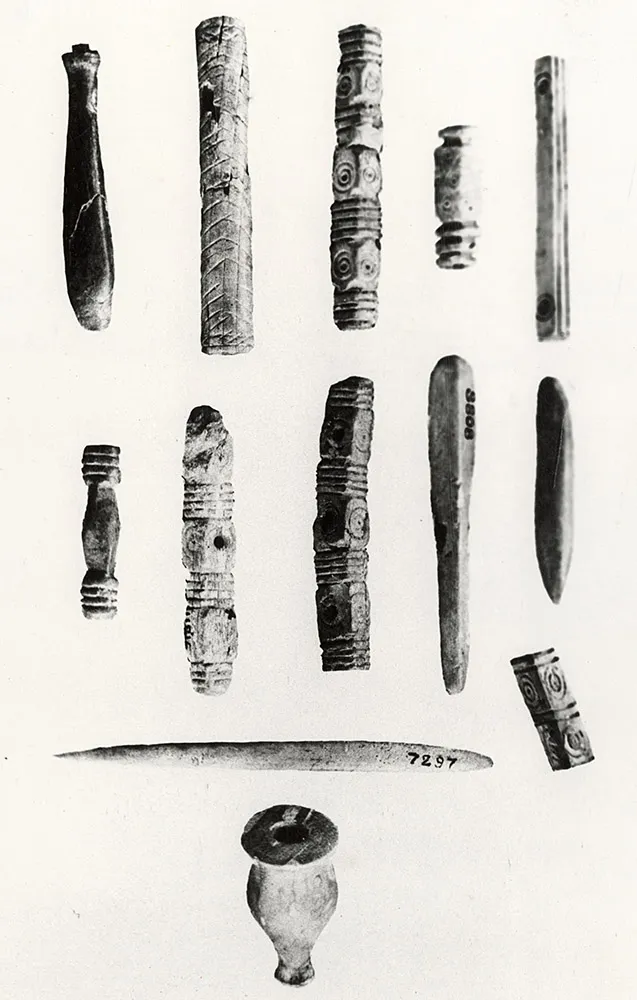
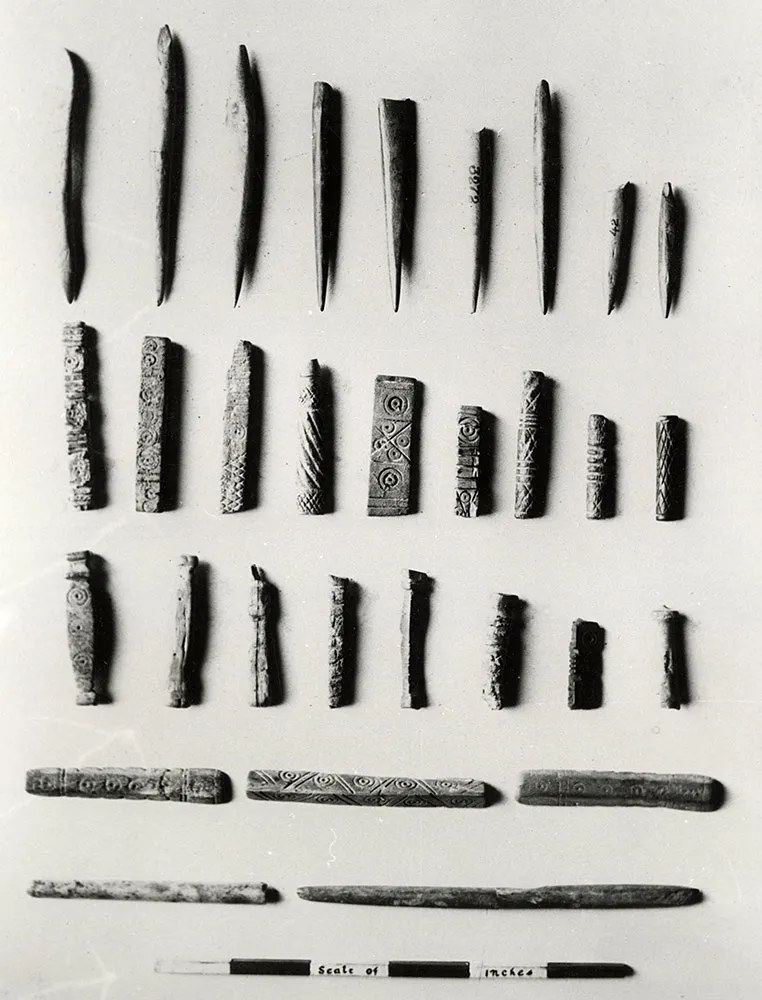
She widens the lens of her article to the hundred-plus rods in John Marshall (1931) and Ernest J.H. Mackay's (1938) books on the Mohenjo-daro excavations, showing that Mackay's own categories — "dice" versus "casting sticks," distinguished by whether all or opposite sides bear the same pattern — collapse into each other, with many objects classifiable as either. Rods ranged in size from 3 to 20 centimeters, and their width varied from 0.3 to 3.0 cms. These are indeed small if high-crafted objects. Miller writes: "Mackay defined five types of tabular dice based on the criteria of section shape and repeating design patterns, as well as four types of casting sticks which differ from dice in that “either all sides or opposite sides, according to their shape, bear exactly the same pattern” yet they “resemble in material and pattern to the dice…” (Mackay 1938, 562). In some examples the difference between rods in these two categories (dice and casting sticks) is not readily apparent and one can easily be classified as the other," (p. 4).
She instead proposes four distinct types from the mass: batons (round, tapering, cross-hatched band with black pigment fill), hair pins (some possibly kohl sticks), the flat "fish" pieces with dot-in-circle heads and chevron scales, and elaborately carved flat pieces with complex circle patterns. Those account for a fifth of the published corpus; the rest resist typology.
One type of rod — the oblong die with one/two/three circles on three sides and parallel lines on the fourth — travels beyond the Indus, showing up as recognized imports at Shahr-i Sokhta (wooden examples in Grave 731), Dalverzin Tepe, Gonur, and Altyn Tepe, with later descendants at Taxila, Porunthal, and the gaming ghat at Nagarjunakonda. The observation that only the standardized numerical dice were exported is a strong pattern, because it suggests contemporaries in Sistan and Margiana recognized that one type as a legible, portable game implement while the rest were embedded in local practice too specific to travel.
For other types, Dr. Miller follows Dr. Jonathan Mark Kenoyer's suggestion that rods not conforming to dice may have served to predict the future or the wishes of deities. She builds an ethnohistorical case from Vedic gambling hymns, the royal consecration dice game, Soar's survey of dice in sculpture, and the Tibetan Lha-mo with her dice and tally stick. She suggests that the lack of standardization shows that the rods or sticks likely served diverse users and divination schemes. Uniformity matters less than the reading of the throw. She adds a complementary explanation to Elke Rogersdotter's finding that Mackay's "casting sticks" cluster spatially at the site, possibly reflecting distinct social groups, which is consistent with Kenoyer, Massimo Vidale and other's theories that the Indus mounds at Mohenjo-daro or Harappa were competing corporate entities.
There is also the possibility that many rods are simply decorated utilitarian objects — awls, netting tools, weaving pin beaters, styli — whose decoration is ornamental; if so, a good deal of time was invested in making these objects confirming once again how much Indus people liked small, highly crafted objects.
Craft-production perspectives are not brought up __for example, were these rods made in one workshop tradition or many? Ivory working is well attested at Mohenjo-daro, and use-wear or manufacturing-trace analysis (polish, edge rounding, pigment residues — she notes Mackay's red/black/yellow fill in the fish pieces) could discriminate between objects that were handled, thrown, worn, or displayed and possibly offer further clues to their use. This would seems to be a fruitful direction for future research on a larger sample.
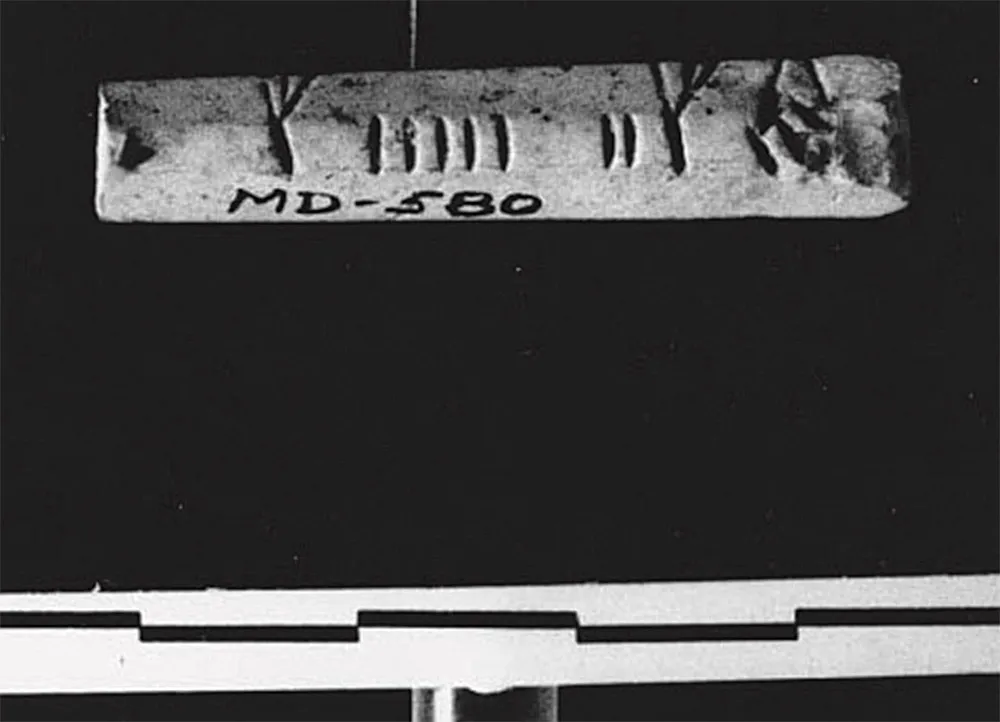
One of the objects she discusses, MD-412 [Image 2] is triangular-sectioned yet carries Indus signs, unlike the generalization that signs go primarily on round rods [1]. If it was meant for divination, what might the signs mean? A name? An invocation of a god or spirits?
Dr. Miller has taken on one of the most interesting set of objects from an ancient Indus city, a type that however small offers many tantalizing clues about the richness of ancient Indus life, the complexities its belief systems, the amount of leisure time and how it might have been spent in cities, the sophisticated design and craft sensibilities that residents benefitted from and exported.