
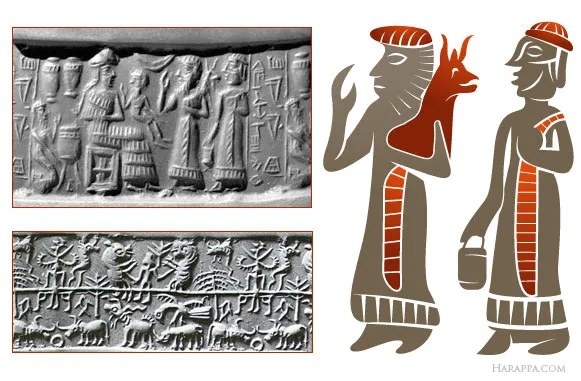
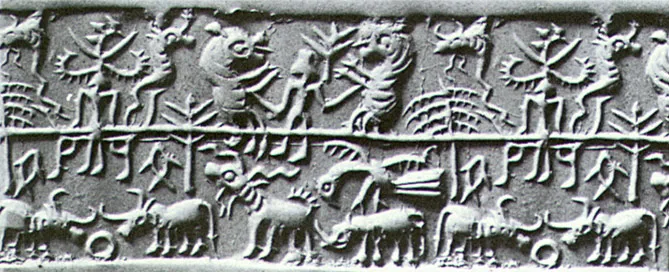


The version of this paper on "The Melammu Project" did not have any images. We have tried to put in as many as possible, and labeled them as Image A, B, C, etc. in brackets [ ] above starting with Image 3 for reference.
It’s around 2300 BCE. A family from Chanhu-daro in Sindh, not far from Mohenjo-daro, is a few generations into life in a Sumerian city. They no longer speak quite the way their great-great-grandparents did. Their seals look a little different from the ones back home. They hold a bit of land, they work in a temple, perhaps one of them keeps a granary in order. They still have a closely guarded way of making long carnelian beads from the quartz that comes in ships from Lothal every few months. When the clerks of Lagash wrote them down, they still wrote down that they came from Meluhha. What does it mean to remain a foreigner for centuries, in a place you have more or less made your own?
That is the question underlying Dr. Massimo Vidale’s 2004 paper, “Growing in a Foreign World,” first delivered at the Melammu Symposium in Ravenna, Italy. Ever since C.J. Gadd published a handful of Indian-style seals from the ancient city of Ur in Mesopotamia back in 1932 [Images A–C], scholars have been finding scraps of evidence for Indus people living in Mesopotamian cities: a seal here, a bead there, a name in a tablet. Dr. Vidale’s great service is to sit down in front of these bits of evidence and ask directly: which of these things do we actually know, and which have we simply come to assume? Even the title of his own paper, he admits, takes for granted something that only the texts from Lagash really support, that there were “villages” of Meluhhans between 2400 and 2200 BCE at all.
The paper works through the textual evidence for Meluhhan traders, translators and communities in Mesopotamia during the Akkadian (2350–2150 BCE) and Ur III (2100–2000 BCE) periods, around the height of the ancient Indus civilization. Vidale then turns to the archaeological side: round steatite seals carved with Indus signs and a single recurring bull, long barrel carnelian beads found in the Royal Cemetery of Ur, and the cheaper etched carnelian beads that appear to spread after Sargon’s rise around 2334 BCE, when he boasted about ships from Meluhha in his harbors. From there Vidale builds an argument about how an immigrant Indus trading community may have adapted, over several centuries, to a changing and often unfriendly political landscape.
Dr. Vidale also begins his paper with a question and a conjectural response that represent the whole approach of this important summary of Indus traces in Mesopotamia: why has not a single incontrovertible Mesopotamian trace been found in ancient Indus cities? He writes: “it is hardly possible that such absence is casual. On the basis of the present evidence, it is more likely that, although we have ascertained that Indian groups travelled, traded and settled in the west, Sumerians did not travel directly to the coasts and plains of the Indus, nor they settled – at least in substantial groups – in the Indus cities. Another possible interpretation is that an ideological attitude prevented Indus traders and travellers from importing objects produced abroad and using them at home. The temptation, at this point, is to refer to the historical and contemporary brahmanical attitude according to which the outer world is considered impure and potentially polluting at a socio-ritual level. Perhaps similar ideas were at play 5000 years ago as well. But although this might appear a reasonable assumption, as you see we have shifted (almost inadvertently) from facts to a conjecture” (pp. 261–62). This ability to self-reflect and question the ease with which we often presume things is one of Vidale’s strengths and allows him to separate fact from assumptions around what we know of the ancient Indus presence in Mesopotamia.
Dr. Vidale offers a neat typology of the Indus seals found in Mesopotamia. The shift from square Indus-style seals, to seals with rounded corners and cuneiform captions, to round seals carrying only Indus signs, reads like a sequence of a community translating its own identity into a foreign visual language over time. Whether or not the chronology holds up, it is a testable proposal. The author flags his own guesses as guesses, including the fascinating idea he developed that Indus communities in the west adopted the short-horned gaur as an ethnic emblem (virtually all seals found outside Indus cities use this icon) [Image A, no. 5].
There is a fruitful discussion about the iconic Indus beads: “The idea that the beautiful long barrel-cylinder carnelian beads with a distinctive central swelling found in Mesopotamia were Indian products had been originally proposed by E.J.H. Mackay (in Marshall 1931: 511 ff.). In Mesopotamia, these beads come mainly from Kish, from the Royal Cemetery of Ur, and Lagash (Inizan 2000). The spectacular finds of Ur suggest that such exclusive, costly products were monopolized and obtained by the great houses of the Sumerian cities from Indian traders and beadmakers since relatively early times, displayed and destroyed by burial in great amounts as an element of ostentation in public funerals aimed at assessing the claim of the Sumerian lords to a royal status” (p. 266) [Image D].
The correlation table linking find-spots of Indus seals to find-spots of etched carnelian beads (Ur, Kish, Lagash, Eshnunna, Nippur) [Images E–G] is a small piece of real data-driven argument in a paper that otherwise leans on textual and stylistic reasoning. The reading of Lu-sunzida, “man of the just buffalo cow,” and the unpublished Paris seal naming a servant of Ninildum, goddess of carpentry, are used carefully. Vidale offers his own alternative reading (that the name may refer to the community’s adopted bovine emblem rather than a personal deity) without insisting on it over Parpola’s. The closing picture of Meluhhans at Lagash, holding land, running a granary, serving as temple staff and possibly as dockyard guards, while apparently absent from the record as traders or craftspeople, is a genuinely interesting puzzle that the paper does not try to resolve too neatly.
The paper’s honesty about its own conjectures keeps us on our toes, and in this context one can say that the gaur-as-ethnic-symbol idea is elegant but thin, as it rests on the absence of the unicorn (which dominates Indus valley seals generally) from the very few seals actually found to the west. The paper leans on undated, unpublished, or privately communicated material at several key points: the Paris cuneiform seal, the Schoyen lapis seal from Bactria, personal communications from Drs. Jarrige and D’Agostino. The chronology throughout depends on the unresolved dating of Sargon’s conquest, which Vidale himself notes swings by a century or more between scholars. Several of the paper’s causal arguments, particularly the idea that the fall of Sumerian elites caused a bead-production collapse at Chanhu-daro, depend on dates lining up in a specific way that is not yet settled. The identification of “Dogs” at the Lagash dockyards as a corps of Meluhhan guards, built from a single ambiguous title and one seal inscription, is the paper’s most speculative leap.
Dr. Vidale also names some of the key open questions that remain: What language, or languages, do the “foreign” Indus signs on the western round seals actually encode? Vidale offers Akkadian, Amorite, Sumerian and even proto-Arabic as candidates for different sites, without being able to test any of them. Why does the frequency of the schematic “man” sign spike so sharply in the western inscriptions compared to its rarity at Mohenjo-daro? Vidale’s tentative answer, that it marks patronymic descent adopted only abroad, is an interesting hypothesis. Why does Ur yield only round seals with Indus signs, while Kish and Umma yield the standard square Indus seals and their sealings? Does this reflect different local policies toward immigrant traders, different dates of settlement, or simply an accident of excavation? Was the long barrel carnelian bead industry at Chanhu-daro really disrupted by the political fallout of Sargon’s conquest in the west, or is the correlation in timing coincidental? Vidale proposes re-excavating Mackay’s old trenches and re-dating the abandonment horizon as a direct test of this. Why does the Ur III textual record from Lagash go silent on craft production and long-distance trade for a community that, a few centuries earlier, seems to have been defined by exactly those activities? Is this a real economic shift, a change in administrative record-keeping, or a sign that the descendants of the original immigrants had simply drifted from the trade their ancestors practiced?
We don’t of course know what happened to the family from Chanhu-daro in Lagash those many thousands of years ago. Records, if they ever existed have been lost. Maybe they made their way home, but more likely they blended into the ancient Mesopotamian landscape once connections between the civilizations were sundered for centuries at a time, their raw materials no longer making their way by boat to the craftsmen who had once worked them into such fine beads, their stories lost to history and the desert.
There is a lot of valuable data and analysis in this paper, a must-read for anyone interested in the Indus civilization as part of a wider ancient world. “In summary,” writes Dr. Vidale, “I believe that it will be only by integrating the textual evidence on the Meluhhan communities in Mesopotamia with a fast-growing body of new archaeological evidence that we may move to a more detailed historical reconstruction. Long-distance trade by navigation between the two poles of the Gulf was already established by late-Neolithic and early Chalcolithic times (Carter 2002a, 2002b). It was the beads and shell trade that, in Mesopotamia, in the Gulf, most probably at Susa and possibly even in Bactria, gradually promoted the local settlement of families of specialized merchants and craft persons from the Indus valley, who channeled along their tracks the supply of raw materials and, in general, the complex know-how of the Indus crafts” (p. 272).
Unfortunately, there is not much new evidence from Mesopotamia during the past two decades to add to this paper (there have however been many new discoveries in the Arabian Gulf that reinforce the extensive nature of Indus trade with the world to its west). The life of an actual bead-making and otherwise well-integrated family from Chanhu-daro in ancient Sumer still eludes us. Future discoveries, textual or material, in the archives or on the ground, may one day shed further light on what must have been extraordinary lives. Until then, this paper is an invaluable catalyst for reflection.
Images:
1. left: Shu-ilishu's Cylinder seal showing Indus language interpreter sitting on lap of Mesopotamian figure.
1. right: Two possible Indus figures on Shu-ilishu's Cylinder seal.
2: Impression of an Indus-style cylinder seal of unknown Near Eastern origin in the Musee du Louvre, Paris. One of the two anthropomorphic figures carved on this seal wears the horns of water buffalo while sitting on a throne with hoofed legs, surrounded by snakes, fishes and water buffaloes.
Figures referred to in the text of the article:
A. PLATE I: SEALS OF INDIAN STYLE FROM UR (nos. 1–7)
C.J. Gadd, 1932
B. PLATE II: SEALS OF INDIAN STYLE FROM UR (nos. 8–13)
C.J. Gadd, 1932
C. PLATE III: SEALS OF INDIAN STYLE: UR AND BABYLONIA (nos. 14–18)
C.J. Gadd, 1932
D. Figure 3. Bead perforations and drill types at Harappa: a. pecked drill hole; b. copper drill with bevelled tip; c. copper tubular drill with abrasive; d. short and long tapered chert drills; e. tapered cylindrical drill; f. constricted cylindrical drill in 3 sizes.
J.M. Kenoyer, 1997, “Trade and technology of the Indus Valley: new insights from Harappa, Pakistan,” World Archaeology 29(2), p. 271
E. Figure 1. Etched beads from Mesopotamia and Iran (scale 1:1 but approximate for A 4, C 5, D 6).
J. Reade, 1979, Early Etched Beads and the Indus-Mesopotamian Trade (British Museum). This is Vidale’s Fig. 3.
F. Figure 5. MAP: FINDSPOTS OF ETCHED CARNELIAN.
Reade, 1979. This is Vidale’s Fig. 4.
G. Figure 5 (revised, 1981). MAP: FINDSPOTS OF ETCHED CARNELIAN.
Reade, revised map as printed in the same PDF. It adds Egypt, Byblos and the chalcedony sources, and is later than the version Vidale cited.
Images courtesy Musee du Louvre, Paris France, the bottom one copyrighted photo by M. Chuzeville for the Departement des antiquites orientales, Musee du Louvre. Artwork by Mohammed Waqas Iqbal.