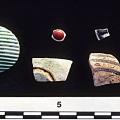
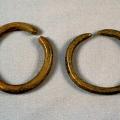
A brief discussion of the methodologies needed for the study of Indus ornaments is presented along with examples of how Indus artisans combined precious metals, stone beads, shell and faience to form elaborate ornaments. >
Understanding the interplay between subsistence systems and settlement patterns is crucial for interpretation of past economies and culture change. The Late Harappan (1900-1700 BCE) in Gujarat, India, witnessed a significant increase in the number of settlements in the arid regions. >
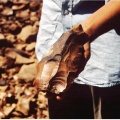
This paper considers one aspect of the research conducted by the Italian Archaeological Mission in Sindh, more specifically the discovery of the Indus flint mines of the III millennium BC in the Rohri Hills, and the excavations carried out at flint mine RH962. >
The Convocation Address of February 26, 2015 at the Dravidian University in Kuppam reflects on similarities between the Indus script and later Dravidian culture. With a number of illustrations and discussions of recent finds in south India. >
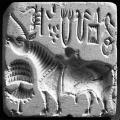
"My conclusion," writes the Indus script scholar Asko Parpola, "is that the Indian Rsyasrnga legend goes back to the Harappan religion, where the unicorn bull depicted on thousands of seals has a real local animal, the nilgai antelope, called rsya in Sanskrit. His single horn, the length of which is exaggerated, has a phallic connotation and emphasizes the importance of this animal as a symbol of fertility." >
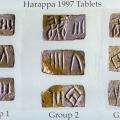
An insightful article that focusses on the clues in a seal and set of sixteen tablets found together at Harappa in 1997 to proffer that they may have been economic tokens. >
An excellent distillation of where we stand to the "Bronze" in the Bronze Age Indus Civilization. "Besides clay," writes the author, "there is no other raw material that Indus craftspeople worked into such a diversity of forms and types of artifacts." >
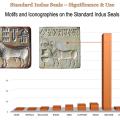
A richly illustrated slide journey through seals and sealings, how and why they were used in other ancient civilizations, and primarily what we might know and deduce about their use in ancient Indus cities. Dennys Frenez has been studying a large group of accidentally fired Lothal sealings for many years, and is joined by other distinguished archaeologists in what was originally a symposium on bead and seal technologies at the University of Padua, Italy, in 2019. >
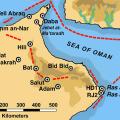
A detailed look at carnelian and agate sources and manufacture throughout the Gulf region, and how many of the beads found show clear evidence of ancient Indus manufacturing techniques. As the authors write: "Recent studies using more refined techniques of morphological and technological analysis c… >