Home

Main navigation

  • home
  • slides
  • essays
  • articles
  • books
  • video
  • q & a
  • blog
Secondary menu
  • about us
    • scholars
    • privacy
    • support
    • image rights
    • credits
    • contact us
  • resources

Secondary menu

  • about us
    • scholars
    • privacy
    • support
    • image rights
    • credits
    • contact us
  • resources

Ancient Indus Civilization Blog

354 posts, also carried on our Facebook page, about the ancient Indus Valley civilization, including important news, research and occasional visits to museums with ancient Indus artifacts.

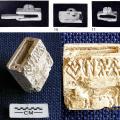
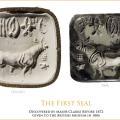
Unicorn Amulet Seal

Only a few specimens of this unicorn amulet-type seal have been found. One was during Marshall's excavations at Mohenjo-daro in the 1920s (top), another at Dholavira a few years ago (bottom). It appears to have been worn around the neck, and have had room for something to be put inside. Although Marshall himself did not favor the amulet theory, he wrote of one of these seals: "The amulet theory finds some support, however, in the shape of ... [a] seal [which] measures 0.77 in. square and 0.3 in. thick, excluding its boss. The interior has been carefully hollowed out to form a compartment … >

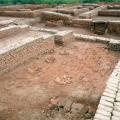
A Dyers' Workshop or a Restaurant?

"This room in VS area was made with bricks set on edge to create a watertight floor. A small well was located in the southeast corner (top right) and circular brick depressions were set into the floor, presumably to hold pottery vessels. The early excavators suggested that the room might have been a dyer's workshop" (Mark Kenoyer). Sir Mortimer Wheeler, the early excavator, wrote: "Of another kind is a building fronting upon one of the main streets, 'First Street', in VR Area (Mohenjo-daro). Its outside dimensions are 87 by 64.5 feet, but within that considerable framework are included no… >

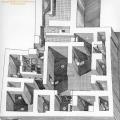
What Was an Ancient Indus House Like?

John Marshall writes of House 8, an "average upper class house" in the HR section of Mohenjo-daro: "To the right of the porter's lodge [5] a short passage led to the central courtyard of the house (18), which was open to the sky and provided light and air to the rooms grouped about it on both the ground and upper floors. And here, let me say parenthetically, that the principle of the open courtyard encompassed by chambers was just as fundamental to house-planning at Mohenjo-daro as it was throughout the rest of the prehistoric and historic Asia, and as it has continued to be in India until th… >

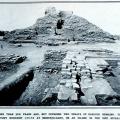
The First Images of the Announcement: The Illustrated London News

The first images of the announcement of the discovery of the ancient Indus Valley civilization in the Illustrated London News, on September 20, 1924. "The remarkable discoveries here illustrated put back by several centuries the date of the earliest known remains of Indian civilization. In his deeply interesting article describing them (on page 528) Sir John Marshall compares them to the work of Schliemann at Tiryns and Mycenae, where likewise it fell to the archaeologist to break new ground and reveal the relics of a long forgotten past. "It looks at this moment," writes Sir John, "as if we … >

Steatite Disc Beads

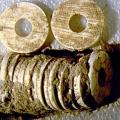
This set of steatite disc beads found at Harappa, each about 1 cm in diameter, were found in a Kot Diji phase (ca. 2800-2600 BCE) street and appear to be a necklace segment that was lost in the trash. The manufacturing marks are clearly visible. The matched nature of the beads suggests that a preform of raw steatite was shaped, drilled with a copper tube, and subsequently sewn into segments. >

Ringstones

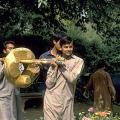
  • Laboratory assistants Mohammad Naim, Shokat Ali, Said Ahmed, and Mukthar Massih carry the cleaned and conserved ringstone to the Harappa Museum for display.

Ringstones are among the most fascinating of ancient Indus objects, particularly after recent research has shown some of those at Harappa to have originally been manufactured near Dholavira and then transported some 1,000 kilometers north. We think they might have been used to support wooden pillars. Here a newly re-discovered ringstone from Harappa is being transported to the Harappa Museum. >

Pipal Leaves: Revisited

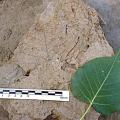
The impressions of a pipal leaf found in the upper clay levels of a drain in Harappa, shown here with a modern pipal leaf, indicate that what many think was a sacred tree was growing in the ancient city of Harappa even at that time. A well at Mohenjo-daro, a sealing from the city and the pipal motif on a unicorn seal are other examples of this critical motif in Indus culture. See also Unicorn and Pipal Tree Seal. >

Anthropomorphized Tigers in Harappa

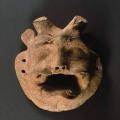
  • In the center is miniature mask of horned deity with human face and bared teeth of a tiger. A large mustache or divided upper lip frames the canines, and a flaring beard adds to the effect of rage. The eyes are defined as raised lumps that may have originally been painted. Short feline ears contrast with two short horns similar to a bull rather than the curving water buffalo horns. Two holes on either side allow the mask to be attached to a puppet or worn as an amulet.

Indus Tigers found at Harappa in recent years, often anthropomorphized. "The most dangerous animals living in the vicinity of the Indus cities were tigers and leopards. The leopard is rarely depicted but some figurines have spotted faces that may indicate the elusive markings of this elusive cat. Both of these large predators would have been a serious threat to human life and domestic animals. Before the introduction of firearms, these animals were usually killed in traps or with poisoned arrows. Among some Naga communities of eastern India, the tiger is totemic animal and the meat is never e… >

Buddhist Stupa at Mohenjo-daro

Image niche and stairway to left ascending to platform of stupa at Mohenjo-daro, modern shot and Bison Seal (ca. 2500 BCE). "This image niche is 7 feet deep by 4 ft. 6 inches wide, and occupies a particularly prominent position, being directly opposite to, though slightly above, the approaching stairway. In it Mr. Banerji found some remains of a statue of Buddah, seated cross-legged, probably on a lotus throne. The core of the image, he says, was of brick covered with a coating of mud, which had originally been painted or gilt." (John Marshall, Mohenjo-daro, I, p. 115). Of course, this is fro… >

Indus Pointed Base Goblets

Indus pointed base goblets from Mohenjo-daro. Found only in the largest cities and towns, these cups appear to have been used once and then tossed away, as is the case with disposable terra cotta cups in the cities of Pakistan and India today. Some of these disposable drinking cups have a seal impression on the shoulder or base and may have been made for specific owners or for specific rituals. The pointed base results from rapid manufacture off a fast wheel and makes it easy for stacking in the kiln. The grooves around the body may serve as a simple decoration, but they also allow for a bett… >

The Streets of Mohenjo-daro

HR Area, Lane 2, looking east with Block 2 on the left (late 1920's). The streets and alleyways wind through the neighborhood and are usually oriented along a strict grid plan, one of the most remarkable features of this four and half thousand year old city. See also The Silent Lanes of Mohenjo-daro. >

Unique Coiled Copper-alloy Necklace

This unique discovery of a coiled copper-alloy wire necklace (H2000/2242-01) dating to Harappa period 3B (circa 2450-2200 BC) is the earliest evidence for silk in South Asia. It has traces of fibers preserved on the inside. Recent studies indicate that the fibers are from the wild silk moth, Antheraea mylitta, commonly called "Tussar" silk today (Irene Good, J. M. Kenoyer and R. H. Meadow 2008). Its discovery demonstrates that silk production may have first been used to make fine threads for necklaces and only later used for weaving fabrics. The copper wire on this necklace is also among t… >

Mystery at Mound F #3

A perfect unicorn seal found in Trench 49E, Harappa. The craftsmanship and balance of the three fish signs, the arrow and two strokes with the so-called unicorn's head and sacred relic is remarkable. Excavations in 1997 at the southeast corner of the Mound F "granary" area were undertaken to recover a full sequence of pottery, architectural features, and inscribed objects. Here workers have found a seal near the base of the excavations in Trench 41NE that dates only somewhat later than the original "granary" structure. This seal dates to approximately 2200 BCE, at the transition between Harap… >

Mystery at Mound F #2

  • Possible granary in Harappa

Although there is no evidence to suggest that Mound F at Harappa or the "granary" at Mohenjo-daro (illustrated above) actually were granaries, this theory by archaeologists like Sir Mortimer Wheeler has taken hold in the public imagination. >

Mystery at Mound F: The Granary Fantasy

The phantasm by Sir Mortimer Wheeler (Image 1) , a diagram of the structure by John Marshall (Image 2), photographs by Jonathan Mark Kenoyer and Richard H (Image 3 and 4). The basic function of this structure on Mound F - there is also one in Mohenjo-daro - remains unknown. Still, there has been important work carried out in Harappa that chips away at myths like "the granary." See also Mystery at Mound F #2 and Mystery at Mound F #3. >

Pagination

  • First page
  • Previous page
  • …
  • Page 13
  • Page 14
  • Page 15
  • Page 16
  • Page 17
  • Page 18
  • Page 19
  • Page 20
  • …
  • Next page
  • Last page

Blog Posts by Subject (16)
  • Animals
  • Art
  • Children
  • City Life
  • Conferences
  • Crafts and Industry
  • Evolution
  • Excavations
  • Food
  • Homes
  • Media
  • Museums
  • Mysteries
  • News
  • People
  • Seals

follow us

Follow us on Facebook, Twitter and Instagram.
Videos on YouTube.
Occasional Newsletter.

donate

A 31 year-old non-profit serving 30,000 people a day.

© Harappa.com 1995-2026 31