Home

Main navigation

  • home
  • slides
  • essays
  • articles
  • books
  • video
  • q & a
  • blog
Secondary menu
  • about us
    • scholars
    • privacy
    • support
    • image rights
    • credits
    • contact us
  • resources

Secondary menu

  • about us
    • scholars
    • privacy
    • support
    • image rights
    • credits
    • contact us
  • resources

Ancient Indus Civilization Blog

354 posts, also carried on our Facebook page, about the ancient Indus Valley civilization, including important news, research and occasional visits to museums with ancient Indus artifacts.
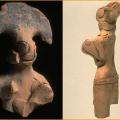
Women of Harappa A

  • Photographs by Richard H. Meadow

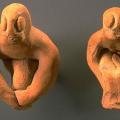
Image A:Two female figurines nursing infants found at Harappa. The female figurine usually holds the infant's head to her breast with one or both arms encircling the infant. LEFT: The female figurine usually holds the infant's head to her breast with one or both arms encircling the infant. The infants being nursed by female figurines are usually very schematically represented by a bent and pinched roll of clay with or without applied eyes. RIGHT: The head, body, and legs of the infant are usually pressed against the female’s breast and torso with the l… >

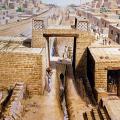
Artistic Reconstruction of Harappa

One of the most detailed reconstructions of an ancient Indus gateway, this one on Mound E at Harappa. The reconstruction was drawn by Chris Sloan, based on the work done by the Harappa Archaeological Research Project. J.M. Kenoyer writes: "A series of side rooms were also excavated along the eastern edge of the gateway in 1995. The latest phase of construction also included a large east-west oriented doorway leading through the eastern edge of the gateway. This doorway appears to have constructed with wooden beams with a threshold embedded in the baked brick structure.The size of these beams … >

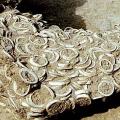
Shell Bangle Workshop in Gola Dhoro

Why was this shell bangle workshop suddenly abandoned in Gola Dhoro, Gujarat? Great wealth was left behind. Archaeologist Kuldeep Bhan writes: "One of the most important craft activities pursued with great vigor at the site was the production of shell bangles from Turbinella pyrum. One of the fascinating discoveries associated with this craft was the recovery of a rectangular mud brick structure measuring approximately 5.60 x 3.20m with an adjoining chamber, situated on the northwestern periphery inside the fortification. Within this structure three large heaps of shell resting against the we… >

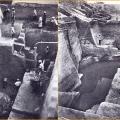
Indus City Layers

How old are ancient Indus cities? Excavations at Harappa show activity going back to approximately 3500 BCE, as do excavations at Mohenjo-daro. Neither site has been fully excavated, however. Attempts to go deep at Mohenjo-daro failed. As Sir Mortimer Wheeler wrote, "The lower level of excavations at Mohenjo-daro have never been reached by excavation due to difficulties of a high water-table. The two photographs illustrate an attempt made with pumps in 1950 to reach the lower levels and the subsequent flooding which happened overnight." (Civilizations of the Indus Valley and Beyond, p. 73). R… >

Discovering the Forgotten

The dating of the ancient Indus civilization was actually done through a Letter to the Editor of the Illustrated London News by Professor A.H. Sayce on September 27, 1924. This was the issue right after Marshall's sensational article on the discovery of the mysterious new cities of Harappa and Mohenjo-daro seven days earlier. Sayce recognized the seals as identical to those he had found in Sumer at layers from around 2300 BCE. With one letter to the editor, India's history had just been pushed back 2,000 years in Western eyes. Nayanjot Lahiri's book Finding Forgotten Cities: How the Indus … >

Two Wide Shell Bangles

  • Two magnificent wide shell bangles, each made from a single conch shell (Turbinella pyrum) found at Harappa.

Two magnificent wide shell bangles, each made from a single conch shell (Turbinella pyrum) found at Harappa. "The use of marine shell in the manufacture of ornaments and ritual objects provides one of the most striking examples of the continuity between the Indus cities and later cultures in South Asia. Along the coastal regions of Makran, Kutch and Gujarat, the conch shell or Turbinella pyrum was collected throughout the period following the decline of Indus cities. Later, with the rise of cities in the northern sub-continent this marine shell became common at inland sites in the Gangetic re… >

Mahadevan's Indus Script Dictionary

None of the many proposed decipherments of the ancient Indus script by many different scholars since the late 1920's is widely accepted. But there are good ideas, and many of them are from Iravatham Mahadevan in Chennai, India's most important scholar of the Indus script. Here he proposes readings of some the most common Indus signs, including the three "functionaries," part of a set of signs, one of which combines the terminal "jar" sign, the most frequent Indus sign, for which Mahadevan also proposes a reading. Mahadevan has been studying the Indus script since he put together the first con… >

Lady of the Spiked Throne Figurines

  • The terracotta model from the left side.

An exceptional and controversial recent find in a private collection is analyzed by a leading Italian archaeologist in a fully illustrated complete online volume with possible implications for understanding ancient Indus culture. Massimo Vidale writes: "In Autumn 2009, I was invited by a private collector to see an artefact that was mentioned as unique and very complex, and reportedly belonged to the cultural sphere of the Indus civilization. I do not have professional links with the antique market and the world of private collectors, but the descriptions I had of the find were so puzzling th… >

Long Indus Seals

Long rectangular seals with no animal motifs from the last part of the Harappan Phase (2200-1900 BCE) found at Harappa and Mohenjo-daro. "This type of seal is found with only abstract writing, which radically altered communication. Impressions made by the square seals carry two distinct messages, one is presented in a script that could only have been understood by a literate person and the other in the animal motif, that even a child could comprehend. Illiterate workers loading or unloading bundles of goods stamped with animal motifs could very easily perceive who the owners were and which bo… >

The Silent Lanes of Mohenjo-daro

1. The Stupa Mound, Mohenjo-daro, 1962. 2. Low Lane, East of Blocks 4 and 7. Inter. III Level. From North. "Low Lane, 4 ft. 10 ins. wide at the Intermediate III level; in the photograph of this lane, the eastern side of Block 4 is seen between the two men." 3. "Crooked Lane" South of Blocks 4 and 5, DK Area, G Section. This was excavated by Ernest Mackay, who wrote "Fore Lane along the north of this building was 5 ft. wide at the Intermediate III Level [about 20 feet below ground]. There is some uncertainty about the alignment of the foundations of the building seen on the left in thi… >

Large Ladle Among Burial Goods

Large ladle found with burial pottery in a disturbed burial of the Harappan cemetery in 1998. Shell ladles were probably used in special rituals for dispensing sacred liquids such as water or oil. A hole in the bottom of the ladle has been repaired with a lead rivet. Corrosion and expansion of the lead has caused the shell to crack. The fact that this object was included with the burial goods indicates that it must have had an important role in the after life or perhaps it could not be passed on to others due to its strong personal association with the dead individual. No complete burial was … >

Discovery of Jute Fibers

Scanning electron microscope photograph of jute textile feature found on a ceramic at Harappa. Very few fibers remain on artifacts from over 4,000 years ago, and this is the first evidence for jute as early as 2200-1900 BCE at Harappa. By Rita P. Wright, David L. Lentz and Harriet F. Beaulieu, the paper discusses how this evidence was extracted and its implications: New Evidence for Jute >

Mohenjo-daro Stupa Mound: Before and After Excavations

The color photograph is a slightly expanded view of the same area from the same angle. The stupa is to the right outside the frame of John Marshall’s original photograph from the 1920's. The new photograph was taken by Mark Kenoyer on Dec. 8, 2013, when Sindh had a Culture Day celebration, and thousands of people were visiting Mohenjo-daro to express their cultural pride in their Sindhi heritage. They were carrying flags and wearing Sindhi ajraks and dancing and singing all over the campus, the museum and the site. >

Harappa Mounds Today #2

A collection of photographs of the Harappan Mounds in March 2013. Image A: A circular grey limestone slab found at Harappa and possibly dated to the post Harappan period. It has been identified by local communities as the gem from the finger ring of Baba Noor Shah who is buried in the nearby tomb. It is said to have turned to stone and became very large when someone tried to rob it from his tomb. Visitors toss coins and currency notes as well as rice grains as offerings to the saint. More than 15,000 people live in the modern town of Harappa which is situated on part of t… >

Tree Tablet

A particularly beautiful tree on a terra-cotta tablet discovered at Harappa in 1995. "Growing from a low platform, this sinuous tree with short leaves may have been held sacred like the pipal tree" writes J.M. Kenoyer. See also Pipal Leaves: Revisited. >

Pagination

  • First page
  • Previous page
  • …
  • Page 16
  • Page 17
  • Page 18
  • Page 19
  • Page 20
  • Page 21
  • Page 22
  • Page 23
  • …
  • Next page
  • Last page

Blog Posts by Subject (16)
  • Animals
  • Art
  • Children
  • City Life
  • Conferences
  • Crafts and Industry
  • Evolution
  • Excavations
  • Food
  • Homes
  • Media
  • Museums
  • Mysteries
  • News
  • People
  • Seals

follow us

Follow us on Facebook, Twitter and Instagram.
Videos on YouTube.
Occasional Newsletter.

donate

A 31 year-old non-profit serving 30,000 people a day.

© Harappa.com 1995-2026 31