Home

Main navigation

  • home
  • slides
  • essays
  • articles
  • books
  • video
  • q & a
  • blog
Secondary menu
  • about us
    • scholars
    • privacy
    • support
    • image rights
    • credits
    • contact us
  • resources

Secondary menu

  • about us
    • scholars
    • privacy
    • support
    • image rights
    • credits
    • contact us
  • resources

Ancient Indus Civilization Blog

354 posts, also carried on our Facebook page, about the ancient Indus Valley civilization, including important news, research and occasional visits to museums with ancient Indus artifacts.
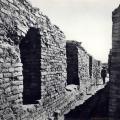
Harappan Drainage System

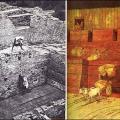
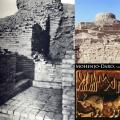
  • This view along Drain [8] into the mound shows details of the brick construction, the robbed out area at the east end of the drain (background), sloping strata above indicating the existence of an open street drain along the same line as the earlier baked brick drain, and the later Period 3C architecture built after the open drain was filled in and the area leveled. The bricks from the eastern part of the drain were robbed by tunneling into the sediment along the line of the drain from the East.

A portion of a large brick drain excavated at Harappa that survived the brick robbers. Dating to about 2400-2200 BCE, it was later filled in and the area leveled. The 5 images here show it in context, as well as some of the banded beads found in situ around it. 1. This view along Drain [8] into the mound shows details of the brick construction, the robbed out area at the east end of the drain (background), sloping strata above indicating the existence of an open street drain along the same line as the earlier baked brick drain, and the later Period 3C architecture built after the open drai… >

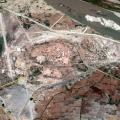
Aerial View of Mohenjo-daro

"Originally, the site of Mohenjo-daro must have been much more extensive than it is today and have formed a more closely connected whole, but water and wind, aided by the action of salt in the soil and the extreme aridity of the climate, have combined to eat deeply into the sides and carve deep furrows and hollows through its middle, leaving only here and there mere fragments of later cities," wrote John Marshall in 1931. The bund and spurs in the Indus in the top right are meant to protect the site from flooding; the white around the site itself is salt. Explore the site yourself with Go… >

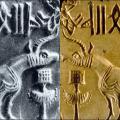
Unicorn Seal

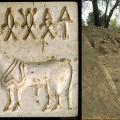
Large square unicorn sealing (left) and seal from Mohenjo-daro. The unicorn is the most common motif on Indus seals and appears to represent a mythical animal that Greek and Roman sources trace back to the Indian subcontinent. A relatively long inscription of eight symbols runs along the top of the seal. The elongated body and slender arching neck is typical of unicorn figurines, as are the tail with bushy end and the bovine hooves. This figure has a triple incised line depicting a pipal leaf shaped blanket or halter, while most unicorn figures have only a double incised line. The arching hor… >

Stairways of Mohenjo-daro

From the southern steps of the Great Bath showing recesses for wooden treads and stairways to platforms of some among the 700 wells in Mohenjo-daro, glimpses of where the ancient Indus people trod every day. "A curious feature of the two stairways leading down into the bath is the presence of a channel 9.25 inches wide and 3.25 inches deep, running parallel with and at the based of the lowest step of each. This channel penetrates into the two sides of each stairway for a distance of 3.5 inches. At either end of each tread there is a recess of the same width as the tread and 3.25 inches… >

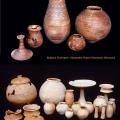
Harappan Burial Pottery

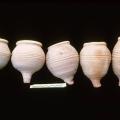
Painted and unpainted burial pottery from Harappa. The two largest vessels were found in the same burial and are described below. The other smaller vessels were found in an earlier burial and represent an older style of pottery. The bottom images shows a collection of burial pottery which come from one of the later burials towards the end of the Harappan period, possibly dating to 1900 BCE. Tall jar with concave neck and flaring rim: The rounded base was originally supported in a ring stand. The black painted geometric designs are arranged in panels with a red slip as background. After ini… >

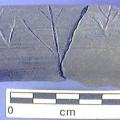
The Evolution of Indus Script

The origins of Indus writing can now be traced as far back as the Ravi Phase (c. 3300-2800 BCE) at Harappa. Some inscriptions were made on the bottom of the pottery before firing. Other inscriptions such as this one were made after firing. This inscription (c. 3300 BCE) appears to be three plant symbols arranged to appear almost anthropomorphic. The trident looking projections on these symbols seem to set the foundation for later symbols. See also Dr. Parpola's Deciphering the Indus Script and Iravatham Mahadevan's The Indus Script. >

The Case of the Split Necklace #2

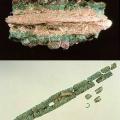
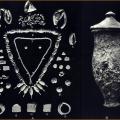
John Marshall writes about one of the greatest of Indus finds, "the jewelry illustrated ... was found in the silver vessel illustrated on the right of the plate, which was unearthed by Mr. Dikshit in a long trench that he dug to connect up sections B and C in the DK Area ... As the walling in this Block is of the Late Period and the depth of the find was only 3 feet below the surface, this hoard of jewelry can definitely be dated to that Period. The large necklace is made up of barrel-shaped beads of a translucent, light-green jade, measuring 0.9 inch long by 0.45 inch in diameter in the midd… >

The Case of the Split Necklace #1

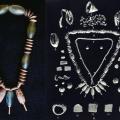
Among the tragedies of partition was the literal breaking apart of one of the finest necklaces from Mohenjo-daro, with half going to India and half to Pakistan. The piece on the left is from Pakistan's share, 6 of 10 of a light-green jade beads, 3 of 4 of the seven pendants of agate-jasper. There is not even a color photograph of the complete necklace. An effort by archaeologists hoping to have the two pieces put back together and exhibited by rotation in India and Pakistan has led nowhere: India-Pakistan Link to Mohenjodaro Necklace See also The Case of the Split Necklace #2 … >

Boating: Now and Then

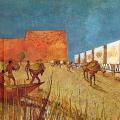
A molded tablet from Mohenjo-daro ca. 2300 BCE, below while above, flat bottomed ferry boats are still used today to help travelers cross the Indus River near Mohenjo-daro. The boat on the seal is part of "a three-sided molded tablet, with boat, gharial and script. One side is a flat-bottomed boat with a central hut that has leafy fronds at the top of two poles. Two birds sit on the deck, and a large double rudder extends from the rear of the boat." (Kenoyer, Ancient Cities, p. 192) See also An Indus Boat Seal and Indus-style Boat. >

Ornaments and Jewelry

Gold and agate ornaments includes objects found at both Mohenjo-daro and Harappa. At the top are fillets of finely burnished hammered gold that would have been worn around the forehead. Each end of the top fillet is decorated with a punctuated design depicting the ritual offering stand that is common on the unicorn seals. The third ornament from the top was probably worn with the center point at the top of the forehead and the sides curving down over the eyebrows. The hole at the center and on the ends were for holding a cord. The other ornaments include bangles, chokers, long pendant neck… >

Burials at Harappa

The body may have been wrapped in a shroud, and was then placed inside a wooden coffin, which was entombed in a rectangular pit surrounded with burial offerings in pottery vessels. The man was buried wearing a long necklace of 340 graduated steatite beads and three separate pendant beads made of natural stone and three gold beads. A single copper bead was also found at his waist. Note that the entire book describing these discoveries, Harappa Excavations 1986-1990: A Multidisciplinary Approach edited by Richard H. Meadow is available with each chapter a single PDF download. These are basic… >

Rare Three Animal Seal from Mohenjo-daro

J.M. Kenoyer describes it as a "square seal with animal whose multiple-heads include three important totemic animals: the bull, the unicorn, the antelope. All three animals appear individually on other seals along with script, but this seal has no script. The perforated boss on the back is plain, without the groove found on most seals." (Ancient Cities, p. 194). E.J.H. Mackay wrote that "a possible explanation of this unusual devices is that its owner may have sought the protection or assistance of three separate deities represented by the heads of these three animals" (Further Excavation… >

The Mounds of Harappa by Indus Time Period

The earliest settlement, during Period 1 (c. 3300-2800 BC), was on the west side of Mound AB and NW corner of Mound E. During Period 2 (c. 2800-2600 BC) all of Mounds AB and E came to be occupied, and by the end of Period 3 (c. 2600-1900 BC), the Harappan Period, most of the area covered by the plan was in use. During Periods 4 and 5 (c. 1900-1300 BC) there was a retraction of settlement to the areas of Mound AB, modern Harappa Town, and the NW corner of Mound E. This plan also shows the location of the 2000/2001 excavation areas. >

Single Bead Pot (Collection)

  • Faience beads of different shapes and colors were found in the bead pot. Some of these appear to be imitations of the natural stones; deep azure blue lapis lazuli, blue-green turquoise and banded to imitate banded agate.

A single bead pot with a private collection of 133 beads from about 1700 BCE found at Harappa in 1996. This amazing find included beads from all phases of Harappan occupation, in carnelian, faience, and even an unknown type of crystalline rock. See also Jewelry from Mohenjo-daro. >

Cubical Weights

  • Cubical Weights

A recreation of an ancient Indus trader using weights to weigh goods (left, by Jonathan Mark Kenoyer), cubical weights in graduated sizes from Allahdino (top right) and Harappa (bottom right). >

Pagination

  • First page
  • Previous page
  • …
  • Page 14
  • Page 15
  • Page 16
  • Page 17
  • Page 18
  • Page 19
  • Page 20
  • Page 21
  • …
  • Next page
  • Last page

Blog Posts by Subject (16)
  • Animals
  • Art
  • Children
  • City Life
  • Conferences
  • Crafts and Industry
  • Evolution
  • Excavations
  • Food
  • Homes
  • Media
  • Museums
  • Mysteries
  • News
  • People
  • Seals

follow us

Follow us on Facebook, Twitter and Instagram.
Videos on YouTube.
Occasional Newsletter.

donate

A 31 year-old non-profit serving 30,000 people a day.

© Harappa.com 1995-2026 31