Home

Main navigation

  • home
  • slides
  • essays
  • articles
  • books
  • video
  • q & a
  • blog
Secondary menu
  • about us
    • scholars
    • privacy
    • support
    • image rights
    • credits
    • contact us
  • resources

Secondary menu

  • about us
    • scholars
    • privacy
    • support
    • image rights
    • credits
    • contact us
  • resources

Ancient Indus Civilization Blog

354 posts, also carried on our Facebook page, about the ancient Indus Valley civilization, including important news, research and occasional visits to museums with ancient Indus artifacts.
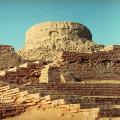
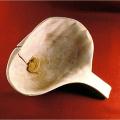
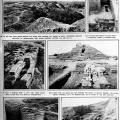
The Rediscovery of the Ancient Indus Civilization, 1924

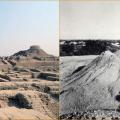
The re-discovery of the ancient Indus Civilization actually was announced in yesterday's version of a tabloid, the pictorial weekly The Illustrated London News on September 20, 1924. "The two sites where these somewhat startling remains have been discovered are some 400 miles apart – the one being at Harappa in the Montgomery District of the Panjab, and the other at Mohenjo-daro in the Larkana District of Sindh. At both these places there is a vast expanse of artificial mounds evidently covering the remains of once flourishing cities, which . . . must have been in existence for many hundreds … >

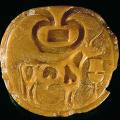
Unicorn Pendant

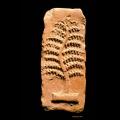
'"Pendant or medallion [from Mohenjo-daro] pictures the unicorn combined with many sacred symbols of the Indus religion. The body of the figure has a womb-shaped symbol in its belly, the same motif is elaborated to form the frame for the pendant, which is also a common design for shell inlay. Two leaf shapes of the sacred pipal tree are depicted at the animals shoulders and rump. A ritual offering stand is placed in front of the image. The deeply incised frame and the symbols on the unicorn would have been set with inlay." (J.M. Kenoyer, Indus Civilization, p. 188) See also The First Unico… >

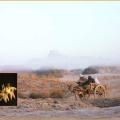
Carts: Then and Now

  • Early morning mist at Mohenjo-daro with the Buddhist stupa perched on top of the "citadel" mound.

The modern road winds through the low-lying area between the "citadel" and "lower town." On the left is an ox or water buffalo-drawn cart and driver from Harappa, possibly a toy, but clearly representative of what was used many thousands of years ago. Several styles of carts as well as wheels made of terracotta have been found at Indus sites. These were probably originally held together by wooden components that have not preserved. These terracotta carts are very similar to carts in South Asia today. See also Jonathan Mark Kenoyer's article Wheeled Vehicles of the Indus Valley Civilization… >

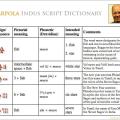
Parpola's Indus Script Dictionary

The Indus script remains to be deciphered and we will probably never be sure until a bilingual text of some sort is found (not improbable). Until then, Asko Parpola's work on the fish sign is probably the closest to guarded approval by other major scholars. The initial insight into the fish/star connection in Dravidian languages was made by a Jesuit priest, Father Heras, in 1932. Dr. Parpola has been studying this undeciphered writing for over 40 years at the University of Helsinki in Finland and is co-editor of collections of all seals and inscriptions in India and Pakistan. More detail … >

Detailed Religious Scene Seal

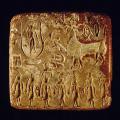
One of the most evocative seals from Mohenjo-daro, depicting a deity with horned headdress and bangles on both arms, standing in a pipal (sacred fig) tree and looking down on a kneeling worshiper. A human head rests on a small stool and giant ram and seven figures in procession complete the narrative. Asko Parpola writes "An anthropomorphic figure has knelt in front of a fig tree, with hands raised in respectful salutation, prayer or worship. This reverence suggests the divinity of its object, another anthropomorphic figure standing inside the fig tree. In the ancient Near East, the gods and … >

Painted Burial Pottery

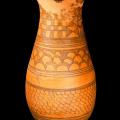
The rounded base was originally supported in a ring stand. The black painted geometric designs are arranged in panels with a red slip as background. After initial firing, the entire painted design was obliterated with a red slip and fired again at a low temperature that turned the exterior layer of the slip red through oxidation, but the inner layer remained gray. This overslip was not well bonded to the previously slipped surface and was partially eroded when first discovered. After initial conservation and documentation, one half of the overslip was removed to reveal the original painted de… >

Interaction Networks of the Harappan Phase

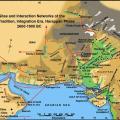
Major Sites and Interaction Networks of the Indus Tradition, Harappan Phase, 2600-1900 BCE, courtesy of J. M. Kenoyer. Six large Indus cities have been discovered. In Pakistan, Harappa was excavated extensively in the 1920-30s', 1960's, and from 1986-2010. Mohenjo Daro was excavated extensively in the 1920-30's, with smaller projects in the 1940's and 1960's. Ganweriwala was discovered in the 1970's and has not been excavated. Lakhanjo Daro was discovered in 1986 but only recent excavations in 2009-2014 have shown that it is probably as big as Mohenjo Daro. In India, Dholavira was excavated i… >

Mohenjo-daro: Narrow Streets and Lanes

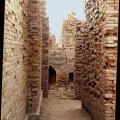
Buildings and streets were aligned along a north-south and east-west grid with minor variations introduced as new buildings were constructed. The corbeled arch in the background was built to cover a street drain, but was eventually blocked as the cross streets were filled with debris. See also First Street of Mohenjo-daro: Revisited. >

An Indus House #3

"One of the finds from the former room [13] consisted of fragments of a pierced lattice of alabaster which presumably filled the windows or ventilators at the top of the wall. Perforated screens with geometric patterns have been met with before in Kushan and Gupta buildings. It is now patent that perforated lattices were known and employed in the Indus valley in the prehistoric period," (Marshall, Mohenjo-daro, Vol. 1, 1931, p. 219). See also An Indus House #1 and An Indus House #2. >

An Indus House #2

Drawing of the Interior of Hall 76, House XIII, VS Area [of Mohenjo-daro], one of 28 rooms in a well-preserved building. "There is nothing that we know of in prehistoric Egypt or Mesopotamia or anywhere else in western Asia to compare with the well-built baths and commodious houses of the citizens of Mohenjodaro" wrote John Marshall. "One of the finds from this [room] consisted of fragments of a pierced lattice of alabaster which presumably filled the windows or ventilators at the top of the wall" (Marshall, Mohenjo-daro Vol. 1, pgs. vi, 219). See also An Indus House #1 and An Indus House … >

An Indus House #1

"House 13 in the VS Area [of Mohenjo-daro] has a more elaborate plan . . . On its ground floor are four fair-sized courts, ten smaller rooms, three staircases, a porter's lodge, and a well-chamber. The front is towards First Street, and here there are three entrances side by side, the principal one of which is plainly the middle, since this is the only one provided with a porter's lodge. ... Entering the house by the main door one finds oneself in a small vestibule (Room 68), with a porter's lodge to the right and a second doorway directly opposite leading to the open Court 67. A feature of t… >

Deity Fighting Off Two Tigers on Seal

This drama is depicted on at least two other seals from the ancient Indus metropolis. In other scenes from Harappa, this is a female deity standing on an elephant with a spoked wheel sign above her head (see Deity Strangling Tigers Tablet). Asko Parpola writes: "The 'contest' motif is one of the most convincing and widely accepted parallels between Harappan and Near Eastern glyptic art. A considerable number of Harappan seals depict a manly hero, each hand grasping a tiger by the throat. In Mesopotamian art, the fight with lions and / or bulls is the most popular motif. The Harappan subst… >

Grand and Rare Zebu Bull Motif

The grand and rare humped zebu (bos indicus) motif on a pot from Nausharo (ca. 2600-2500 BCE) and on a square steatite seal from Mohenjo-daro (ca. 2500 BCE). Note how similar they are. The majestic zebu bull, with its heavy dewlap and wide curving horns is perhaps the most impressive motif found on the Indus seals. Generally carved on large seals with relatively short inscriptions, the zebu motif is found almost exclusively at the largest cities of Mohenjo-daro and Harappa. The rarity of zebu seals is curious because the humped bull is a recurring theme in many of the ritual and decorat… >

Bell Shaped Gold Ornaments

Gold cap shaped ornaments from Harappa found in a hoard of jewelry from Mound F, Trench IV, House 2. Note the tiny hoops on the inside. The loops could have been used to attach the ornament to clothing, as a hair ornament, or to attach them to a fancy necklace. See also Ornaments and Jewelry. >

Dancing Girl Figurine

  • Three views of Mohenjo-daro artifact

The dancing girl of Mohenjo-daro in three views, with close-ups of face, choker and bangles. John Marshall writes of this figure: "the arms and legs . . . are adorned with armlets, bangles, and anklets. These ornaments may sometimes have been made of metal, but in all probability the majority of them were shell. The custom of wearing so many shell bracelets as almost to conceal the whole of the forearm is very common in India at the present day." (Mohenjo-daro and the Indus Civilization, 1931, p. 339). >

Pagination

  • First page
  • Previous page
  • …
  • Page 17
  • Page 18
  • Page 19
  • Page 20
  • Page 21
  • Page 22
  • Page 23
  • Page 24
  • Next page
  • Last page

Blog Posts by Subject (16)
  • Animals
  • Art
  • Children
  • City Life
  • Conferences
  • Crafts and Industry
  • Evolution
  • Excavations
  • Food
  • Homes
  • Media
  • Museums
  • Mysteries
  • News
  • People
  • Seals

follow us

Follow us on Facebook, Twitter and Instagram.
Videos on YouTube.
Occasional Newsletter.

donate

A 31 year-old non-profit serving 30,000 people a day.

© Harappa.com 1995-2026 31