Home

Main navigation

  • home
  • slides
  • essays
  • articles
  • books
  • video
  • q & a
  • blog
Secondary menu
  • about us
    • scholars
    • privacy
    • support
    • image rights
    • credits
    • contact us
  • resources

Secondary menu

  • about us
    • scholars
    • privacy
    • support
    • image rights
    • credits
    • contact us
  • resources

Ancient Indus Civilization Blog

354 posts, also carried on our Facebook page, about the ancient Indus Valley civilization, including important news, research and occasional visits to museums with ancient Indus artifacts.
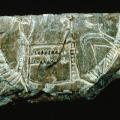
Indus-style Boat

  • Found near Mohenjo-daro.

The nautical historian Basil Greenhill makes an interesting point about why this boat style may have endured on the Indus: "As for the punts [long, narrow, flat-bottomed boats, square at both ends and propelled with a long pole, used on inland waters chiefly for recreation], their silhouette bears perhaps some resemblance to that of the boat depicted in one of the two scribings of boats found at Moenjo Daro, the Indus civilization site which lies on the west side of the river roughly in the center of the long stretch of the Indus on which these boats are to be found today. Models of carts fou… >

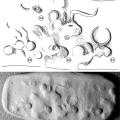
Rare White Marble Cylinder Seal from Jiroft

A rare white marble cylinder seal from Jiroft. A brand new paper by Massimo Vidale and Dennys Frenez, Indus Components in the Iconography of a White Marble Cylinder Seal from Konar Sandal South (Kerman, Iran) provides a detailed analysis of this seal found at the recently discovered site of Jiroft . Well used, and apparently worn at the wrist, it testifies to the multiple cultural and trade connections between the Indus civilization and its western neighbors. It also suggests many more discoveries and insights into Indus civilization will come from material found at and connected to Jiroft. … >

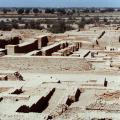
Mohenjo-daro 50 Years Ago in 6 Images

Mohenjo-daro 50 Year Ago in 6 shots. A long view towards the Great Bath, the Great Bath, a narrow street, a street with a covered drain, a photographer at the site, and the Stupa Mound, all in 1962. See also Urban Construction of Mohenjo-daro. >

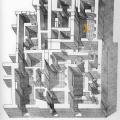
Large Indus House and Interior Room Drawing, Mohenjo-daro

John Marshall writes "House 13 in the VS Area has a more elaborate plan . . . On its ground floor are four fair-sized courts, ten smaller rooms, three staircases, a porter's lodge, and a well-chamber. The front is towards First Street, and here there are three entrances side by side, the principal one of which is plainly the middle, since this is the only one provided with a porter's lodge ... Entering the house by the main door one finds oneself in a small vestibule (Room 68), with a porter's lodge to the right and a second doorway directly opposite leading to the open Court 67. A feature of… >

Kot Diji Phase Button Seal

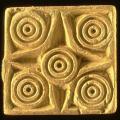
This seal plays an illustrative role in Asko Parpola's essay Beginnings of Indian Astronomy with Reference to a Parallel Development in China. He writes "The Yangshao culture burials discovered at Puyang in 1987 suggest that the beginnings of Chinese astronomy go back to the late fourth millennium. The instructive similarities between the Chinese and Indian luni-solar calendrical astronomy and cosmology therefore with great likelihood result from convergent parallel development and not from diffusion." For more information, read Asko Parpola's Beginnings of Indian Astronomy with Reference … >

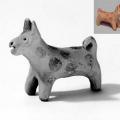
Toys of the Indus Valley

  • Approximate dimensions (W x H(L) x D): 7.2 x 9.4 x 3.0 cm. Photograph by Georg Helmes.

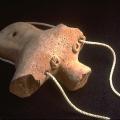
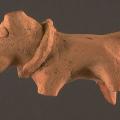
Movable head of a bovine figurine from Harappa. Some movable figurine heads are pierced through the horns on either side of the head. The movable heads of figurines often depict cattle. They are usually pierced laterally through the neck and vertically or sagittally through the head in order to secure them to the bodies and control them with a cord. Also a toy cart from Nausharo, a bird whistle and a complete ox or water buffalo cart with figurine. >

Imagining Life in Lothal

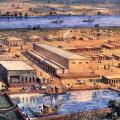
A reimagining of life in Lothal 4,000 years ago, satellite images of the town in context of today's landscape, and the discoverer, S. R. Rao's drawings of the town plan, bead factory and warehouse. "While exploring the Sabarmati estuary an ancient mound presently known as Lothal was discovered in November, 1954," wrote S. R. Rao. "The excavation conducted here during the following seven years has brought to light the existence of a flourishing port-city of the Indus Civilization with an excellent brick-built dock and nearly laid-out streets. One comes across at Lothal the same regimentation i… >

A Unicorn Seal from Harappa

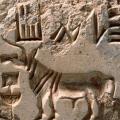
A perfectly cut unicorn seal with a sign right above the horn. The seal was found in Harappa. The year is given at approximately 2000 BCE, when craftsmanship in seal manufacture was probably at its height. It was purchased by the Ashmolean Museum in Oxford, UK in 1956. This artifact is one of many unicorn seals from the Indus Valley people. >

Near Eastern Seal

Impression of an Indus-style cylinder seal of unknown Near Eastern origin in the Musee du Louvre, Paris. All indications are that the Bronze age was built on a robust international trade system. Massimo Vidale's article Growing in a Foreign World: For a History of the "Meluha Villages" in Mesopotamia in the 3rd Millenium BCE gathers together all facts about Indus settlements and trading with ancient Mesopotamia around 2500 BCE. Conjectures and implications by an Italian archaeologist who is a pioneer in multidisciplinary analysis. The connections between these ancient Bronze age civilizations… >

Chanhu-daro Excavations (1935)

Workers digging a deep pit during the 1935-36 excavations in Chanhu-daro, Sindh. Chanhu-daro was the only American run pre-partition Indus excavations, by the Museum of Fine Arts in Boston, and led by Ernest J.H. Mackay. They revealed a highly-advanced ancient Indus manufacturing site. An illustrated 1937 article by Dorothy Mackay describing it in Finds at Chanhu-daro. Asko Parpola speculated that the discovery of a unique sign on selas from the site may be indicative of a place name in the Indus script: See https://www.harappa.com/blog/indus-sign-place-name and https://wwwharappa.com/bl… >

Ancient Indus Men's Hairstyles

  • Male hair styles and fashion in Ancient Indus

Ancient Indus males of stature seem to have had their hair tied in close buns, and with headband to further articulate their head. This is true of the priest king, shown here in a possible colored replica, the original, and in profile soon after being found in the 1920's. The figure below, with the same hair hair arrangement and headband, was found at Mohenjo-daro. Mark Kenoyer writes "Finely braided or wavy combed hair is tied into a double bun on the back of the head, and a plain fillet or headband with two hanging ribbons falls down the back. The upper lip is shaved and a closely cropped … >

The Chimaera

"The Harappan chimaera was composed of body parts derived from different animals, as well as humans and other fantastic beings of the Indus imagination." Dennys Frenez and Massimo Vidale's article Harappan Chimaeras as ‘Symbolic Hypertexts’. Some Thoughts on Plato, Chimaera and the Indus Civilization is a truly fascinating paper on composite Indus creatures. See also The Chimaera Revisited. >

The First Unicorn Seals

  • Harappan Seals

The splash of the new. Pictures of mysterious seals from Harappa had appeared in specialized journals, but no composite picture of seals had been offered to the masses until September 24, 1924. This set of seals from the Illustrated London News were the vehicle. From the very beginning, the face of the unicorn was the face of the Indus civilization, and that is probably how its rulers had intended it to be. Sir John Marshall, who published the findings wrote "The animal most often represented on the seals is the apparently single-horned beast . . .. There is a possibility, I think, that th… >

The First Latrines

It is often said that the ancient Indus people invented latrines, as these examples from Harappa and Mohenjo-daro suggest. Mark Kenoyer writes "Many urban dwellers may have walked outside the city wall to the nearby fields to relive themselves, as is commonly done today throughout much of Asia. But many houses had latrines that were distinct from the bathing areas. The early excavators at Harappa and Mohenjo-daro did not pay mch attention to this essential feature of the Indus cities, but current excavations at Harappa are finding what appear to be latrines in almost every house. The commodes… >

A Story Tablet from Harappa

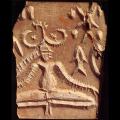
One side of a planoconvex molded tablet found in 1995 in Mound ET at Harappa. Mark Kenoyer writes about his narrative scene depicting the killing of a water buffalo: "A person, possibly a man, with hair tied in a bun on the back of the head, impales a water buffalo with a barbed spear. The hunter's foot presses down on the water buffalo's head as he thrusts the spear into its shoulder. In Later Hindu rituals, the water buffalo sacrifice is associated with the worship of the goddess Durga, but on this seal the sacrifice takes place in the presence of a priest or deity seated in yogic position… >

Pagination

  • First page
  • Previous page
  • …
  • Page 11
  • Page 12
  • Page 13
  • Page 14
  • Page 15
  • Page 16
  • Page 17
  • Page 18
  • …
  • Next page
  • Last page

Blog Posts by Subject (16)
  • Animals
  • Art
  • Children
  • City Life
  • Conferences
  • Crafts and Industry
  • Evolution
  • Excavations
  • Food
  • Homes
  • Media
  • Museums
  • Mysteries
  • News
  • People
  • Seals

follow us

Follow us on Facebook, Twitter and Instagram.
Videos on YouTube.
Occasional Newsletter.

donate

A 31 year-old non-profit serving 30,000 people a day.

© Harappa.com 1995-2026 31