Home

Main navigation

  • home
  • slides
  • essays
  • articles
  • books
  • video
  • q & a
  • blog
Secondary menu
  • about us
    • scholars
    • privacy
    • support
    • image rights
    • credits
    • contact us
  • resources

Secondary menu

  • about us
    • scholars
    • privacy
    • support
    • image rights
    • credits
    • contact us
  • resources

Ancient Indus Civilization Blog

354 posts, also carried on our Facebook page, about the ancient Indus Valley civilization, including important news, research and occasional visits to museums with ancient Indus artifacts.
Women of Harappa B

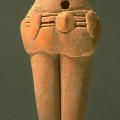
  • The multiple-strand belt on some of the female figurines is often accompanied by a plain short "skirt". The applied decorations on the belt may represent beads or other decorations. Approximate dimensions (W x H x D): 3.8 x 7.3 x 2.0 cm. (Photograph by Richard H. Meadow)

At the peak of the Indus Civilization (Period 3, 2600-1900 BCE), the most common dress for female figurines was the belt and/or short skirt usually situated at the same point on the hips as the figurine’s hands, shown in these two terra cotta figurines found at Harappa. See also Women of Harappa A and Men of Harappa. >

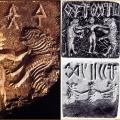
Bare Handed Tiger Wrestling Seals

  • Images show a figure strangling two tigers with his bare hands.

In color is a seal, in black and white two seals and corresponding sealings made from them (Joshi and Parpola, Corpus of Indus Seals and Inscriptions, Vol. 1, M 306-8). Mark Kenoyer writes that "discoveries of this motif on seals from Mohenjo-daro definitely show a male figure and most scholars have assumed some connection with the carved seals from Mesopotamia that illustrate episodes from the famous Gilgamesh epic. The Mesopotamian motifs show lions being strangled by a hero, whereas the Indus narratives render tigers being strangled by a figure, sometime clearly males, sometimes ambiguo… >

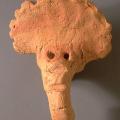
Indus Elephants

It is unknown whether elephants were domesticated in the Indus Civilization. However, one of the few elephant figurines from Harappa is a head with large stylized ears and red and white stripes painted across the face. This may mirror the custom of decorating domesticated elephants (red and white are common colors) for ceremonies or rituals that is still practiced in South Asia. Elephant bones have also been found at Harappa. Approximate dimensions (W x H (L) x D): 5.4 x 4.8 x 4.6 cm. Photograph by Richard H. Meadow. See also Hollow Elephant Figurine from Harappa and Elephant Head. >

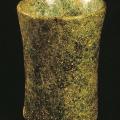
Fuchsite Drinking Glass

  • A drinking glass with finely polished exterior surface and sparkling internal crystal facet.

Mark Kenoyer writes: "One famous stone vessel found at Mohenjo-daro is a tall glass with concave sides that is similar in shape to ritual columns found in Balochistan and Afghanistan. This green stone, called fuchsite, is rare, but it can occur with quartzite which is common throughout Balochistan and Afghanistan. When this fuchsite vessel was first examined by a geologist in the 1930's, the only know source was Mysore State, over 1600 km south of the Indus Valley. Early scholars suggested that the stone was brought to the Indus cities from the south along with gold and ivory, but both of the… >

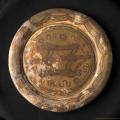
Kulli Plate

A Kulli plate very similar to ancient Indus plates with two tigers facing each other and motifs similar to those of the Nal culture of Balochistan (see also the related post National Museum of Oriental Art- Tucci). A recent article, Commodities and Things: The Kulli in Context by Rita P. Wright, looks at the mysterious Kulli culture of Balochistan that both pre-dated and was contemporaneous with ancient Indus culture, and apparently was part of an elaborate trading network that stretched west as far as the Jiroft culture in Iran. >

Glimpses of Dholavira #1

  • Photograph by Sunil Shanbag

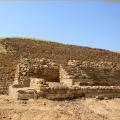
Dholavira is located on Khadir Beyt, an island in the Great Rann of Kutch in Gujarat State, India. It was excavated between 1990 and 2005 by R.S. Bisht (the field research reports still await publication). In the same size range as Harappa and Mohenjo Daro, it has some of the best preserved stone architecture from the ancient Indus period. The city flourished between 2650 and 2100 BCE and seems to have been abandoned about 1900 BCE. It is thought to have controlled the movement of goods between the resource areas of Gujarat and core areas of the Indus plains. Included is an image showing an a… >

Composite Tubular Gold Bead

  • This artifact was found on Mound AB at Harappa in 2000.

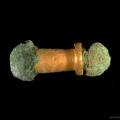
A composite tubular gold bead found on Mound AB at Harappa in 2000. Greenish corroded copper-alloy from an interior wire covers part of the gold bead. "Gold was easily obtained from the sands of the upper Indus river where it is still panned by itinerant miners. Another source of gold was along the Oxus river in northern Afghanistan where a trading colony of the Indus cities has been discovered at Shortughai. Situated far from the Indus Valley itself, this settlement may have been established to obtain gold, copper, tin and lapis lazuli, as well as other exotic goods from Central Asia," (J.M… >

Painted Harappan Dish

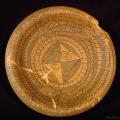
A painted dish of a pedestaled vessel from Harappa found in 1993. The painted design includes two peacocks and a sacred tree. Mark Kenoyer writes: "Painted dish portion from a dish-on-stand. The black-on-red painted decoration is arranged in panels that are divided into four sections. Two peacocks are depicted on one side, and a many-branched tree with short leaves is painted on the opposite panel section. Between these two motifs are multiple lines of loops with circle-and-dot designs and hatching which totally fill all of the empty space. In the center of the dish is a geometric design with… >

First Street, Mohenjo-daro

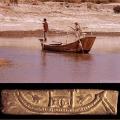
  • Looking north along First Street, Mohenjo-daro. "Only the facades of the eastern side of the street have been cleared, this being the limits decided upon for our excavations in this direction. Beyond this line, two-thirds of the mound, still remains untouched and will undoubtedly provide many buildings of interest for future excavations." (Mohenjo-daro, 1938, I, p. 25). The area to the left has been fully excavated and the area to the right is un-excavated. Later street levels are seen in the background.

Ernest Mackay writes (1938) "As far as we can tell at present, this street appears to be the second most important thoroughfare of the city; for although it is longer than the street that crosses it at right angles, coming presumably from the east gate of the city, the latter [First Street] is undoubtedly wider-along it, the grass-covered road to the camp now runs between the HR and VS Areas." The fourth image shows the layers of excavation on this street, looking into the past. MackKay continues "the general impression that they make upon the eye and mind is that the masonry [stonework] i… >

Interaction Networks of the Ravi Phase

Sir Mortimer Wheeler noted that "Harappa has produced a hint of an antecedent culture... " The so-called Ravi Phase, an early phase of Indus culture (c. 3300-2800 BCE), elaborated by discoveries in the late 1990's by HARP (the Harappa Archaeological Research Project led by Jonathan Mark Kenoyer, Richard H. Meadow and Rita P. Wright) suggests that even before the the full ancient Indus civilization phase at Harappa, raw materials such as agate, lapis lazuli, steatite, marine shell and copper were transformed into ornaments and tools for local trade. For more see Around the Indus in 90 Slide… >

Proto-Historic Objects from Balochistan

Today an unusual and spectacular exhibition opens at the National Museum of Oriental Art (MNAO) 'Giuseppe Tucci' in Rome, Italy. Living Symbols presents a group of painted protohistoric objects from the 4th and 3rd millennium BCE, illegally excavated in Balochistan and seized in 2005 by the Italian police. Although much about their provenance is lost, they are apparently from the little know Nal Buthi and Kulli cultures that preceded (Nal) and accompanied (Kulli) the height of Indus culture. They use of the zebu bull, pipal tree, tiger and other major motifs familiar to us from Harappa and Mo… >

Seal with Two-Horned Zebu Bull

  • Courtesy of The Cleveland Museum of Art, J. H. Wade Fund 1973.160.

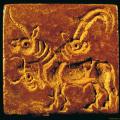
"At their best, it would be no exaggeration to describe them as little masterpieces of controlled realism, with a monumental strength in one sense out of all proportion to their size and in another entirely related to it," wrote Sir Mortimer Wheeler. Seal with Two-Horned Zebu Bull and Inscription, ca. 2000 BCE. As Mark Kenoyer writes "The majestic zebu bull, with its heavy dewlap and wide curving horns is perhaps the most impressive motif found on the Indus seals. Generally carved on large seals with relatively short inscriptions, the zebu motif is found almost exclusively at the largest c… >

Men of Harappa A

  • Most male figurines from Harappa sit with knees bent and arms at the sides of the legs or around the knees. Some of these figurines have facial features and even genitalia, and a few have stylized legs joined into a single projection.

Although there are fewer male than female figurines to be found at Indus sites, these terracotta males from Harappa give some sense of the principles underlying their representations. Shari Clark writes: "After many decades of research, the Indus Civilization is still something of an enigma -- an ancient civilization with a writing system that still awaits convincing decipherment, monumental architecture whose function still eludes us, no monumental art, a puzzling decline, and little evidence of the identity of its direct descendants. In a civilization extending over an area so vast, we expe… >

Wheeler's Harappan Trench

Sir Mortimer Wheeler's famous trench at Harappa in 1946 and today, when it has been filled in once again. Wheeler writes of the incision he orchestrated: "The monsoon-cutting was filled with mud-bricks, which were carried up in bricks and mud to form an anti-flood 'bolster'' or bund, spreading protectively beyond the outer foot of a great defensive wall 45 feet wide at the base and tapering upwards. The main bulk of the wall was of mud-brick but there was an external revetment of baked brick four feet wide as preserved. The back of the mud-brick wall was at first vertical, but insecurity quic… >

Mohenjo-daro Restaurant?

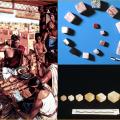
Was this an ancient Mohenjo-daro restaurant? Sir Mortimer Wheeler writes "Of another kind is a building fronting upon one of the main streets, 'First Street', in VR Area [Mohenjo-daro]. Its outside dimensions are 87 by 64.5 feet, but within that considerable framework are included not only residential quarters around the courtyard but also, towards the street, industrial or commercial premises of some note: in particular, three rooms neatly paved with bricks on edge, one room with five conical pits or holes sunk in the floor and lined with wedge-shaped bricks, apparently to hold the pointed b… >

Pagination

  • First page
  • Previous page
  • …
  • Page 15
  • Page 16
  • Page 17
  • Page 18
  • Page 19
  • Page 20
  • Page 21
  • Page 22
  • …
  • Next page
  • Last page

Blog Posts by Subject (16)
  • Animals
  • Art
  • Children
  • City Life
  • Conferences
  • Crafts and Industry
  • Evolution
  • Excavations
  • Food
  • Homes
  • Media
  • Museums
  • Mysteries
  • News
  • People
  • Seals

follow us

Follow us on Facebook, Twitter and Instagram.
Videos on YouTube.
Occasional Newsletter.

donate

A 31 year-old non-profit serving 30,000 people a day.

© Harappa.com 1995-2026 31