Home

Main navigation

  • home
  • slides
  • essays
  • articles
  • books
  • video
  • q & a
  • blog
Secondary menu
  • about us
    • scholars
    • privacy
    • support
    • image rights
    • credits
    • contact us
  • resources

Secondary menu

  • about us
    • scholars
    • privacy
    • support
    • image rights
    • credits
    • contact us
  • resources

Ancient Indus Civilization Blog

354 posts, also carried on our Facebook page, about the ancient Indus Valley civilization, including important news, research and occasional visits to museums with ancient Indus artifacts.
Harappa Mound AB Center

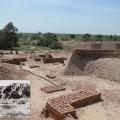
Harappa Mound AB Center with the great drain looking out over Punjab. Harappa was first excavated in 1872 by Alexander Cunningham, the original Director General of the Archaeological Survey of India. Although he named the mounds and found a seal and other implements after digging a handful of trenches, he was in search of a Buddhist city and did not realize that he had come upon a Bronze Age civilization that would push back Indian history 2,000 years. It took until 1921 before Harappa was excavated again by Daya Ram Sahni (inset shows unexcavated mound that year), but even then, it was not u… >

Harappan Feline Figurine

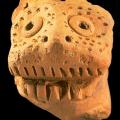
An Indus feline figurine from Harappa. Among the dangerous wild animals represented in the figurine corpus are large wild felines. This feline figurine with punctuate designs on the face (possibly representing spots) and an open mouth showing teeth is a relatively naturalistic representation of a large wild cat, possibly representing a leopard or a cheetah. Approximate dimensions (W x H(L) x D): 4.6 x 11.5 x 6.2 cm. Photograph by Richard H. Meadow. For another feline face, see also Ritual Mask or Amulet. >

Horned Figure Copper Tablet

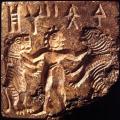
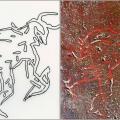
  • An incised copper tablet from Mohenjo-daro showing a figure with large horns.

The large horns could represent the power or virility of the animal; whoever wore the horns would possess similar attributes. According to J.M. Kenoyer, they may depict powerful hunters, shamans or even some form of water buffalo or cattle deity. Asko Parpola writes "a male deity having similar long eyes and bulls horns, but a goat's beard in addition, is known from several terracotta masks and terracotta statuettes" (Indus Script, p. 234). See also Deity Strangling Tigers Tablet and Parpola's essay Deciphering the Indus Script. >

The Great Bath of Mohenjo-daro B

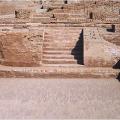
1. The Great Bath at Mohenjo-daro, looking north. The side walls of the roughly 12 by 7 meter tank were constructed with finely fitted bricks and a thick layer of bitumen (natural tar) was laid along the sides of the tank to keep water from seeping through the walls and up into the superstructure. 2.Lower ledge inside the Great Bath, southern edge, looking east. At the foot of the stairs is a small ledge with a brick edging that extends the entire width of the pool. People coming down the stairs could move along this ledge without actually stepping into the pool itself. Small sockets at th… >

Intricately Painted Jar from Chanhu-daro

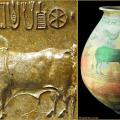
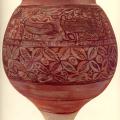
One of the finest ancient Indus painted jars ever found, excavated at Chanhu-daro during the 1935-36 season led by Ernest MacKay. JM Kenoyer describes it as a "large storage jar with red slip and black painted motifs, including peacocks, vegetation and the famous intersecting-circle design. Such vessels were probably used as marriage gifts or for other ritual occasions, and the motifs undoubtedly represent auspicious blessings on the owner" (Ancient Cities of the Indus Civilization, p. 231). See also Finds and Chanhu-daro. >

Harappa Mounds Today #1

The tomb of Baba Noor Shah, whose 9 meter long grave lies on Mound AB. By the entrance are singers, pipal trees and huge ancient Indus ringstones. The 17th century saint is said to have worn them on his toes. See also Harappan Mounds #2. >

Carnelian Beads

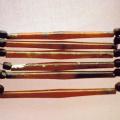
"Indus beadmakers have the distinction of producing the longest and most slender beads of carnelian in the world, prior to the advent of diamond drilling," (J.M. Kenoyer). Chanhu-daro has provided the most data about the manufacture of these long carnelian beads, seen here in a necklace or belt from Mohenjo-daro's DK Area. It could take weeks of intense labor to create one bead, some nearly 5 inches long, with much breakage along the way. See also Dorothy Mackay's article Finds at Chanhu-daro. >

Seated Faience Monkey Figurine

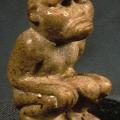
Seated faience monkey figurine or amulet from Mohenjo-daro. Its broken feet suggest that it was once attached to another object, possibly a second monkey as in the Triple Monkey Figurine. Molded and carved. See also Monkey Figurine from Harappa >

Harappan Female Figurine

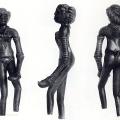
"The importance of females as symbols of religious power [in Indus Civilization] is supported by the fact that figurines of women or mother goddesses are more common than male figurines." (J.M. Kenoyer). Shown is a female figurine from Harappa with four flowers arranged on the front part of a fan shaped headdress with cups at two sides and braided edging. This figurine is adorned with a triple strand choker with pendant beads and a double strand necklace with central disc pendant. See also Women of Harappa. >

Mystery of the Pillared Hall

What was the large pillared hall at Mohenjo-daro used for? The hall was approximately 27.5 meters square (90 feet square) with twenty square brick pillars arranged in four rows, only two of which are still preserved. Strips of paved floors sloped from south to north and each strip of flooring had row of bricks set on edge along both sides. The cross wall in the foreground was built later and divided the hall into smaller rooms. Its purpose remains an enigma. >

Mohenjo-daro Male Sculpture (Shell in Eye)

Seated male sculpture from Mohenjo-daro with shell inlay still remaining in one eye. The braided or combed hair lays back straight and a plain fillet or ribbon encircles the head and falls down the back of the neck. Two strands of a ribbon or braided hair hang over the shoulder. The stylized ear is a simple cup shape with a hole in the center. The upper lip is shaved and a short combed beard covers the lower jaw. The forward projecting head and large lips may reflect a specific personality or may be due to the particular style of carving. See also Men of Harappa and Ancient Indus Men's Hai… >

4 Unicorns

Richard H. Meadow at Harvard wrote in response to a question about whether the so-called unicorn seal depicts a mythical animal or a composite: "Some believe the one, some the other. There is no evidence for any unicorn - one horned beast - from the faunal record. A third belief is that it was a wild ox with the horns shown in profile. That is possible, although if so it is idealized and perhaps a conventional depiction. I go for either the depiction being of a mythical animal or of an ox with head in profile produced according to a particular convention - not necessarily an either/or interpr… >

Corbelled Arch Drain

The corbelled arch drain from the great bath in Mohenjo-daro is large enough to walk into. It has a small ledge on either side of the actual drain channel. See also Mohenjo-daro: City of Wells. >

Harappan Water Well

One of only eight wells, public and private, that have thus far been discovered at Harappa. Most of the water used by the population probably came from the adjacent Ravi River. The curved wall was probably a large drain used during the latter stages of ancient Harappa, around 2,000 B.C.E. See also Mohenjo-daro: City of Wells. >

Steatite Unicorn Seal

A steatite unicorn seal from Harappa with Indus script and dating to around 2450-2200 BCE. When pressed into clay the impression will be reversed. Since the Indus script may have been read from right to left, the last two signs visible at the top right hand edge of the seal would in fact be the last two signs of the inscription. See also Four Unicorns and A Unicorn Seal. >

Pagination

  • First page
  • Previous page
  • …
  • Page 17
  • Page 18
  • Page 19
  • Page 20
  • Page 21
  • Page 22
  • Page 23
  • Page 24
  • Next page
  • Last page

Blog Posts by Subject (16)
  • Animals
  • Art
  • Children
  • City Life
  • Conferences
  • Crafts and Industry
  • Evolution
  • Excavations
  • Food
  • Homes
  • Media
  • Museums
  • Mysteries
  • News
  • People
  • Seals

follow us

Follow us on Facebook.
Videos on YouTube.
Occasional Newsletter.

donate

A 31 year-old non-profit serving 30,000 people a day.

© Harappa.com 1995-2026 31