Home

Main navigation

  • home
  • slides
  • essays
  • articles
  • books
  • video
  • q & a
  • blog
Secondary menu
  • about us
    • scholars
    • privacy
    • support
    • image rights
    • credits
    • contact us
  • resources

Secondary menu

  • about us
    • scholars
    • privacy
    • support
    • image rights
    • credits
    • contact us
  • resources

Ancient Indus Civilization Blog

354 posts, also carried on our Facebook page, about the ancient Indus Valley civilization, including important news, research and occasional visits to museums with ancient Indus artifacts.
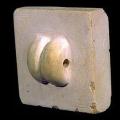
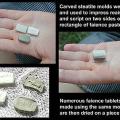
Manufacturing Faience Tablets

First it is necessary to make the faience paste and the steatite molds. Then the paste is formed into a rectangle and impressed on both sides by the molds. Finally the molded tablets must be dried slowly with air flowing on all sides to allow efflorescence of the glazing flux that is mixed with the faience paste. See also Reconstruction of Faience Tablet Manufacturing or see more images in Harappa 2000- 2001 slideshow. >

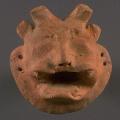
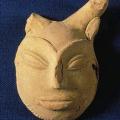
Miniature Mask from Mohenjo-daro

Miniature mask from Mohenjo-daro of bearded horned deity. The face is made from a mold and thumb impressions from pressing the clay are visible on the back. The mouth is somber and the long almond shaped eyes are open. The short horns arch from the top of the forehead and two long ears lay against the horns. Two holes on either side allow the mask to be attached to a puppet or worn as an amulet. 5.3 x 3.5 cm. See also Ritual Mask. >

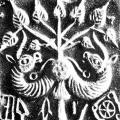
Unique Mold-made Faience Tablet

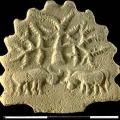
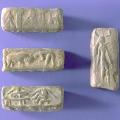
A unique mold-made faience tablet or standard was found in the eroded levels west of the tablet workshop in Trench 54 at Harappa in 2000. On one side is a narrative scene with two bulls fighting under a thorny tree. >

Harappan Bird Cage

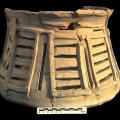
Reconstructed bird cage found at Harappa in 1999. On the other side it has a slot for a terracotta door, but no top was found. The exterior was decorated with red slip and black paint. See also Broken Terra Cotta Bird Cage and Bird Whistle. >

Topography of Ancient Harappa

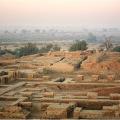
Topography of the ancient site of Harappa, including smaller mound in the top right still settled today, by Bill Belcher. See also Mark Kenoyer's comprehensive article The Ancient City of Harappa. >

Steatite Wig

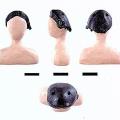
Black steatite wig from late Period 3C deposits in Trench 43 found at Harappa. This small stone hairpiece, here displayed on a modern clay mannequin, may have been set on an alabaster head like similar pieces found in western Pakistan, Afghanistan, and Southern Central Asia. >

Another Skeleton from Harappa

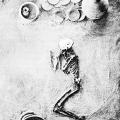
Another skeleton from Harappa, this from Marshall's excavations published in 1931. He writes: "At Harappa several examples of this mode of sepulture [complete inhumation], which are unquestionably orthodox, have already been exposed in the lower stratum of Cemetery H, and more are likely to come to view as the excavation progresses." See also Burials at Harappa and Painted Burial Pottery. >

Another Carnelian Bead

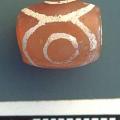
A carnelian bead found at Harappa artificially colored with white lines and circles using a special bleaching technique developed by the ancient Indus inhabitants. For more information read Kenoyer and Vidale's paper Carnelian Bead Production in Khambat, India: An Ethnoarchaeological Study. See also Single Bead Pot (Collection). >

Mysterious Sandstone Objects

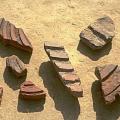
Fragments of a grooved red sandstone object or objects were found in the upper disturbed levels at Harappa. Similar fragments were recovered in the excavations by Rai Bahadur Daya Ram Sahni in 1921-22, but so far none of them fit together into a complete object and their original function is unknown. >

Pedestal Vessel

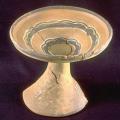
Pedestaled vessels, such as this hand-built painted bowl-on-stand of the Ravi Phase found at Harappa, appear to be the predecessors of a vessel form that becomes more common during the later Kot Diji and main Harappan Phases. See also Indus Pointed Base Goblets and An Ancient Indus Plate. >

Raw Materials

Flakes of various shades of agate, carnelian, jasper, chert, and lapis lazuli indicate the range of raw materials being processed in this part of the Harappa during the pre-Indus Ravi phase (3300-2800 BCE). All of these raw materials were brought to the site from distant resource areas, between 300 to 800 kilometers away. >

Gender and the Indus People: An Unusual Male Figurine

An unusual male figurine found at Harappa with a fan shaped headdress and choker around the neck may be a representation of alternative gender in the ancient Indus civilization. These are usually characteristic of female figurines. For more on Masculinity, see also Men of Harappa A, Men of Harappa B and Nude Male Figurine. For more on Femininity, see Women of Harappa A and Women of Harappa B. >

Multi Animal Seal from Mohenjo-daro

Sealing from Mohenjo-daro depicting a collection of animals and some script symbols. This terra cotta sealing may have been used in specific rituals as a narrative token that tells the story of an important myth. See also Rare Three Animal Seal from Mohenjo-daro. >

Headdresses or Hair?

Three female figurines with painted fan-shaped headdresses from Harappa. Could these headdresses have represented black hair stretched over a frame of bamboo or other material? See also Gender and the Indus People: An Unusual Male Figurine and Harappan Female Figurine. >

Ravi Phase Jewelry

Beautiful strand of Pre-Indus Ravi Phase (3300-2800 BCE) beads of terra cotta, carnelian, amazonite and lapus lazuli found at Harappa. For more, read Mark Kenoyer's Bead Technologies at Harappa, 3300-1900 BC: A Comparative Study. >

Pagination

  • First page
  • Previous page
  • …
  • Page 17
  • Page 18
  • Page 19
  • Page 20
  • Page 21
  • Page 22
  • Page 23
  • Page 24
  • Next page
  • Last page

Blog Posts by Subject (16)
  • Animals
  • Art
  • Children
  • City Life
  • Conferences
  • Crafts and Industry
  • Evolution
  • Excavations
  • Food
  • Homes
  • Media
  • Museums
  • Mysteries
  • News
  • People
  • Seals

follow us

Follow us on Facebook, Twitter and Instagram.
Videos on YouTube.
Occasional Newsletter.

donate

A 31 year-old non-profit serving 30,000 people a day.

© Harappa.com 1995-2026 31