Home

Main navigation

  • home
  • slides
  • essays
  • articles
  • books
  • video
  • q & a
  • blog
Secondary menu
  • about us
    • scholars
    • privacy
    • support
    • image rights
    • credits
    • contact us
  • resources

Secondary menu

  • about us
    • scholars
    • privacy
    • support
    • image rights
    • credits
    • contact us
  • resources

Ancient Indus Civilization Blog

354 posts, also carried on our Facebook page, about the ancient Indus Valley civilization, including important news, research and occasional visits to museums with ancient Indus artifacts.

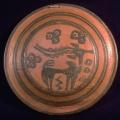
Painted Antelope Lid or Dish

  • Blackbuck Antelope Dish or Lid

Late Harappan Period dish or lid with perforation at edge for hanging or attaching to large jar. It shows a Blackbuck antelope with trefoil design made of combined circle-and-dot motifs, possibly representing stars. It is associated with burial pottery of the Cemetery H period, dating after 1900 BCE. See also Another Skeleton from Harappa. >

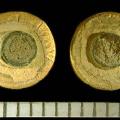
Gold Foiled Beads

Two gold beads originally part of the same ornament found in Harappa in 2000. Thin gold foil was placed over the outside of a sandy core around a copper tube. For more information about gold and Indus culture, read Jonathan Mark Kenoyer's article Wealth and Socioeconomic Hierarchies of the Indus Valley Civilizations. For more golden jewelry, see also Composite Tubular Gold Bead and Ornaments and Jewelry. >

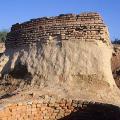
The Great Bath of Mohenjo-daro C

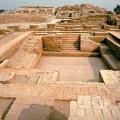
The "great bath" is without doubt the earliest public water tank in the ancient world. The tank itself measures approximately 12 meters north-south and 7 meters wide, with a maximum depth of 2.4 meters. Two wide staircases lead down into the tank from the north and south and small sockets at the edges of the stairs are thought to have held wooden planks or treads. At the foot of the stairs is a small ledge with a brick edging that extends the entire width of the pool. People coming down the stairs could move along this ledge without actually stepping into the pool itself. The floor of the … >

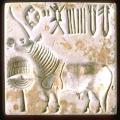
The Chimaera: Revisited

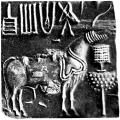
Further to the discussion of chimeras, among the first unicorn seals found by John Marshall at Mohenjo-daro in the 1920's was this one. He wrote: "The animal most often represented on the seals is the apparently single-horned beast ... There is a possibility, I think, that the artist intended to represent one horn behind the other. In other animals, however, the two horns are shown quite distinctly. In some respects the body of this beast, which is always a male, resembles that of an antelope of heavy build, such as the eland or oryx, and in others that of an ox. The long tuffed tail may belo… >

Reconstruction of Faience Tablet Manufacturing

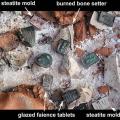
Fully and partially glazed faience tablets and other fired objects could be examined after the fire had cooled and the canister opened during experimental firings at the University of Madison, Wisconsin. The steatite molds were also included in the canister to see how they would be affected by this type of firing. For more on this experiment, see Reconstruction of Tablet Manufacture and Manufacturing Faience Tablets. >

3 Harappan Phase Clay Seals

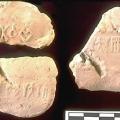
Three clay sealings from the Harappa Phase levels (2600-1900 BCE) that may have come from large bundles of goods shipped to the site from a distant region. The clay does not appear to be the same type of clay as found near Harappa and each sealing has the impression of two different seals. >

Coiled Basket Imprint

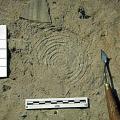
From the school of careful excavations: a Kot Diji phase (2800-2600 BCE) coiled basketry impression unearthed at Harappa in 2000. See also Kot Diji Phase Kiln >

Terra Cotta Tokens

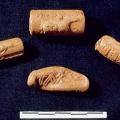
Terra cotta tokens or tablets from Harappa. In Area G, south of the gateway on Mound ET, excavators found a concentration of as many as 31 identical cylindrical terracotta tablets (top center), but it is not known what they could have been used for. Concentrations of tablets recovered through recent excavations at Harappa indicate that these tablets become popular during the late part of Period 3B (2450 B.C.E.) and continue on into the final phase of the Harappan occupation, Period 3C (2200 to 1900 B.C.E.). >

Nude Male Figurine

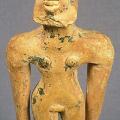
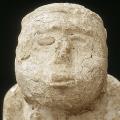
Nude male figurine or deity from Mohenjo-daro. Note the wide, spreading beard. He is wearing a broken headdress that may have had two curving horns. For additional information on the representation of masculinity, see also Men of Harappa A and Men of Harappa B. For more male and female figurines, see also Embodying Indus Life: Terra Cotta Figurines. >

Storage Jar with Script

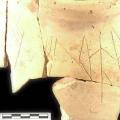
Many large storage jars of the (Period 3) Harappa Phase (2600-1900 BCE) have writing inscribed along the upper portion of the vessel. This inscription includes a figure of a man with the bow and arrow sign in each hand. It is impossible to shoot two bows and arrows at the same time so this is clearly not a pictograph, but rather a combined symbol used as part of a Indus writing system. See also The Evolution of Indus Script. >

Molded Tablets from Trench 11

Molded tablets from Trench 11 at Harappa sometimes have impressions on one, two, three or four sides. This group of molded tablets shows the complete set of motifs. One side is comprised entirely of script and has six characters, the first of which (on the very top) appears to be some sort of animal. A second side shows a human figure grappling with a short horned bull. A small plant with at least six branches is discernible behind the individual. The third panel portrays a figure seated on a charpoy or throne in a yogic position, with arms resting on the knees. Both arms are covered with ban… >

The Great Bath of Mohenjo-daro A

The great bath at Mohenjo-daro at dawn and in context. Surrounded by a brick colonnade, it measures approximately 12 meters north-south and 7 meters wide, with a maximum depth of 2.4 meters. In the background is a massive brick structure with narrow passages that was first identified as a hammam or hot-air bath, and later as the state "granary," but this is not certain. See also The Great Bath of Mohanjo-daro B. >

Back of a Seal

Ernest Mackay writes (1931): "The boss was then carefully rounded off after the groove that always runs across its center had been roughly made by a V-shaped cut. The rounding of the boss was apparently done with a knife and finished off with an abrasive, after which a hole was bored through it from opposite sides to take a cord." See also Seal with Two-Horned Zebu Bull. >

Ritual Mask or Amulet

Loosely included under the rubric of terracotta "figurines" are the terracotta masks found at some Harappan sites. This mask clearly has a feline face with an open mouth with exposed fangs, a beard, small round ears and upright bovine horns. It is small and has two holes on each side of the face that would have allowed it to be attached to a puppet or worn, possibly as an amulet or as a symbolic mask. The combination of different animal features creates the effect of a fierce composite animal. As an amulet or a symbolic mask, it may represent the practice of magic or ritual transformation in … >

Unicorn and Pipal Tree Seal

A seal from Mohenjo-daro found by Wheeler in the 1920's. From his 1931 text: "The plant on the [seal] has been identified as a pipal tree, which in India is the Tree of Creation. The arrangement is very conventional and from the lower part of the stem spring two heads similar to those of the so-called unicorn." See also Pipal Tree Tablet and Pipal Leaves: Revisited. >

Pagination

  • First page
  • Previous page
  • …
  • Page 17
  • Page 18
  • Page 19
  • Page 20
  • Page 21
  • Page 22
  • Page 23
  • Page 24
  • Next page
  • Last page

Blog Posts by Subject (16)
  • Animals
  • Art
  • Children
  • City Life
  • Conferences
  • Crafts and Industry
  • Evolution
  • Excavations
  • Food
  • Homes
  • Media
  • Museums
  • Mysteries
  • News
  • People
  • Seals

follow us

Follow us on Facebook, Twitter and Instagram.
Videos on YouTube.
Occasional Newsletter.

donate

A 31 year-old non-profit serving 30,000 people a day.

© Harappa.com 1995-2026 31