
Home

Main navigation

  • home
  • slides
  • essays
  • articles
  • books
  • video
  • q & a
  • blog
Secondary menu
  • about us
    • scholars
    • privacy
    • support
    • image rights
    • credits
    • contact us
  • resources

Secondary menu

  • about us
    • scholars
    • privacy
    • support
    • image rights
    • credits
    • contact us
  • resources

Ancient Indus Civilization Blog

354 posts, also carried on our Facebook page, about the ancient Indus Valley civilization, including important news, research and occasional visits to museums with ancient Indus artifacts.
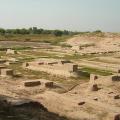

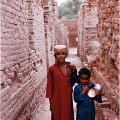
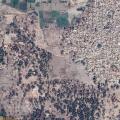
Touching Mounds at Harappa

Touching Mounds at Harappa, one of the oldest inhabited places on earth, and one of those real world images that makes you think about the relationship between past and present. >

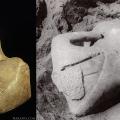
Finding the Priest King

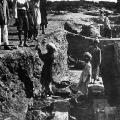
A workman handing over the Priest King at the time of excavations in I, Block 2 of DK-B Area during the John Marshal led 1925-26 excavations at Mohenjo-daro. Possehl writes "many classic Harappan style artifacts came to light at this time, including the so-called Priest King which emerged from Dikshit's excavations in DK-B Area, in a building that the excavators thought may have been a hammam or hot bath." >

The Domestication of Sesame Seed - Ancient Gift from Harappa

The first sesame seeds were actually found at Harappa. About.com's Archaeology Guide K. Kris Hearst discusses the importance of sesame to cooking. >

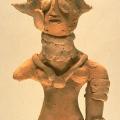
A Deer from Lothal

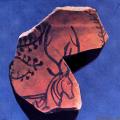
"The Lothal craftsmen exhibited originality of thinking and great resourcefulness. As an example we may mention the new style of earthenware with animal motifs which are more realistic than those on the Indus valley pottery," writes excavator S.R. Rao. >

Lothal and Mohenjo-daro: 3 Similarities

1. "The word 'Lothal' in Gujarati formed by combining the words Loth and thal (sthal) means 'the mound of the dead'. The word 'Mohenjodaro' in Sindhi also conveys the same meaning." (S.R. Rao, Lothal, p. 18). 2. "Wheeler had also observed that even during the occupation of the citadel [of Mohenjo-daro] the rising water-table had posed a problem and necessitated protecting the platform by a mud-brick embankment or bund, 13 metres-wide, at an early date of the occupation of the city. It is interesting to find that far south of Mohenjo-daro [in Lothal] the Harappans built simu… >

The Discovery of Lothal

"The main purpose of undertaking excavation at Lothal was to decide whether it could be considered as a true Harappan settlement where the people observed the same urban discipline and enjoyed the same material prosperity as in the metropolitan centres of Harappa and Mohenjo-daro." >

Around the Indus in 90 Slides Turns 20 Years Old

In 1996, we unveiled this 90 slide tour by Jonathan Mark Kenoyer. It has since been viewed by millions of people. Many have been kids in schools around the world. For the new version of Harappa.com, a new interface has been added, as well as taxonomies and links to related items. >

Poll: The first tools in the Indus Valley?

When did inhabitants use the first tools in the Indus Valley? The Neolithic Period (6500-4500 BCE) period? The Chalcolithic Period (4500-3500 BCE) period? The Bronze or Indus Period (3500-1800 BCE) period? Or 2 million years ago? Only 20% of the 1,573 respondents to this poll got it right - 2 millions years ago. As Mark Kenoyer writes in Ancient Cities of the Indus Valley Civilization, "The earliest inhabitants of South Asia belonged to the hominid species Homo erectus, the ancestor of modern Homo sapiens. These stone tool-using hominids lived in the Potwar plateau region… >

Wheeler's Mohenjo-daro 1950: A New Slide Show

We start 2016 and inaugurate the new Harappa.com by publishing long-lost images from Sir Mortimer Wheeler's personal collection. They are of the excavations he led at Mohenjo-daro in 1950. >

Happy New Year 2016

Happy New Year 2016, from a relaunched Harappa.com, starting our 21st year and the year of the expected release of Ashutosh Gowariker's Mohenjo Daro, an epic romance with some of India's biggest stars than could do more for consciousness of the ancient Indus Civilization than so many new discoveries. >

Ghats Since Indus Times?

"In my view Hindu bathing places, such as the ghats at Varanasi, may have existed from the time of the Indus civilization. It is supposed that a canal or branch of the Indus flowed next to the lower city of Mohenjo-daro, which appears to have been surrounded by revetments functioning as flood defenses. Next to what Ernest Mackay took to be 'a small fort on the city wall,' he found a "ghat like staircase" that led down at least as far as the present water level" (Wheeler, 1968:47). In any case the derivation of Sanskrit Ghatta- from Dravidian *katta, river bank, embankment, d… >

Mohenjo-daro Great Bath Diagram

"The Great Bath, which I have reserved to the last, was part of what appears to have been a vast hydropathic [water therapeutic] establishment and the most imposing of all the remains unearthed at Mohenjo-daro. Its plan is simple: in the centre, an open quadrangle with verandahs on its four sides, and at the back of three of the verandahs various galleries and rooms; on the south, a long allery with a small chamber in each corner; on the east, a single range of small chambers, including one with a well (no 16); on the north, a group of several halls and fair-sized rooms. In t… >

Lothal Sanitation

Lothal's sophisticated sanitary and drainage system was a hallmark of ancient Indus cities. All of Lothal's drainage channels met at right angles, engineered with several steps to separate solid and liquid wastes. >

Empire of Cotton

Farmers in the Indus valley were the first to spin and weave cotton. In 1929 archaeologists recovered fragments of cotton textiles at Mohenjo-Daro, in what is now Pakistan, dating to between 3250 and 2750 BCE. >

ASI to Improve Sites at Lothal and Dholavira

The Archaeological Survey of India has apparently allocated a large sum to improve sites at Lothal and Dholavira and enhance the visitor experience. >

Pagination

  • First page
  • Previous page
  • …
  • Page 9
  • Page 10
  • Page 11
  • Page 12
  • Page 13
  • Page 14
  • Page 15
  • Page 16
  • …
  • Next page
  • Last page

Blog Posts by Subject (16)
  • Animals
  • Art
  • Children
  • City Life
  • Conferences
  • Crafts and Industry
  • Evolution
  • Excavations
  • Food
  • Homes
  • Media
  • Museums
  • Mysteries
  • News
  • People
  • Seals

follow us

Follow us on Facebook, Twitter and Instagram.
Videos on YouTube.
Occasional Newsletter.

donate

A 31 year-old non-profit serving 30,000 people a day.

© Harappa.com 1995-2026 31