Home

Main navigation

  • home
  • slides
  • essays
  • articles
  • books
  • video
  • q & a
  • blog
Secondary menu
  • about us
    • scholars
    • privacy
    • support
    • image rights
    • credits
    • contact us
  • resources

Secondary menu

  • about us
    • scholars
    • privacy
    • support
    • image rights
    • credits
    • contact us
  • resources

Ancient Indus Civilization Blog

359 posts, also carried on our Facebook page, about the ancient Indus Valley civilization, including important news, research and occasional visits to museums with ancient Indus artifacts.
The Politics of Mohenjo-daro

"I stood on a mound of Mohenjo-daro in the Indus valley in the northwest of India," wrote Jawaharlal Nehru in The Discovery of India (1946), "and all around me lay the houses and streets of this ancient city that is said to have existed over five thousand years ago . . ." >

Harappa.com Crosses 100,000 Facebook Followers

An 8 year effort that began on Sept. 13, 2008 to publish quality ancient Indus civilization content on Facebook reaches a milestone. >

The Mandi Hoard

"The discovery of a rich hoard of Harappan jewelry from the village of Mandi (29-26 degrees 10' North, 77 degrees 34-35'E) in Muzzaffarnagar district, western Uttar Pradesh, has surprised the archaeological world for several reasons. First, Mandi is located to the east of the Yamuna river, and this area has been considered peripheral to the main distribution area of the Harappan civilization." >

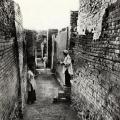
Low Lane, Mohenjo-daro

"With the exception of First Street, the most impressive thoroughfare in the DK Area, Southern Portion," writes the early excavator of Mohenjo-daro, Ernest J.H. Mackay, "is unquestionably Low Lane which runs practically parallel with it. This is chiefly because the depth to which it has been excavated and its narrow width increase the apparent height of the houses on either side. But the street has preserved its character and identity from the Intermediate III (XVI., 2.) onwards to the Late I Phase (Pl. XX). The facades of most of the houses as far as the northern limit of Block 6 ar… >

The Tale of Sea Goddess of Lothal

S.K. Rao wrotes: "It is relevant to record here a local tradition regarding Lothal, which is considered a sacred place for Vanuvatimata, the sea-goddess who is represented by stones placed in a small enclosure of bricks built in the south-east corner of the mound." >

Kalibangan

"The site Kalibangan - literally 'black bangles' - derives its name for the dense distribution of the fragments of black bangles which were found at the surface of its mounds. . ." writes Madhu Bala. "Evidence of this period consists of a citadel area over the 1.6 metre-thick early Harappan deposit in KLB-1 (the western mound of the site [Image 1]), a chessboard pattern 'lower city' in KLB-2 (the lower and larger eastern mound), and a mound full of fire altars in a much smaller mound further east (KLB-3). The citadel complex of KLB-1 is roughly a parallelogram (240 by 120 metres) divided i… >

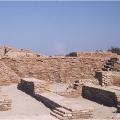
Stairways of Mohenjo-daro II

In addition to hundreds of wells, Mohenjo-daro would have had hundreds of staircases. Many houses had stairs leading to upper courtyards of the building or to a second floor. This house in HR area had a double staircase that would allow people to enter and exit the upper courtyard in an orderly fashion. Some scholars feel this may have been a palace or a temple. Two doorways lead to a narrow courtyard at a lower level. >

The Buffalo Sacrifice

Asko Parpola writes: "Early Harappan cultures started moving toward the east and south in about 3000 BCE, and later waves of influence in these same directions came from the Indus civilization. That the Harappan water-buffalo cult had reached penninsular India by the late Harappan on Chalcolithic times is suggested by the large bronze sculpture of water buffalo discovered in 1974 in a hoard at Daimabad, the southernmost Indus site in Maharashtra. >

Mohenjo-daro Deep Soundings and Flood Damage

These images that show how difficult if not impossible it is to ascertain Mohenjo-daro's age; the water table even 50 years ago was doing great damage to the city's remains and making deep digging impossible. >

The Chanhu-daro Seal: Gaur Ravaging a Female

"Mackay found an extraordinary seal in his excavations at Chanhu-daro. It shows a short-horned bull, Bos gaurus, above a prostrate human figure. He thought that the scene depicted an attack by the bull, and the human on the ground was attempting a defense against the trampling animal." >

Mohenjo-daro City of Wells II

"Remarkable as it may seem, the [estimated 700] well locations at Mohenjo-daro seem to have been laid out when the original platforms were built." >

Surkotada, Gujarat

Surkotada is a small, 3.5 acre site northeast of Bhuj, in Gujarat. "The mound has an average height of five-to-eight metres (east-to-west) and was discovered by the author during the course of his explorations in Kutch in December, 1964," writes Jagat Pati Joshi in Excavation at Surkotada and Exploration in Kutch. >

Which ancient Indus civilization has been excavated for the most seasons (almost 2x the next highest)?

The correct answer is Harappa, excavated for 26 seasons, compared to Mohenjo-daro at 15 and Kalibangan at 10 when Gregory Possehl wrote in 1990: "Harappa has been the most frequently investigated of any of the ancient settlements of the Harappan cultural tradition. >

Satyajit Ray and The Unicorn Expedition

  • The frontpiece to The Unicorn Expedition was drawn by Ray himself

"I saw a herd of unicorns today. I write this in full possession of my senses." So begins the short story The Unicorn Expedition by the great Bengali filmmaker Satyajit Ray. A Professor Shanku story from the early 1960s, one of a series which reflect "my love of [Jules] Verne and [H.G.] Wells and [Sir Arthur] Conan Doyle whose works I read as a schoolboy," wrote Ray. Like anything by him, it is charming and effortless and rich and rich and starts in Mohenjo-daro. >

85 pc conservation work completed at Harappa

The Punjab Archeology Department has completed 85 per cent conservation work at remains of Harappa site according to a story in Pakistan Today. >

Pagination

  • First page
  • Previous page
  • …
  • Page 8
  • Page 9
  • Page 10
  • Page 11
  • Page 12
  • Page 13
  • Page 14
  • Page 15
  • …
  • Next page
  • Last page

Blog Posts by Subject (16)
  • Animals
  • Art
  • Children
  • City Life
  • Conferences
  • Crafts and Industry
  • Evolution
  • Excavations
  • Food
  • Homes
  • Media
  • Museums
  • Mysteries
  • News
  • People
  • Seals

follow us

Follow us on Facebook, Twitter and Instagram.
Videos on YouTube.
Occasional Newsletter.

donate

A 31 year-old non-profit serving 30,000 people a day.

© Harappa.com 1995-2026 31