Home

Main navigation

  • home
  • slides
  • essays
  • articles
  • books
  • video
  • q & a
  • blog
Secondary menu
  • about us
    • scholars
    • privacy
    • support
    • image rights
    • credits
    • contact us
  • resources

Secondary menu

  • about us
    • scholars
    • privacy
    • support
    • image rights
    • credits
    • contact us
  • resources

Ancient Indus Civilization Blog

359 posts, also carried on our Facebook page, about the ancient Indus Valley civilization, including important news, research and occasional visits to museums with ancient Indus artifacts.
Excavation of Pottery Debris

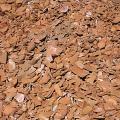
Discarded ancient Indus sherds, after archaeologists have sifted through them and cleaned them. This pottery debris from excavations at Harappa covers hundreds - if not a thousand – years of habitation, far longer a period than say modern times. One can imagine each sherd having its own story, connected to another sherd now far away in the pile, the centuries layered upon each other in the sunlight. 1 and 2. Sorted and discarded pottery sherds from continuing excavations at Harappa since 1985. 3. Earth and debris excavated from the houses and streets of DK-I area was dumped directly onto … >

The Harappan Kiln and Pottery-making Experience in Wisconsin 2016

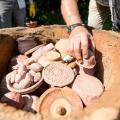
A nice piece on students on replicating Harappan techniques in Wisconsin in 2016 with Mark Kenoyer shows how much we have to learn about the complexity of ancient manufacturing. >

Yogic Deity M-305

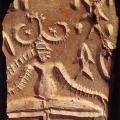
"Astronomy, including the use of a star calendar, played an important role in ancient Mesopotamia, and deeply influenced its religion: all the main gods were symbolized by particular stars or planets. In West Asia, one or two "star" symbols placed near the head distinguished divinities in pictorial representations. The practice seems to have been borrowed by the Indus civilization, for a seal from Mohenjo-daro depicts an Indus deity with a star on either side of his head enclosed by a pair of curved horns. (Asko Parpola, The Roots of Hinduism, p. 272). Elsewhere he writes: "Indus signs (in… >

DNA of First Farmers Shows Diversity

Lots if interesting stuff here, including "It had been widely assumed that these first farmers were from a single, genetically homogeneous population." >

Beatrice de Cardi, 1914-2016

In connection with the recent post about Indus discoveries in Oman, we note that the archaeologist who discovered the first definitive evidence of Bronze Age trade between Balochistan and the Gulf, Beatrice de Cardi, just died at the age of 102. She worked with Sir Mortimer Wheeler who lent her "his foreman, Sadar Din, a minor official of the Pakistani Archaeological Department who, despite being illiterate, had an extraordinarily retentive memory for archaeological sites and taught her what to look for. Together they located some 47 archaeological sites . . .." >

Prehistoric Rock Paintings and Ancient Indus Motifs

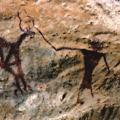
One of the least explored avenues in ancient Indus research, one which would so clearly reinforce the available evidence for the long, deep local roots of Indus civilization stretching back deep into the Stone Age (25,000-30,000 years back). >

Lothal Terracotta Dice and Game Board

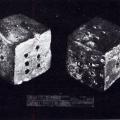
"Much valuable information about the various indoor games indulged in by the Harappans is available from the gamesmen, game-boards and dices found at the major Indus cities. A game involving the use of dice was very popular in the Harappan and later times, especially in the time of the Mahabharata war. The Pandava prince is said to have lost everything including his kingdom in a game of dice. An earlier reference to the games is contained in the Rgveda whcih mentions the use of Vibhitika wood for making dice. Lothal has yielded a cubical terracotta dice marked 1 opposite 2, 3 opposite 4, and … >

First and Central Block, Mohenjo-daro

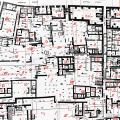
"Late III Phase. Average level: – 9.9 ft. – A few walls only remained of House I, and it will be noticed that Fore Lane had been closed in by continuing the east wall of House I right across it to the northern wall of Block I on the opposite side. >

New Indus Finds in Salut, Oman

Exciting new discoveries through 2015 at Salut tower in Oman show how extensive Indus trade and relationships with this area were during the Bronze Age (2500-2000 BCE). >

The Best Ancient Indus Reimaginings

1. A conjectural view of Indus settlement at Surkotada. Painting by Lalit Jain, Archaeological Survey of India. 2. One of the most detailed reconstructions of an ancient Indus gateway, this one on Mound E at Harappa. >

How Old is Mohenjo-daro?

Recent claims suggest that Rakigarhi is older (ca. 7000 BCE) than Mohenjo-daro. Whereas at Harappa thus far evidence of settlement prior to 3500 BCE has not been found (among limited excavations), of Mohenjo-daro's age excavator Ernest Mackay wrote: "Owing, however, to the fact that the bed of the Indus has risen some twenty feet or more in the course of the ages, it is impossible without very costly plumbing machinery to explore the earliest levels of Mohenjo-daro; in one place, where the excavations have penetrated forty feet below the surface of one of the principal mounds, the objects fo… >

The Origins of Curry in the Indus Civilization

An article by Andrew Lawler discusses how archaeologist Arunima Kashyap and Steve Weber at the Washington State University determined that curries - using garlic, ginger and turmeric - were prevalent in the Indus civilization. This was done by analyzing finds from Farmana and Harappa, using starch grain analysis and other methods. >

New Evidence Pushes the Origins of Indus Settlements to the 7th Millennium

A new article published in Nature argues that Bhirrana is one of the earliest Harappan sites in India and dates back to the 7th millennium BCE based on radiocarbon dating. >

Night of the Indigo

The Bengali filmmaker Satyajit Ray's book of short stories The Unicorn Expedition, the title story of which concerns Mohenjo-daro, includes another brilliant story which may also have connections to the ancient Indus civilization. It is called Night of the Indigo and begins with "My name is Aniruddha Bose. I am twenty-nine and a bachelor. For the last eight years I've been working in an advertising agency in Calcutta. . . .. The last few months I haven't written at all, but I have read a lot about indigo plantations in Bengal and Bihar in the nineteenth century. . . . and how, finall… >

The Harappan Bathroom

"The bathroom itself was usually a small square or rectangular room with a carefully-laid brick pavement sloping towards one corner. In this corner was the outlet for the water, which, in some cases also ran through the latrine." >

Pagination

  • First page
  • Previous page
  • …
  • Page 6
  • Page 7
  • Page 8
  • Page 9
  • Page 10
  • Page 11
  • Page 12
  • Page 13
  • …
  • Next page
  • Last page

Blog Posts by Subject (16)
  • Animals
  • Art
  • Children
  • City Life
  • Conferences
  • Crafts and Industry
  • Evolution
  • Excavations
  • Food
  • Homes
  • Media
  • Museums
  • Mysteries
  • News
  • People
  • Seals

follow us

Follow us on Facebook, Twitter and Instagram.
Videos on YouTube.
Occasional Newsletter.

donate

A 31 year-old non-profit serving 30,000 people a day.

© Harappa.com 1995-2026 31