
1921: Sahni's First Finds at Harappa
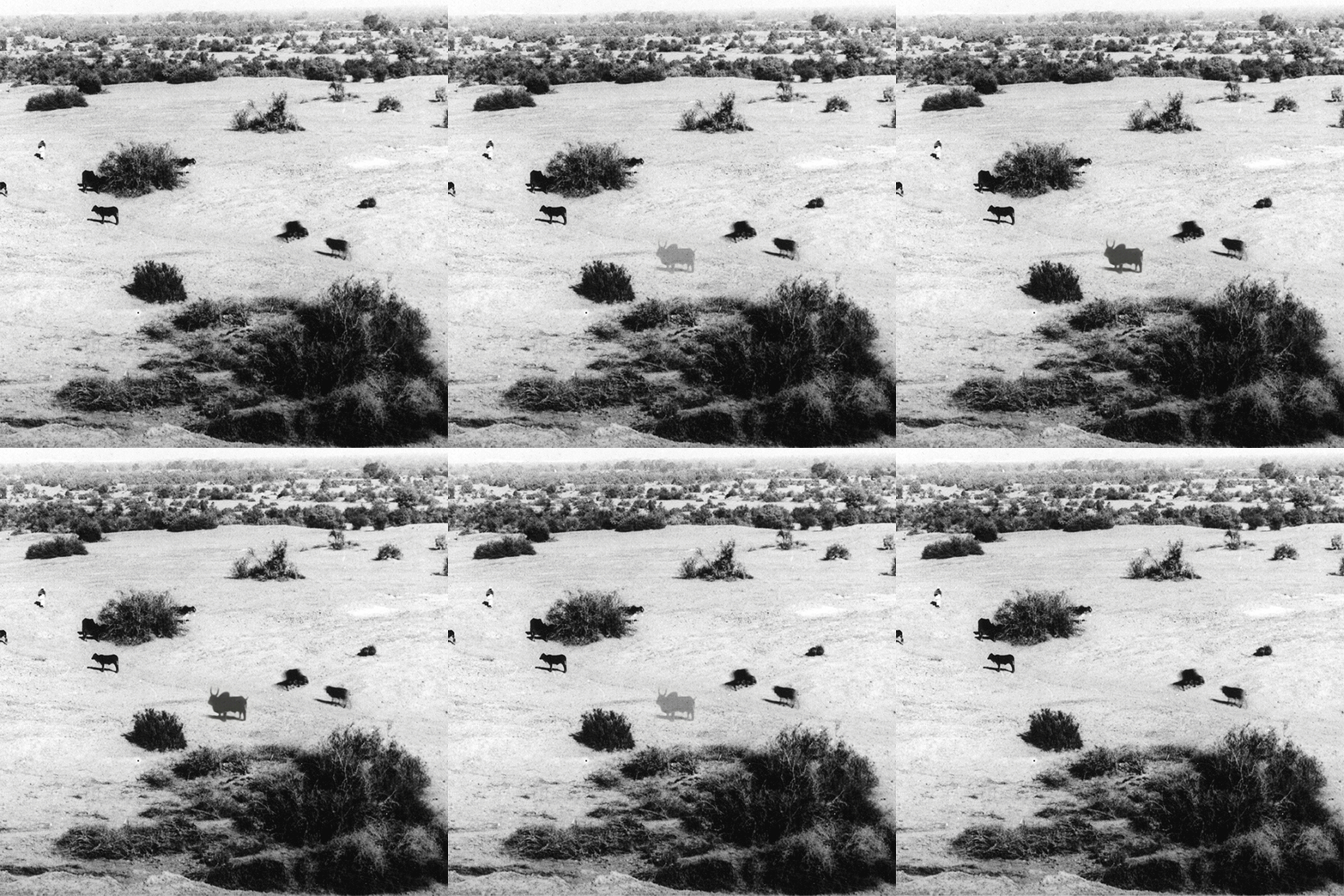
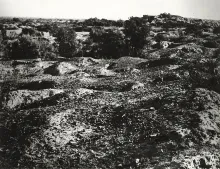
Mound F, Harappa before excavations
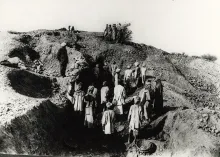
"The excavation of the mounds F and A and B was commenced in the beginning, of January 1921, and continued up to the middle of February. The operations were carried on under my personal supervision, but arrangements for supply of labour, tools, etc., were kindly made by the Executive Engineer, Lahore Provincial Division, The total expenditure on excavations, including the cost of huts provided for' the use of the Bikaner labourers that had to be imported from outside, as no local labourers were available, amounted to Rs. 4,384-5 6."
- Daya Ram Sahni, Annual Progress Report of the Archaeological Survey 1921, p. 9.
As he was excavating and cataloguing his finds over these 6 weeks, Daya Ram Sahni had no idea that he was dealing with the site and remnants of the world's largest Bronze Age civilization. It was far older than he guessed, but still recognizable as many of the goods he brought out of the ground were given familiar names.
In the slides below, his original descriptions accompany the images, together with those of Madho Sarop Vats, John Marshall and others, followed by an updated perspective by Jonathan Mark Kenoyer based on recent excavations at Harappa.
|
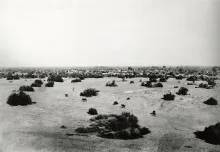
1. General view of Harappa Mound F from S.W. before excavation "Mound F is the northernmost mound on the site, and measures roughly 780' from north to south by 970', from east to west. At the time of General Cunningham’s visit the height of this mound was 2.5 to 30 feet above the surrounding land, and it is still about the same." |
|
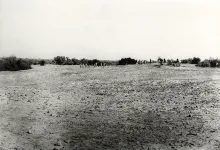
2. General View of Mound F from SE before excavation "The mound was covered with potsherds and brick bats, but no brick foundations were visible anywhere that might have served as a starting point." - Daya Ram Sahni, Annual Progress Report of the… |
|
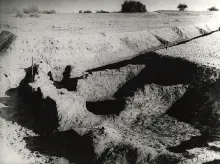
3. Harappa Fragmentary Brick Structure and Map "It was therefore decided to carry a trench wide and long enough to lay bare the general lie of the remains hidden in it. A plan and section of this trench will be published in a special article and will show the nature of the structural remains exposed." |
|
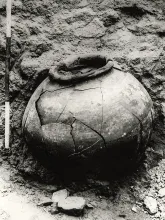
4. Large Earthen Chati unearthed in Long Trench in Mound F "It was at this point that the large earthen jar (No. A 233 of the list and photo. No. 2741) came to light. The contents of this vessel were a number of domestic earthenware utensils, a stone chess… |
|
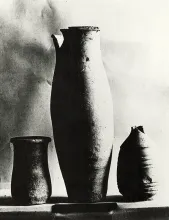
5. Crucible, Water Jug and Bottle "The pottery found at Harappa is of the light red or brown colour, excepting some specimens which are black. The latter colour is produced by the application of a variety of earth after it has been fired once." |
|
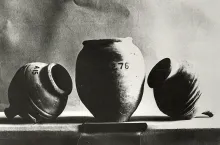
6. An Earthenware Martban and Two Lotas In the large earthen chati, more commonly called a globular pot today, were found what Sahni called lotas, used colloquially to designate drinking vessels, and are now referred to as pointed base… |
|
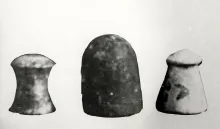
7. An Ivory Chess Disc and Two Chess Figures "Objects used for games are not many. Those that may be said to be unmistakable are balls and marbles in stone, shell, faience and pottery; dice of the same materials except shell; and some gamesmen of tetrahedral or chessman shape, the latter hardly distinguishable from baetyls." |
|
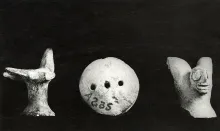
8. Terracotta toy, Female Bust and Bird It is appropriate that – besides broken seals – among the very first objects that the ancient Indus people represented themselves through four thousand years later were toys. Indeed, it would have… |
|
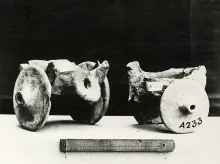
9. Two Terracotta Toy Carts The wheel (A 233) was found inside the large earthen chati unearthed in the first long trench on Mound F. "(21) The only other kind of toy is a cart (Plate X. Photo. No. 2749) consisting of a… |
|
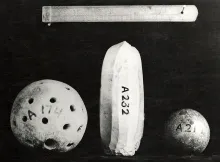
10. Yellow Stone and Pierced Terracotta Balls and Stone Implement "Balls in terracotta, stone, shell, and faience have been found universally at Harappa, those in terracotta being recovered in specially large numbers." |
|
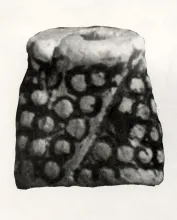
11. Chest of a Figurine "This object is actually part of a composite figurine of a gharial, the narrow snouted crocodile that used to live in the local rivers and ox-bow lakes. The animal is commonly depicted on terracotta… |
|
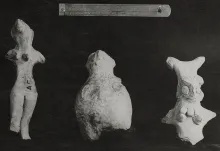
12. Female Figurines It is appropriate that Daya Ram Sahni quickly found female figurines on Mound F at Harappa as he made the first incisions. Female figurines greatly outnumber those of men at ancient Indus sites. |
|
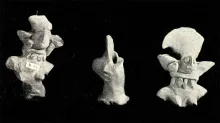
13. Harappa Excavations, Terracotta Figurines Daya Ram Sahni quickly recognized the preponderance of female figurines; after describing the two male figurines found, he writes: "All the other human figures are female figures (Plate X, Photo. No… |
|
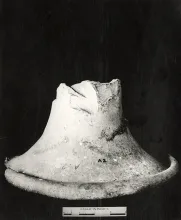
14. Top of a Colossal Clay Jar Whether or not this was one of the first objects discovered in Trench A, given the catalogue number 2, is unclear, but it was unusual to Daya Ram Sahni who said he had not seen something of the sort… |
|
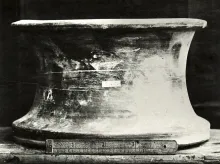
15. An earthenware ring In his 1921 summary of pottery finds, Daya Ram Sahni called out "earthenware rests for dishes or pitchers" of which this one was considered the prime example (p. 13). "This type of ring stand was… |
|
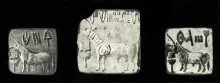
16. Harappa Excavations, Three Seals "Among the antiquities found here was a seal die (No. A 214), Plate IX, Photos. Nos. 2817 a-b. It is square in shape, along each, side and provided with a round projection on the reverse pierced… |
|
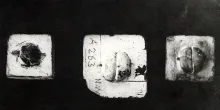
17. Three Seals [Backs], Harappa "The discovery at Harappa of the very remarkable seal illustrated in figure 1 of Cunningham's Plate XXXIII in this volume [see Image 2 above] and later of a few more now in the British Museum,… |
|
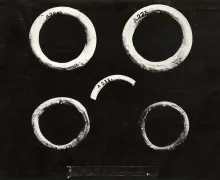
18. Terracotta Bangles found in Large Chatis Among the objects found in the large earthen chati [A 233] and a second example which would have been most familiar to Daya Ram Sahni were "earthenware bangles of various sizes were found in large… |
|
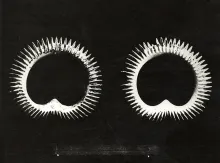
19. Bangles of Fine Blue Clay He continues, about perhaps one of the finest objects he found in 1921: "One pair of them attains a high degree of excellence. It is made of fine clay coloured blue. (No. A 182.) Plate IX, Photo No… |
|
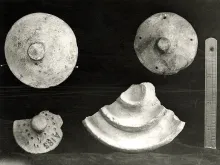
20. Terracotta objects A number of miscellaneous objects emerged during excavations on Mound F, which contributed the majority of artifacts catalogued in the 1921 ASI report by Daya Ram Sahni. Among these were what he… |
|
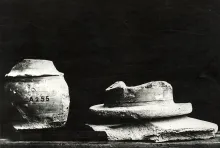
21. Lid and Dish Cover The lid on the left – "shaped like a vase" – shows how varied these objects interpreted as covers could be, including the complex "dish cover" on the right. Sahni concluded, of which these objects… |
|
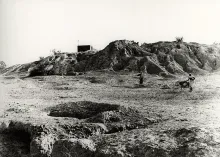
22. Mound AB General View from the North Next to the excavations on Trench A, Mound F, in 1921 Sahni also cut into Mound AB, under the remnants of a mosque that once stood on top of the mound and the tomb of a holy man which still stands… |
|
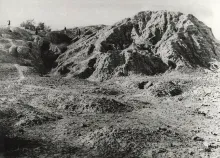
23. Mound AB Northeast Before Excavation "The mounds at Harappa are a prominent landmark in the countryside visible long distances away. They were visited by Masson in 1826, by Burnes five years later, and by General Cunningham twice in… |
|
24. Harappa Mound AB Under Excavation "The excavation of the mounds F and A and B was commenced in the beginning, of January 1921, and continued up to the middle of February. The operations were carried on under my personal supervision … |
|
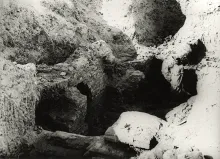
25. West of Naugaza Tomb after Excavations "My operations did, indeed, reveal portions of a large brick building, but unfortunately they were found to have been so badly hacked about by brick diggers that it is well nigh impossible to… |
|
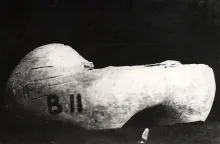
26. Miniature Undulating Ring Similar to Large Ones "Most of these fragments were, however, easily identified as parts of the undulating rings, three complete specimens of which are lying on the site. The precise purpose of these rings is not yet… |
|
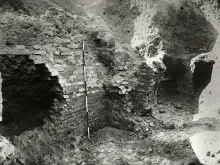
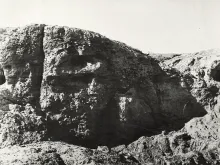
27. Harappa East of Naugaza Tomb Daya Ram Sahni continues his narrative after the ringstone discussion on the Mound AB excavations: "The floor level of the building referred to above was reached at the depth of about thirteen feet… |
|
28. Harappa Mound AB Perpendicular Cutting "A second trench was started in the western portion of this mound, but I was so completely bewildered by the enormous accumulations of earth that had to be cleared away that it appeared futile to… |
|
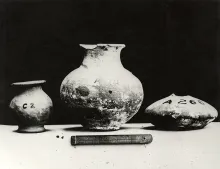
29. Two Earthenware Inkpots and Lota Daya Ram Sahni found objects he quickly called "inkpot[s] of the shape used in old type Pathsalaif and maktabs to this day" (p. 13). One of these was found in Trench C – "No. C. 2 has three holes in… |
|
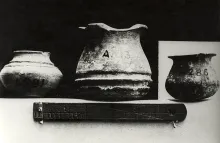
30. Three Earthenware Inkpots Three more examples, all from Mound F, of what Daya Ram Sahni immediately identified as inkpots. "The other portable antiquities recovered in this Mound F, though not numerous, all point to a high… |
|
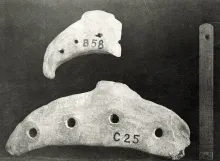
31. Two earthenware implements Another class of objects, even if incomplete, were also immediately familiar to Day Ram Sahni: "(16) An earthen instrument for making twines. It is a curved shaped piece with five holes, one of… |
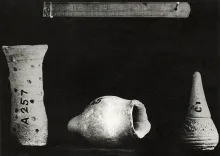
|
32. Three Crucibles Sahni recognized the object on the right [C 2]as linked to twining as well:"A conical-shaped object with a hole in the base which might have held a wooden stick. Such instruments are used for twining… |
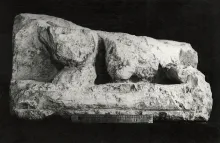
|
33. Terracotta Feet "Base of a terracotta image containing feet of a deity with an uncertain, figure between them (B 54)." - Daya Ram Sahni, Annual Progress Report of the Archaeological Survey [of India], Hindu and… |
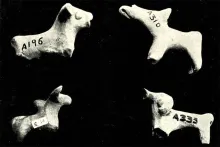
|
34. Terracotta Dog, Ram and Bulls Daya Ram Sahni described these four objects as a "a terracotta dog (A 166), a ram (A 233) ; and two bulls (A 310 and C 14)" the latter of which he considered "nicely made" (p. 13, 26). The ram was… |
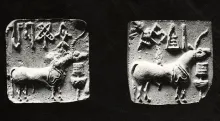
|
35. Two Unicorn Sealings from Harappa These two sealings are labelled 1917-1920 in the ASI archives. They come from Punjab volume 26, earlier than the full 1921 excavation images which were in volumes 27 and 28. Why 1917? In the absence… |
|
36. Mound E Tunnelling by Villagers + Map In addition to the excavations at Mound F and Mound AB, Daya Ram Sahni had this photograph taken in 1921 of Mound E [Map, Image 2 above, although this is not considered very accurate today]. Sahni… |