Home

Main navigation

  • home
  • slides
  • essays
  • articles
  • books
  • video
  • q & a
  • blog
Secondary menu
  • about us
    • scholars
    • privacy
    • support
    • image rights
    • credits
    • contact us
  • resources

Secondary menu

  • about us
    • scholars
    • privacy
    • support
    • image rights
    • credits
    • contact us
  • resources

Ancient Indus Civilization Blog

354 posts, also carried on our Facebook page, about the ancient Indus Valley civilization, including important news, research and occasional visits to museums with ancient Indus artifacts.
Harappa on My Plate

A clever piece by Soity Banerjee uses the modern era to ask some good questions and interrogate the many layers of evidence for what may have brought down the ancient Indus civilization. >

The Streets of Mohenjo-daro

"Inside the major blocks, the streets [of Mohenjo-daro] are not well-aligned. There are many doglegs and some deadends. The walls along the streets and lanes may pinch in on the avenues that grow narrower and narrower, but curves are rare in the Mohenjo-daro system of roads. "While there is regularity in the layout of Mohenjo-daro it is far from perfect. The regularity itself suggests that the founders of this city started with a clean plate, virgin soil, on which they began the construction of the metropolis." (Gregory Possehl, The Indus Civilization A Contemporary Perspective, p. 191, … >

A Visit to the Metropolitan's Indus Collection

On a recent trip to New York, I was able to get away for an afternoon to explore the ancient Indus collection at that battleship of a museum, the Metropolitan Museum of Art. I found the Indus collection split between two rooms, 234 in the Asian Art and 403 in the Ancient Near Eastern Art sections, with a nice long walk in between. >

The Wheel in Indus Times

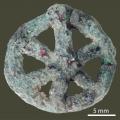
It is hard to underestimate the importance of the wheel to ancient Indus civilization. All indications are that it was an indigenous development, pursued in flat agricultural areas, and probably preceded that other great wheel - pardon the pun - of change, the potter's wheel. >

Matrilocality and the Ancient Indus Civilization

Matrolocality in Harappa? What does that mean? Women are very important in the social hierarchy, and it may not be unrelated that most figurines like these found in Indus cities like Harappa are of women. First, the evidence: "Of particular interest" writes bioarchaeologist Nancy Lovell in the recent compendium of new research . . . >

The Mysterious Pillared Hall in Mohenjo-daro

What was this enormous building in Mohenjo-daro used for? "The northern portion of Block 4 (Image 1)," in the L Area wrote the archaeologist John Marshall, "was originally a large hall of the Intermediate Period which appears to have been entirely covered ink the roof being supported by twenty rectangular piers averaging 5 feet by 3 ft. 4 in. in thickness." >

Banawali An Indus Site in Haryana

"The centralized planning of the Harappan settlements," writes the archaeologist write Dilip Chakrabarti, "is one of their most famous features." >

One or two - unicorn - horns?

One unicorn horn or two? Two leading Indus researchers, after years of thought and research, came to different conclusions. >

Ancient Indus City Drains

Few things better represent the power of ancient Indus cities in their time - much like subways and digital switches do modern cities - than brick drains. Four drains that could from Harappa and Mohenjo-daro show that the volume of water that flowed through these structures must have been like nothing seen before by ancient wayfarers. John Marshall writes: "A remarkable feature of the city of Mohenjo-daro is the very elaborate drainage system that exists even in the poorest quarters of the city. Every street and lane had one or two water-channels with brick or stone covers that could easi… >

Ramprasad Chanda and the Aryan Invasion Theory

Ramprasad Chanda, was "one of the best archaeologists that the Survey [of India] had trained under their scholarship scheme," and organizer of one of the first Indus exhibitions at the Indian Museum in Kolkata in 1924. >

Crocodiles: The Magar Much and The Gharial

  • Pilgrims in the 21st century

There are two crocodilians found in the Indus river system: One is the mugger crocodile (Crocodylus palustris) also known as 'magar much', and the other is the gharial (Gavialis gangeticus). >

Mesopotamian Studies Online

If we may fantasize about where ancient Indus archaeology could go online, one need not look farther than the City of Ur project. >

Harappa: revetment of defence of citadel

Sir Mortimer Wheeler, the excavator of the wall shown here, wrote that ". . . . both Harappa and Mohenjo-daro were dominated by am embattled acropolis or citadel, occupying a marginal block and built up with mud and mud-brick to a height of forty or fifty feet above the featureless lain with a revetment of backed brick. Upon this acropolis were ritual buildings and places of assembly. . .. From its acropolis one may suppose that each city was regarded by rulers who may on general probability had had priestly attributes but, as their well ordered towns and evolved dwellings imply, were essenti… >

Tsunami at Dholavira?

Evidence for a tsunami hitting Dholavira at some point in the past was recently presented by scientists from the Indian National Institute of Oceanography (NIO). >

What Effect did the Release of Mohenjo Daro have on Traffic to Harappa.com?

Quite a bit. Release weekend August 12-14 visits to the site went from about 2 thousand to 8 thousand per day. With the latest stats, Facebook demographics and poll question. >

Pagination

  • First page
  • Previous page
  • …
  • Page 4
  • Page 5
  • Page 6
  • Page 7
  • Page 8
  • Page 9
  • Page 10
  • Page 11
  • …
  • Next page
  • Last page

Blog Posts by Subject (16)
  • Animals
  • Art
  • Children
  • City Life
  • Conferences
  • Crafts and Industry
  • Evolution
  • Excavations
  • Food
  • Homes
  • Media
  • Museums
  • Mysteries
  • News
  • People
  • Seals

follow us

Follow us on Facebook, Twitter and Instagram.
Videos on YouTube.
Occasional Newsletter.

donate

A 31 year-old non-profit serving 30,000 people a day.

© Harappa.com 1995-2026 31