
Home

Main navigation

  • home
  • slides
  • essays
  • articles
  • books
  • video
  • q & a
  • blog
Secondary menu
  • about us
    • scholars
    • privacy
    • support
    • image rights
    • credits
    • contact us
  • resources

Secondary menu

  • about us
    • scholars
    • privacy
    • support
    • image rights
    • credits
    • contact us
  • resources

Ancient Indus Civilization Blog

354 posts, also carried on our Facebook page, about the ancient Indus Valley civilization, including important news, research and occasional visits to museums with ancient Indus artifacts.
Haider Ali's Mohenjo-daro

A stunning VW Bug by the Pakistani folk artist Haider Ali in Sindh. >

A Passport from Mohenjo-daro?

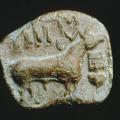
"Sealing or token with impression made from a unicorn seal with script. The back is smooth and rounded, suggesting that this object was a certificate or pass representing the seal owner and not something attached to a bundle of goods. Three script signs appear above a unicorn which stands facing right, with a ritual object or offering placed under a head" writes archaeologist Mark Kenoyer about this object found at Mohenjo-daro. He also writes that "impressions of seals on clay tags and on circular tokens show how the rulers and traders actually used their seals and provide insight into co… >

Ancient City Unearthed

A Wide World Photo news agency photograph with the title given above was dated June 4, 1959. The caption, reflecting then popular conceptions like "invaders," was printed on the back: "For three thousand years a great and peaceful civilization has lain buried and forgotten on the banks of the Indus in what is today Pakistan. Now archaeologists are slowly excavating its capital, the ancient city of Moenjo Daro, a few miles south of Dokri. The city of Moenjo Daro is remarkable in many ways but most of all in its complete absence of fortifications. The assumption has been that the civilisat… >

Knobbed Terracotta Vessel MSR4

"This terracotta vessel with a pronounced knob at the centre has engaged the attention of archaeologists as a "unique find" and was probably used in rituals or ceremonies. Similar vessels have been depicted on Harappan seals and copper plates" according to the ASI description of this object found at Bijnor (MSR 4) in 2017. >

Mundigak at the Guimet, Paris

A brand new slide show has just been opened featuring objects from Mundigak, a little-known Bronze Age [c. 4000-2400 BCE] set of mounds in southern Afghanistan. The objects are now at the Guimet, the French National Museum of Asian Art in Paris. Their similarity to objects and motifs in the ancient Indus Valley is remarkable. Examples include the pipal leaf, a rat trap, the humped bull, a bird whistle and classic goblets the Mundigak excavators called "brandy balloons." There is even a stone sculpture which resembles the "priest-king." This 33 slide section Mundigak @ the Guimet is accompa… >

The Musee Guimet Indus and Amri Collection in Paris

In the summer of 2019, one of the warmest ever in Paris, I managed to slip one afternoon into the Musee Guimet, and click away on my iPhone at objects usually not seen in colour. This French national museum which contains one of the best collections of Asian Art in the world (as one collector of Indian art, Gursharan Sidhu once put it, the French taste in objects from India is second to none). >

A Counting or Prayer Disc?

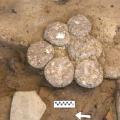
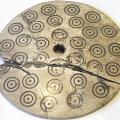
Was this disc from Mohenjo-daro at the National Museum of Pakistan in Karachi used for counting? The circles with dots in the middle are identical to those found on other ivory objects from Mohenjo-daro thought to have been used as counters. >

Etched Carnelian Beads from Chanhu-daro

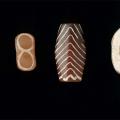
Etched carnelian beads are a hallmark of the Harappan phase and copies of them in different materials are found during this period illustrating their value to the people of the Indus Valley Civilization. Examples of this bead type have also been found in Mesopotamia, Iran and the Gulf and it is believed now that all of these may have been manufactured in the Indus Valley. >

Four Seals Up Close

A visit to the National Museum of Pakistan in Karachi gave me the opportunity to take close shots of four seals from Mohenjo-daro. They show both the exquisite workmanship of Indus craftsmen and the merciless wear, in different degrees, of four thousand years of history. >

Indus Figures at the National Museum, Karachi

On a visit earlier in 2019 to the National Museum of Pakistan in Karachi, an iPhone camera was a welcome companion in trying to bring out something of the character of Indus figurines resident within the large glass vitrines. >

Glimpses of Ganweriwala

The least excavated of the five large known ancient Indus cities – Mohenjo-daro and Dholavira, Harappa and Rakigarhi – is Ganweriwala, discovered in the late 1980s by Rafique Mughal. Deep in the desert, far from towns and close to the Indian border, it is hardly written about. >

An Indus Monkey Figurine

Of all the objects in the National Museum of Pakistan's Indus Gallery in Karachi, none quite so grabs your attention with its innate character as this tiny faience monkey from Mohenjo-daro. >

At the National Museum, Delhi

On a recent visit to Delhi, I found myself free for two hours and made my way in a rickshaw from Jama Masjid to the National Museum. It was a Sunday afternoon. After paying the entrance fee and breathlessly arriving at the Harappan Civilisation doorway, I found that it was closed for renovations! Momentarily dispirited, it turned out that there was another entrance and much of the gallery was still open – disaster averted. >

The Rhinoceros in Indus Times

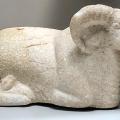
In the excellent new book The Story of India's Unicorns (Marg, 2018), which is all about the rhinoceros in the subcontinent, Shibani Bose writes in the section Evidence from Indus Sites that what "needs to be explained is the presence, and in cases like Kalibangan, the profusion of rhinoceros remains at some of the major urban sites of the civilization. >

Prisoners of War?

Shereen Ratnagar, in her brand new book The Magic in the Image Women in Clay at Mohenjo-daro and Harappa (soon to be reviewed here) offers an interesting conjecture around a set of male figurines found at the two iconic Indus sites. >

Pagination

  • First page
  • Previous page
  • Page 1
  • Page 2
  • Page 3
  • Page 4
  • Page 5
  • Page 6
  • Page 7
  • Page 8
  • …
  • Next page
  • Last page

Blog Posts by Subject (16)
  • Animals
  • Art
  • Children
  • City Life
  • Conferences
  • Crafts and Industry
  • Evolution
  • Excavations
  • Food
  • Homes
  • Media
  • Museums
  • Mysteries
  • News
  • People
  • Seals

follow us

Follow us on Facebook, Twitter and Instagram.
Videos on YouTube.
Occasional Newsletter.

donate

A 31 year-old non-profit serving 30,000 people a day.

© Harappa.com 1995-2026 31