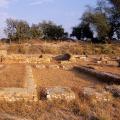
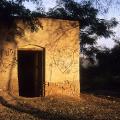
Contemporary guard hut overlooking the "Granary." Many questions about ancient Harappa will never be answered. But with the first modern, multi-disciplinary excavations of an Indus city at Harappa, many misconceptions are being laid to rest and much… >
"My operations did, indeed, reveal portions of a large brick building, but unfortunately they were found to have been so badly hacked about by brick diggers that it is well nigh impossible to determine its real nature or date, Plate VIII, Photo. N… >
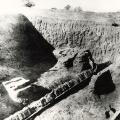
Published in ARASI 1924-25, Plate XXVI (b). Title: ‘Mound B, Pit I, A Long Drain with Gabled Roof’ Description of the find ARASI 1924-1925, pp. 79-80: "Four large pits, each 50’ square were sunk simultaneously in a line in th… >
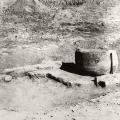
Harappa Platform with large jar in square 2 x 12 in southern portion of Trench A (e). The jar is broken at the top. "2 x 17" is painted on the surface, and this number possibly denotes area of find. Notably, Sahni mentioned a large jar in the … >
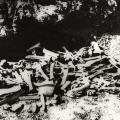
Published in ARASI 1924-25, Plate XXVI (a). Title: ‘Harappa: Mound B, A large collection of animals’ bones’. From “large trench excavated in mound B … behind the Naugaza tomb”, stratum below stratum III, and the collection numbered B. 95… >
Two large fragmentary jars, one of the cylindrical and the other of the bulged type. From Trench Af, Mound F. Both jars are insitu, and broken. The one which appears cylindrical has a field number, which is marked on the side, and it is … >
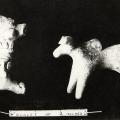
These two photographs are of two terracotta figurines, on the left is a female figurine with a scrolled headdress, and on the right is a humped bull with broken horns. In the first image (ASI no. 416/86) the human head on the left is upside down, an… >
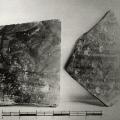
These two pot sherds depict commonly recurring motifs on pottery at Harappa and Mohenjodaro. The sherd on the left has an interlocking circle, while the one on the right has a double-ring with starburst above a band of stripes and triangles. P… >