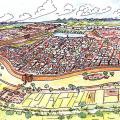
Visualization of ancient Harappa as it may have appeared in late Period 3B/early Period 3C, drawn by J. Mark Kenoyer. The granary and working platforms of Mound F are in the northwestern corner of the city (upper left). >
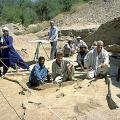
After marking, the entire excavation team is called in to map and eventually collect the bead manufacturing debris and all of the sediment from each layer of Ravi phase floors. >
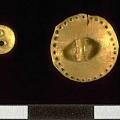
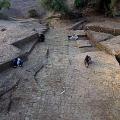
Gold sequins found in the Kot Diji phase street suggest that some people were wearing clothing or paraphernalia decorated with rare and presumably costly materials. >
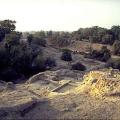
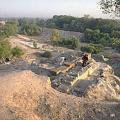
North end of Harappa Mound AB, looking down on the Kot Diji phase levels from the heights above the Harappa phase baked brick wall (on the right) that has been covered with protective plaster for conservation. In the background (to the North) is… >
The reconstructed brick wall is covered each year with a protective coating of clay and straw plaster. The original structure and unexcavated levels remain safely buried beneath a layer of bricks and back dirt. >
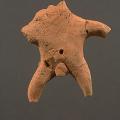
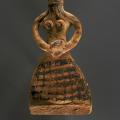
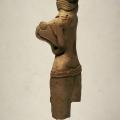
Another style of Early Harappan female figurine holds a round object, possibly a vessel, with both hands at the waist above a flaring lower body which ends in a (broken) forward-extending base. The hair is bound at the back of the head into a tiered… >
The female figurine usually holds the infant's head to her breast with one or both arms encircling the infant. Approximate dimensions (W x H x D): 3.2 x 8.4 x 1.9 cm. >
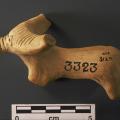
Water buffalo are often similar to figurines of humpless cattle, except that the water buffalo figurines usually have large (and sometimes incised) backswept horns. Approximate dimensions (W x H(L) x D): 6.0 x 8.0 x 6.0 cm. >