Home

Main navigation

  • home
  • slides
  • essays
  • articles
  • books
  • video
  • q & a
  • blog
Secondary menu
  • about us
    • scholars
    • privacy
    • support
    • image rights
    • credits
    • contact us
  • resources

Harappa

Harappa, Punjab ancient Indus civilization excavations, figurines, seals and other objects.

Group of incised baked steatite tablets

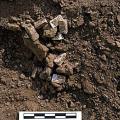
A group of 16 three-sided incised baked steatite tablets, all with the same inscriptions, were uncovered in mid- to late Period 3B debris outside of the curtain wall. (See 56). These tablets may originally been enclosed in a perishable container su… >

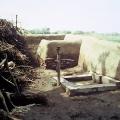
Bathing area and latrine in Harappa town

  • Mohenjo-daro, Bathing area and latrine in Harappa town

The bathing areas and walled latrine are located on the interior edge of the courtyard that touches the street. The drain from the bathinga area runs through the wall and falls directly into the street drain. Piles of firewood and an inverted cookin… >

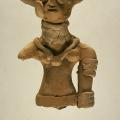
Female figurine with painted ornaments from Harappa

Some of the ornaments on female figurines were accentuated with white and/or black pigment, and some ornaments were completely rendered in pigment. One female figurine has a choker, a necklace, and bangles on the left upper and lower arm, all painte… >

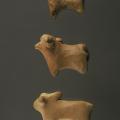
Three Early Harappan zebu figurines from Harappa

The earliest animal figurines from Harappa are Early Harappan (Ravi Phase, Period 1 and Kot Diji Phase, Period 2) zebu figurines. They are typically very small with joined legs and stylized humps. A few of these zebu figurines have holes through the… >

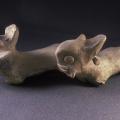
Two feline figurines from Harappa

Other feline figurines with large round ears and beards may represent tigers or lions. They are often depicted either standing or lying down with their legs extended to one side. Approximate dimensions (W x H(L) x D) of the larger figurine: 3.3 x… >

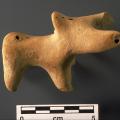
Body of a figurine with a movable head and tail from Harappa

Another figurine that may have been used as a toy is the quadruped, probably a bovine, with a movable head and tail. It usually has pierced projections extending from the base of the neck to secure the (separate) head and neck laterally and a pierce… >

Mysterious circular platforms, Harappa

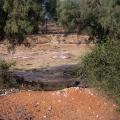
Between Mound AB and Mound F are a number of mysterious circular platforms, originally inside houses and small courtyards. >

Modern town of Harappa

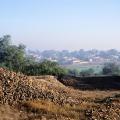
In the distance, the modern town of Harappa survives on another set of mounds. During ancient times they were separated from Mound AB in the foreground by a river channel. Archaeologists suspect that those mounds were also first settled in ancient t… >

Period IIIBC Paleotopography

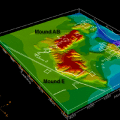
Period 3B and 3C deposits essentially cover the entire modeled area and represent the greatest extent of the ancient urban center. J. M. Kenoyer has developed a model describing some of the processes that contribute to the urban growth at Harappa… >

Unexcavated Areas, Harappa

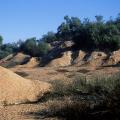
More unexcavated areas at Harappa. >

Pagination

  • First page
  • Previous page
  • …
  • Page 60
  • Page 61
  • Page 62
  • Page 63
  • Page 64
  • Page 65
  • Page 66
  • Page 67
  • Page 68
  • …
  • Next page
  • Last page
© Harappa.com 1995-2026 31