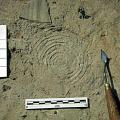
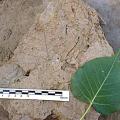
The impressions of a pipal leaf found in the upper clay levels of the drain (shown here with a modern pipal leaf) indicate that what many think was a sacred tree even at that time was growing in the ancient city of Harappa. >
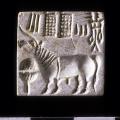
The majestic zebu bull, with its heavy dewlap and wide curving horns is perhaps the most impressive motif found on the Indus seals. Generally carved on large seals with relatively short inscriptions, the zebu motif is found almost exclusively at the… >
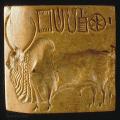
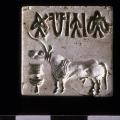
A steatite unicorn seal from Harappa with Indus script. This seal was found in the central area of Mound E and dates to Period 3B or early 3C, around 2450-2200 BCE. When pressed into clay the impression will be reversed. Since the Indus script may h… >
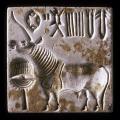
A square steatite unicorn seal with a unique inscription was found in the street debris on the inside of the city wall. The two sets of signs on the right hand side of the seal would appear in reverse, i.e. be on the left, when it was pressed into c… >
Unicorn seal from Trench 37, which lies to the east of the "Granary." This type of seal comes from levels dating to Harappa Phase Period 3B. Similar seals were found near the "granary" in 1997. >
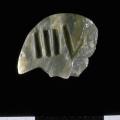
Broken steatite mold carved into a unique fan-shape. (H2001-5069/2913-02). This mold was probably used to make a faience tablet that was found on the eroded slope to the south of the workshop in Trench 54 South (Slide 65). >
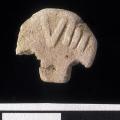
Fan-shaped molded faience tablet found on the eroded slope south of the Trench 54 South workshop. It was probably made using the steatite mold found in the workshop (Slide 64). >