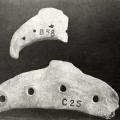
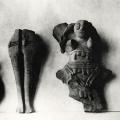
Another class of objects, even if incomplete, were also immediately familiar to Day Ram Sahni: "(16) An earthen instrument for making twines. It is a curved shaped piece with five holes, one of which is broken off. Each hole received a strand, al… >
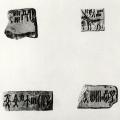
These steatite seals are depicted in Sahni's report for 1923-24, although only only is described and its location provided. The four seals are listed clockwise from the top left. Seal 1: (Sahni Pl XIX, 13)Seal 2: M…>
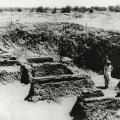
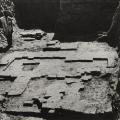
Pit IV showing excavated structures from N.W. Possibly of this structure after its excavation, Sahni reported that the “fourth or the northernmost pit revealed the remains of several structures, the best preserved one of which is a rectangular c… >
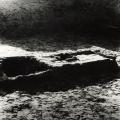
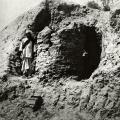
A slightly different photograph of the structure, not so close as in this photograph is published in ARASI 1924-25, Plate XXV (d). Title: ‘Harappa: Mound B, A Double Burial Structure’ Sahni noted: “On the next or third stratum from the t… >
"In the northern portion of this mound, Rai Bahadur Daya Ram Sahni excavated a considerable area (B) in the years 1920-21, 1923-24 and 1924-25. He began by sinking a trial trench 55 ft. long by 20 ft. wide, a little to the west of and parallel to th… >
Note that Trench Bf was subsumed by Trench B over subsequent seasons. "The operations were then shifted to the mound marked A—B in General Cunningham's plan, on the east side of which some trial diggings had been carried out in the year 1920-21… >
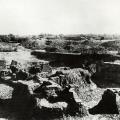
View of the parallel wall area, Mound F, noted subsequently by Vats as the eastern part of the Great Granary. For Sahni’s and Vats’s description of the excavations of this area see Parallel Walls. See Plate III Vats 1940 Vol II, for a ‘Plan of… >
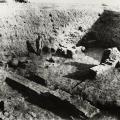
View of Pit I, in southern portion of Section of B, Mound AB, showing remains of brick lined structures and a few large earthen jars insitu. Sahni reported: “Four large pits, each 50' square, were sunk simultaneously in a line in the sou… >
Three are female, the fourth, second from left is of the lower part of a finely modelled figure. Find no. A 127. Right: has a thick braid. Second from right: wears “a distinctive headdress which rises fan like from back of the head… a close fi… >
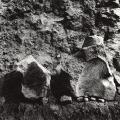
The back of two stone pieces in Stone Objects. Possibly the two blocks of grey and red sandstones, B. 1514 and B. 1515 (cf. ARASI 1924-25, p. 79) B.1515 was noted by Vats as “carved somewhat in the shape of a tortoise shell” (Vats 194… >