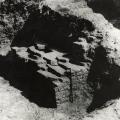
View of Pit II, Mound AB, showing parts of a brick structure with a label, PII 99. About the excavations of Pit II in Mound AB, Sahni reported: “No structural remains were met with in this trench until the excavation reached the depth of 12’, whe… >
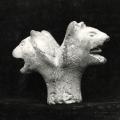
Published in ARASI 1924-25, Plate XXVII (f), with the ‘cone’ base. Title: ‘Double-headed Terracotta bust of a Lion’ Published in Vats 1940, Vol. II, Plate LXXIX, 88. Described as ‘A Jugate Tiger Head’ The field number of this object … >
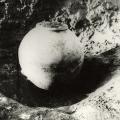
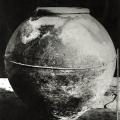
Circular Hearth in Eastern Part of Trench A (f) from S.E. View of a large globular pot. Sahni reported a “large heap of ashes mixed with charred bones” from Trench A (f) [p. 75], and described the excavations at this area as: “In the area b… >
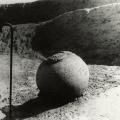
Earthen chati filled with earth containing several bones. Pot insitu filled with several bones, Pit II. Field no on the jar PII 84. A walking cane placed near the jar represents the scale for height. Of Pit II, in Mound AB, Sahni n… >
"Four trial trenches were dug in site F in places which appeared most favourable for examination. One of them to the west of the main trench disclosed at the depth of about 8 feet a well-preserved water reservoir lined with brick and provided with a… >
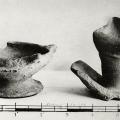
These two clay lamps were photographed together, however one (A419) was found in Mound F, and the other (Bg3) was found in Mound A-B. There are three photographs of these lamps, with subtle differences. E.g two of them include photographic scale… >
View of a trench with structures, which comprise bricks. Sahni excavated four pits in section B of Mound AB. For description see ARASI 1924-25, pp. 79-80. Note: The exact location of the area photographed is unclear. >
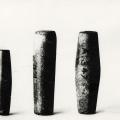
Three long terracotta objects; the find number of the one in the right: A 347. NOTE: The find numbers on the back of the photograph are A 347, B IV 48, AB 81. >
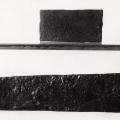
Two copper objects, in two rows. The one on top row has a design etched on it. The one in the bottom row is possibly the copper chisel, which Sahni reported among the finds from Mound F, area of parallel wall: “a large copper chisel (Ae 342) mea… >
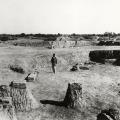
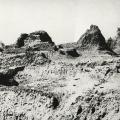
Looking from the northeast to the southwest, this photo shows the plinths left from the excavation of this area. The reason for not excavating these large sections may be due to the fact that there were traces of walls at the uppermost levels. Late… >