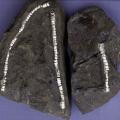
Fragments of a steatite bead necklace recovered from the floor of a house dating to the Ravi Phase (circa 3100 BCE, see 9). The beads have been fired and glazed. >
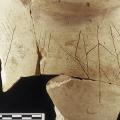
Many large storage jars of the Harappa Phase (2600-1900 BCE) have writing inscribed along the upper portion of the vessel. This inscription includes a figure of a man with the bow and arrow sign in each hand. It is impossible to shoot two bows and a… >
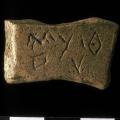
Most inscribed sherds are part of larger vessels that were inscribed and then broken. This object (c. 2300 BCE) was inscribed as a sherd. It is clear that broken sherds were occasionally used as a form of "scrap paper" to send notes or serve as temp… >
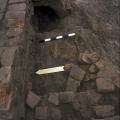
A small pot was found on the floor just to the west of the large globular vessel (the big hole in the wall is where it once sat). In the foreground are other large jars set into the floor and used as hearths or garbage pits. Trench 38, Late Harappan… >
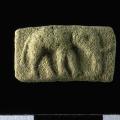
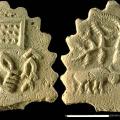
This unique mold-made faience tablet or standard (H2000-4483/2342-01) was found in the eroded levels west of the tablet workshop in Trench 54. On one side is a short inscription under a rectangular box filled with 24 dots. The reverse has a narrativ… >
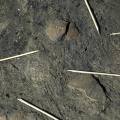
A high concentration of tiny steatite bead blanks was found on an ashy floor near the kiln dump in Trench 54. Each (modern) bamboo piece is pointing at one bead. >
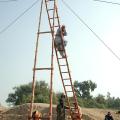
J. Mark Kenoyer using the bamboo ladder to get an overview of the excavation area in Trench 54 South. Photography is done using digital, film, and video cameras. >
In order to glaze faience it must be fired at approximately 940 degrees Celsius for several hours. The red color of the glowing faience barely visible inside the canister indicates that this temperature has been reached. This was confirmed by using … >
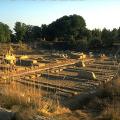
Overview of the "granary" area looking towards the southeast. The walls have been partly restored for conservation purposes by the Department of Archaeology and Museums, Government of Pakistan. >