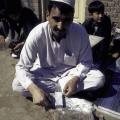
The technique for making tiny beads is still practiced by craftsmen today. Mullah Ashoor from Peshawar is seen grinding a string of tiny steatite beads that will later be fired to make them hard >
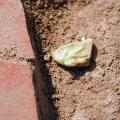
Faience tablet fragment (H2001-5064/2373-01) with glaze still quite well preserved. The bright greenish blue glaze is usually not preserved on artifacts that have eroded from the Trench 54 South workshop. >
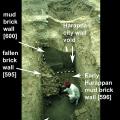
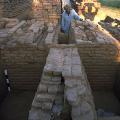
View of excavations on the west side of Trench 54 where brick robbers had removed several massive Harappan Period baked brick walls (c. 2600-1900 BC, Harappa Period 3). At the bottom of the brick robber trench are remains of the Harappan walls and a… >
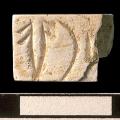
A broken steatite tablet (H97-3431/7615-01) was recovered from deposits just below the fired brick revetment of the "granary" platform and dates to Harappa Period 3B (2450-2200 BC). >
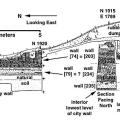
Excavations were conducted in the narrow space running west from the buttresses and between the interior walls to determine what was inside of the "granary" structure. >
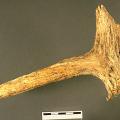
Part of an antler, including the burr and the brow tine, shed from a large deer, probably sambhar (Cervus unicolor) or swamp deer (Cervus duvauceli) (H99-3828/8763-01 from Trench 43). This specimen may have been used as a pick or possibly a punch fo… >
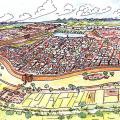
Visualization of ancient Harappa as it may have appeared in late Period 3B/early Period 3C, drawn by J. Mark Kenoyer. The granary and working platforms of Mound F are in the northwestern corner of the city (upper left). >
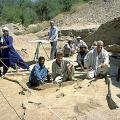
After marking, the entire excavation team is called in to map and eventually collect the bead manufacturing debris and all of the sediment from each layer of Ravi phase floors. >