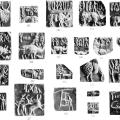
[Original 1931 text] This animal also rarely appears on the seals, Nos. 341-7 being the only examples that we have as yet. In every case it is the single horned animal that is represented, probably the great Indian rhinoceros which was formerly foun… >
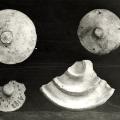
A number of miscellaneous objects emerged during excavations on Mound F, which contributed the majority of artifacts catalogued in the 1921 ASI report by Daya Ram Sahni. Among these were what he called lids and covers for crucibles – "shallow bowls … >
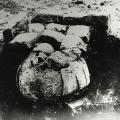
Published in Vats 1940, plate XCII, No 296. The published version is the other way up. Title: Seal Found in Mound AB. Vats noted the provenance as: “In squares P 18/11 and 12 are the remains of an oblong room measuring 14 by 12 ft. internal… >
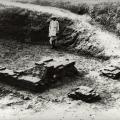
Published in Vats 1940, Vol. II, Plate XXXIV (d). Title: ‘Pit III Fragmentary Remains, from North-West’. Of Pit III in Mound AB Sahni noted: “Four large pits, each 50' square, were sunk simultaneously in a line in the southern portion of mo… >
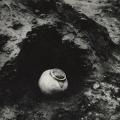
A (e) 308 earthen jar lying to the east of earlier sepulchre in trench A (e). A jar insitu. For Sahni’s description of trench A (e) in Mound F, and its contents, see ARASI 1924-25, pp. 75-76. There is no mention of this eart… >
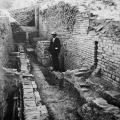
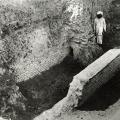
The section above the wall shows the remains of a deep pit left by the brick robbers. Often when the digging got too deep, they just abandoned the removal of bricks and left the lowest levels of the wall intact. The workman is standing next to a cro… >