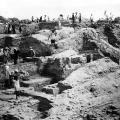
REM Granary Overview of the REM Granary excavations, viewed from the northwest. The fired brick mass of the western slope is visible at the right. No. 91 Also "1101" penciled on back >
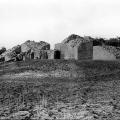
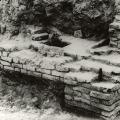
ACC - Citadel Gateway Southeast Overview of excavated remains of the so-called city wall and gateway at the southeast edge of the citadel mound at Mohenjodaro. This structure was interpreted as a postern gate, with associated rooms and massive fire… >
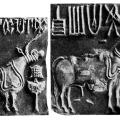
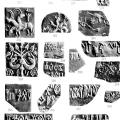
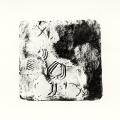
[Original text] "The animal most often represented on the seals is the apparently single-horned beast . . .. There is a possibility, I think, that the artist intended to represent one horn behind the other. In other animals, however, the two horns a… >
[Original 1931 text] This animal is on fifteen of the seals, Nos. 362-76. In fact, it may be said to rank next in order of popularity to the bull. On most of the seals it is carefully portrayed, in some cases even to the wrinkles along its back. . … >
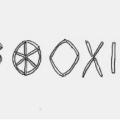
A 10 lettered signboard found in the western chamber of North Gate of Castle, (c. 2500-1900 BC). There are ten symbols in the panel. One symbol has been repeated four times. These symbols are indicative of use in Stage IV of Harappan Culture. These … >
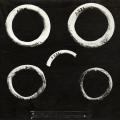
Among the objects found in the large earthen chati [A 233] and a second example which would have been most familiar to Daya Ram Sahni were "earthenware bangles of various sizes were found in large abundance. A few complete specimens were fo… >
These three seals all have the same unicorn animal motif and a ritual container placed below the head of the animal. The script location and carving styles indicate that the seals belong to different time periods. The right hand seal probably dates … >
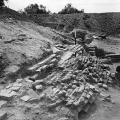
Sculpture in thickness of wall in the N.E. corner of pit II from S.E. The photograph is of brick structure, with a label PII 99. No sculpture is visible. PII is Pit II, AB Mound, and Sahni stated that: “No structural remains were met with in t… >