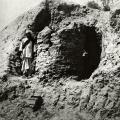
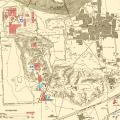
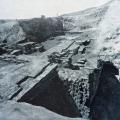
Note that Trench Bf was subsumed by Trench B over subsequent seasons. "The operations were then shifted to the mound marked A—B in General Cunningham's plan, on the east side of which some trial diggings had been carried out in the year 1920-21… >
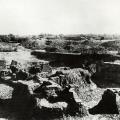
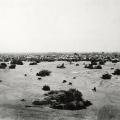
View of the parallel wall area, Mound F, noted subsequently by Vats as the eastern part of the Great Granary. For Sahni’s and Vats’s description of the excavations of this area see Parallel Walls. See Plate III Vats 1940 Vol II, for a ‘Plan of… >
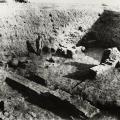
View of Pit I, in southern portion of Section of B, Mound AB, showing remains of brick lined structures and a few large earthen jars insitu. Sahni reported: “Four large pits, each 50' square, were sunk simultaneously in a line in the sou… >
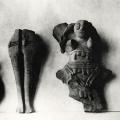
Three are female, the fourth, second from left is of the lower part of a finely modelled figure. Find no. A 127. Right: has a thick braid. Second from right: wears “a distinctive headdress which rises fan like from back of the head… a close fi… >
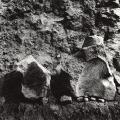
The back of two stone pieces in Stone Objects. Possibly the two blocks of grey and red sandstones, B. 1514 and B. 1515 (cf. ARASI 1924-25, p. 79) B.1515 was noted by Vats as “carved somewhat in the shape of a tortoise shell” (Vats 194… >
"Mound F is the northernmost mound on the site, and measures roughly 780' from north to south by 970', from east to west. At the time of General Cunningham’s visit the height of this mound was 2.5 to 30 feet above the surrounding land, and it is still about the same." >
"The number of strata varies considerably in different mounds which are not all contemporary with each other. In the present state of our knowledge their dating can hardly be definite. At best it must be rough and provisional, with a fair margin for error when accounting for the upper and lower limits of the culture1 at Harappa as revealed up till now. On the basis of the evidence regarding the chronology of Mohenjo-daro, which has been so ably discussed Comparative by Sir John Marshall,2 I tabulate below the tentative and comparative age of Mounds F, AB, Areas J and G, and of the Cemetery H. >
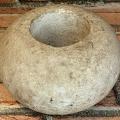
While it may be surmised that these two circular stones are well-placed in the yoni display case (see linga for Marshall's discussion), Dr. Kenoyer writes of these objects (Ancient Cities , p. 109): "The circle is also a protective symbo… >
ON THE OTHER NEWLY DISCOVERED PREHISTORIC SITE IN INDIA, CCCUPIED FOR MANY HUNDREDS OF YEARS BEFORE THE THIRD CENTURY B.C: EXCAVATIONS AT HARAPPA, IN THE PANJAB >