HARP (Harappa Archaeological Research Project) a group of scholars from a variety of fields dedicated to advancing the study of the ancient Indus Valley civilization.
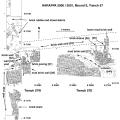
Deep digging at the southeast corner of the "granary" revealed an earlier building [wall 330] constructed along the same east-west alignment. This structure could have been built as early as the beginning of Period 3B, ca. 2450 BC. The currently vis… >
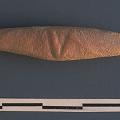
Unique cylindrical object made of maroon and white faience from Harappa (H99-3856/8756-26 from Trench 43, length = 21.9 mm). Numerous examples of this identical type of bead have been found in other parts of Harappa, but this may have been where the… >
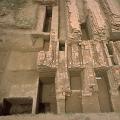
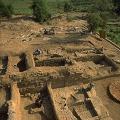
Overview of Trench 43 in 2000 looking north, showing the HARP-exposed circular platform in the foreground and the "granary" area in the background. Note the wall voids to the west, south, and east of the circular platform (see also image 86) >
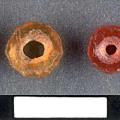
Many broken and unfinished stone beads of carnelian (red-orange) and amazonite (blue-green) were found in the floor levels associated with the Ravi phase pits and hearths. (See also slide 119.) >
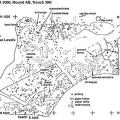
This plan shows concentrations of bead manufacturing debris on several superimposed Ravi phase floor levels that indicate the positions of actual work areas. >
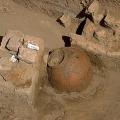
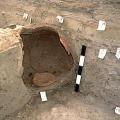
At the bottom of the Kot Diji phase storage vessel was a broken lid and charcoal that was used for dating the fill inside the pot. There is a 91 percent chance that the date obtained from this charcoal falls between 2602 and 2445 radiocarbon years B… >
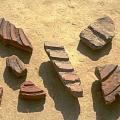
Fragments of a grooved red sandstone object or objects were found in the upper disturbed levels of Mound AB, Trench 39N. Similar fragments were recovered in the excavations by Rai Bahadur Daya Ram Sahni in 1921-22, but so far none of them fit togeth… >