HARP (Harappa Archaeological Research Project) a group of scholars from a variety of fields dedicated to advancing the study of the ancient Indus Valley civilization.
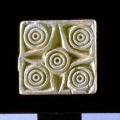
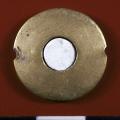
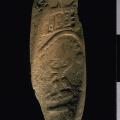
On this Kot Diji phase steatite button seal from Harappa (H2000-4495 / 9597-01), traces of blue-green glaze can be seen (upper center and left center). Similar seals have been found at other Kot Diji period sites and even in distant Central Asia. >
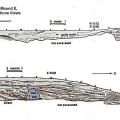
Cross-sections inside (top) and outside (bottom) of perimeter wall [250]. The wall itself, being of mud-brick, was heavily eroded, sometimes to a lower elevation than the adjoining more densely packed street debris. As can be seen in the bottom cros… >
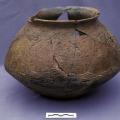
Cooking pots during the Ravi Phase were made in large globular shapes that had a low center of gravity to keep them from tipping over when filled with food. In order to protect the fine clay from cracking due to the heat of the fire, the exterior wa… >
Fired steatite beads appear to have been extremely important to the Indus people because they were incorporated into exquisite ornaments, such as this "eye bead" made of gold with steatite inlay found in 1995 at Harappa [Harappa Phase]. >
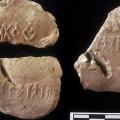
Three clay sealings from the Harappa Phase levels (2600-1900 BCE) that may have come from large bundles of goods shipped to the site from a distant region. The clay does not appear to be the same type of clay as found near Harappa and each sealing h… >
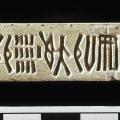
This type of seal is only found in the last part of the Harappan Phase, Period 3C. A similar rectangular seal was found on Mound F in the 1998 excavations of the circular platforms (Trench 43). >
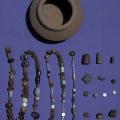
In the end, the small Late Harappan Period Pot yielded 133 beads and other decorative objects. Although left behind by a bead collector at almost 1700 BCE, the wide variety of beads and other objects found inside the pot belong to all periods of Har… >
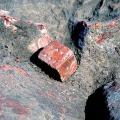
After mapping and photography, the fragile mud brick walls of Trench 54 are covered with a protective layer of burlap and sifted soil to form a sacrificial layer in which dissolved salts can dry and crystallize without damaging the ancient walls. Th… >
Twisted terra cotta tablet (H2000-4441/2102-464) with a mold-made inscription and narrative motif from the Trench 54 area. In the center is the depiction of what is possibly a deity with a horned headdress in so-called yogic position seated on a sto… >