HARP (Harappa Archaeological Research Project) a group of scholars from a variety of fields dedicated to advancing the study of the ancient Indus Valley civilization.
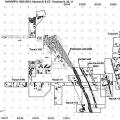
Plan view of the east side of Mound E and the west side of Mound ET showing areas excavated between 1993 and 2001 (Trenches 9, 10, 11). The massive perimeter wall of Mound E encloses architectural remains of Harappa phase Periods 3B and 3C and proba… >
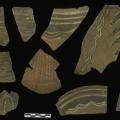
All pottery from the first part of the Ravi Phase was hand built. Most of the forms were finely made shallow bowls, deep bowls, narrow-mouthed carinated vessels, or thick walled cooking pots. >
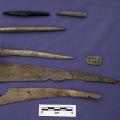
Bone tools from the Ravi Phase levels at Harappa ( c. 3300-2800 BCE) include projectile points (top three objects), a bone awl that may have been used for making basketry (middle) and polished rib fragments that may have been used in weaving. The pe… >
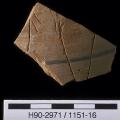
On some sherds, two signs of the Early Indus script (Kot Dijian Phase) appear together. The complete shapes of these signs can be seen on later seals carved with the Indus script (see 43). The sign on the left eventually becomes one of the most com… >
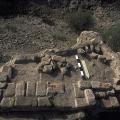
Cemetery H house wall and floor level dating to around 1700 BCE Complete bricks used to make the wall indicates an active brick industry rather than the decline previously assumed. >
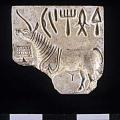
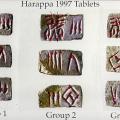
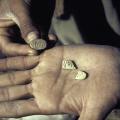
High concentrations of objects such as these terra cotta seal and faience tablets indicate the significance of this part of the site (Trench 54 area) for obtaining further insights on the manufacture and use of inscribed pieces. >