HARP (Harappa Archaeological Research Project) a group of scholars from a variety of fields dedicated to advancing the study of the ancient Indus Valley civilization.
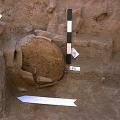
Excavation of the fill inside the jar (image 33) indicates it was left exposed for some time and gradually filled with silt as the room became covered with debris (Trench 41NE). >
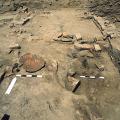
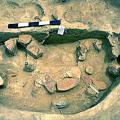
A broken terracotta bird cage (near the scale at right) was discovered next to the remains of a broken storage jar that had been reused as a hearth (near the scale at left) (Trench 43). >
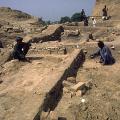
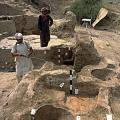
Pakistani excavators working in Trench 43. The man on the right has just discovered a spherical agate weight (image 68) while cleaning the section for photography. >
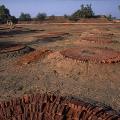
Circular platforms in the southwestern part of Mound F excavated by M.S. Vats in the 1920s and 1930s, as conserved by the Department of Archaeology and Museums, Government of Pakistan. >
This large Ravi phase pit was filled with domestic trash and some bead making debris. The broken amazonite bead in (8) can be seen just above the scale inside the pit to the lower right of the image. >
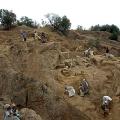
Harappa Mound AB, Trench 39N, showing the Kot Diji phase (Period 2, ca. 2800-2600 BC) and later levels during excavation. The surveying tripod is standing next to two Kot Diji phase kilns, and the rod is leaning against a later Harappa phase baked b… >
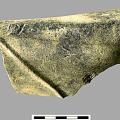
Carved stone fragment of what may be the leg of a composite sculpture, possibly of a large bull. This fragment came from Mound AB, Trench 39N (H98-3475 / 8306-2). No monumental sculptures of the Indus period have been identified, but this object sug… >
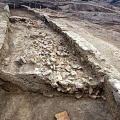
Deposits of building debris and household rubbish were discarded over the perimeter wall into the open area below and were retained by the curtain wall. This infilling probably took place toward the end of Period 3B when the perimeter wall was being… >
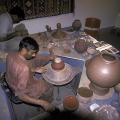
Mohammad Nawaz, master potter from Harappa, demonstrates how fish scale and intersecting circle motifs may have been painted onto Harappan pottery. Here he is demonstrating at the Elvehjem Museum of Art in Madison, Wisconsin, USA during the major ex… >