Home

Main navigation

  • home
  • slides
  • essays
  • articles
  • books
  • video
  • q & a
  • blog
Secondary menu
  • about us
    • scholars
    • privacy
    • support
    • image rights
    • credits
    • contact us
  • resources

HARP (Harappa Archaeological Research Project) a group of scholars from a variety of fields dedicated to advancing the study of the ancient Indus Valley civilization.

Ravi Phase Motifs

Whereas many other motifs of the Ravi Phase (Period 1) disappear in the later Kot Diji Phase (Period 2), the intersecting circle and fish scale motifs continued to be used, but they came to be executed in black paint on a red slip. In this image the… >

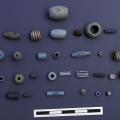
Steatite beads

Steatite beads from the Early Harappan Periods at Harappa. On the right are many different styles of Ravi Phase beads (circa 3300-2800 BC). Note the blue green glazed bead in the center and the row of unfired beads in the second to the bottom row. T… >

Inscribed storage jar

Many large storage jars of the Harappa Phase (2600-1900 BCE) have writing inscribed along the upper portion of the vessel. This inscription includes a figure of a man with the bow and arrow sign in each hand. It is impossible to shoot two bows and a… >

Inscribed sherd, Harappa Phase

Most inscribed sherds are part of larger vessels that were inscribed and then broken. This object (c. 2300 BCE) was inscribed as a sherd. It is clear that broken sherds were occasionally used as a form of "scrap paper" to send notes or serve as temp… >

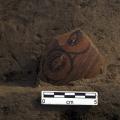
Small pot

A small pot was found on the floor just to the west of the large globular vessel (the big hole in the wall is where it once sat). In the foreground are other large jars set into the floor and used as hearths or garbage pits. Trench 38, Late Harappan… >

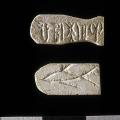
Elephant faience tablet

Faience tablet (H2000-4387/2089-02), found during surface collecting, depicts an elephant on one side and has script on the reverse (not shown). >

Unicorn sealing

Low fired sealing in terra cotta of a unicorn seal from the Trench 54 area (H2000-4453/2174-192). This type of clay sealing was used to seal bundles of goods for transport. >

Terra cotta pestle

A terra cotta pestle that may have been used for sanding wooden planks was found discarded along with broken pottery in an early Harappan Period 3B deposit in Trench 54. >

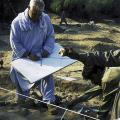
Indus steatite tablets

Fragile steatite tablets are exposed under the skilled hands of trained excavators using small pointed bamboo sticks and brushes. >

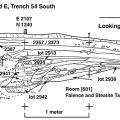
Stages of faience tablet manufacture

Stages in the manufacture of faience tablets. First it is necessary to make the faience paste and the steatite molds. Then the paste is formed into a rectangle and impressed on both sides by the molds. Finally the molded tablets must be dried slowly… >

Pagination

  • First page
  • Previous page
  • …
  • Page 7
  • Page 8
  • Page 9
  • Page 10
  • Page 11
  • Page 12
  • Page 13
  • Page 14
  • Page 15
  • …
  • Next page
  • Last page
© Harappa.com 1995-2026 31