Home

Main navigation

  • home
  • slides
  • essays
  • articles
  • books
  • video
  • q & a
  • blog
Secondary menu
  • about us
    • scholars
    • privacy
    • support
    • image rights
    • credits
    • contact us
  • resources

Seals

Seals and tablets with inscriptions from the ancient Indus Valley Civilization.

Pipal Leaves: Revisited

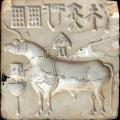
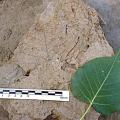
The impressions of a pipal leaf found in the upper clay levels of a drain in Harappa, shown here with a modern pipal leaf, indicate that what many think was a sacred tree was growing in the ancient city of Harappa even at that time. A well at Mohenjo-daro, a sealing from the city and the pipal motif on a unicorn seal are other examples of this critical motif in Indus culture. See also Unicorn and Pipal Tree Seal. >

Seals and Sodalities

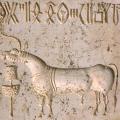
"Thus the main motifs of the seal tablets emphasize two cultural phenomena. The first is that there was a rich mythopetic basis for the use of these motifs. The second is that the main motifs emphasize pan-settlement relationships, i.e. something held in common by the society at large, namely, the sodality to which the individual belonged. In contrast, we can assume that the Harappan writing identifies the indivudual who bears the seal tablet since the sign order is rarely duplicated. Here then is a clue to the meaning of the writing as it appears on seal tablets. With high probability it des… >

Four Seals Up Close

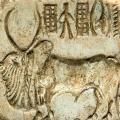
A visit to the National Museum of Pakistan in Karachi gave me the opportunity to take close shots of four seals from Mohenjo-daro. They show both the exquisite workmanship of Indus craftsmen and the merciless wear, in different degrees, of four thousand years of history. >

The Chimaera: Revisited

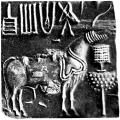
Further to the discussion of chimeras, among the first unicorn seals found by John Marshall at Mohenjo-daro in the 1920's was this one. He wrote: "The animal most often represented on the seals is the apparently single-horned beast ... There is a possibility, I think, that the artist intended to represent one horn behind the other. In other animals, however, the two horns are shown quite distinctly. In some respects the body of this beast, which is always a male, resembles that of an antelope of heavy build, such as the eland or oryx, and in others that of an ox. The long tuffed tail may belo… >

Unicorn Amulet Seal

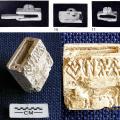
Only a few specimens of this unicorn amulet-type seal have been found. One was during Marshall's excavations at Mohenjo-daro in the 1920s (top), another at Dholavira a few years ago (bottom). It appears to have been worn around the neck, and have had room for something to be put inside. Although Marshall himself did not favor the amulet theory, he wrote of one of these seals: "The amulet theory finds some support, however, in the shape of ... [a] seal [which] measures 0.77 in. square and 0.3 in. thick, excluding its boss. The interior has been carefully hollowed out to form a compartment … >

Bos Indicus

"The humped bull (Bos indicus) has a long and special association with India. Its association with Siva, its all pervading holiness and its basic usefulness in agriculture and commerce for than four millennia are too well known to need description. Its peculiar importance extends back to prehistoric times." >

A Passport from Mohenjo-daro?

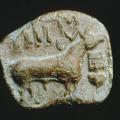
"Sealing or token with impression made from a unicorn seal with script. The back is smooth and rounded, suggesting that this object was a certificate or pass representing the seal owner and not something attached to a bundle of goods. Three script signs appear above a unicorn which stands facing right, with a ritual object or offering placed under a head" writes archaeologist Mark Kenoyer about this object found at Mohenjo-daro. He also writes that "impressions of seals on clay tags and on circular tokens show how the rulers and traders actually used their seals and provide insight into co… >

Steatite Unicorn Seal

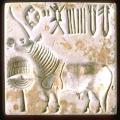
A steatite unicorn seal from Harappa with Indus script and dating to around 2450-2200 BCE. When pressed into clay the impression will be reversed. Since the Indus script may have been read from right to left, the last two signs visible at the top right hand edge of the seal would in fact be the last two signs of the inscription. See also Four Unicorns and A Unicorn Seal. >

The First Seal

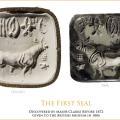
The first seal, found at Harappa before 1872. Included in The British Museum's A History of the World in 100 Objects, a nice podcast of the chapter on this black stone unicorn seal is available for free at bbc.co.uk (Episode 16, Indus seal). Sir Alexander Cunningham, who led the first excavations there in 1872-73 and published news of the seal, wrote 50 years before we understood that the Indus civilization had existed: "The most curious object discovered at Harappa is a seal, ... The seal is a smooth black stone without polish. On it is engraved very deeply a bull, without a hump, looking to… >

Indus Cylinder Seals

  • Impression of a Harappan cylinder seal from Kalibangan

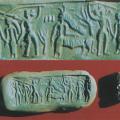
"The cylinder seals of Mesopotamia constitute her most original art," wrote the scholar Henri Frankfort, and much the same has been said about the very different square stamp seals used by the ancient Indus civilization. Cylinder seals are "small, barrel-shaped stone object[s] with a hole down the center, rolled on clay when soft to indicate ownership or to authenticate a document . . . used chiefly in Mesopotamia from the late 4th to the 1st millennium BCE." Many of the handful of cylinder seals found at ancient Indus sites or Mesopotamian ones with Indus themes are collected below. 1. I… >

Pagination

  • First page
  • Previous page
  • Page 1
  • Page 2
  • Page 3
  • Page 4
  • Page 5
  • Page 6
  • Next page
  • Last page
Blog Posts by Subject (16)
  • Animals
  • Art
  • Children
  • City Life
  • Conferences
  • Crafts and Industry
  • Evolution
  • Excavations
  • Food
  • Homes
  • Media
  • Museums
  • Mysteries
  • News
  • People
  • Seals
© Harappa.com 1995-2026 31