Home

Main navigation

  • home
  • slides
  • essays
  • articles
  • books
  • video
  • q & a
  • blog
Secondary menu
  • about us
    • scholars
    • privacy
    • support
    • image rights
    • credits
    • contact us
  • resources

Seals

Seals and tablets with inscriptions from the ancient Indus Valley Civilization.

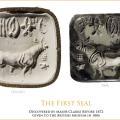
The First Seal

The first seal, found at Harappa before 1872. Included in The British Museum's A History of the World in 100 Objects, a nice podcast of the chapter on this black stone unicorn seal is available for free at bbc.co.uk (Episode 16, Indus seal). Sir Alexander Cunningham, who led the first excavations there in 1872-73 and published news of the seal, wrote 50 years before we understood that the Indus civilization had existed: "The most curious object discovered at Harappa is a seal, ... The seal is a smooth black stone without polish. On it is engraved very deeply a bull, without a hump, looking to… >

Indus Cylinder Seals

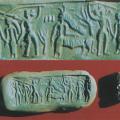
  • Impression of a Harappan cylinder seal from Kalibangan

"The cylinder seals of Mesopotamia constitute her most original art," wrote the scholar Henri Frankfort, and much the same has been said about the very different square stamp seals used by the ancient Indus civilization. Cylinder seals are "small, barrel-shaped stone object[s] with a hole down the center, rolled on clay when soft to indicate ownership or to authenticate a document . . . used chiefly in Mesopotamia from the late 4th to the 1st millennium BCE." Many of the handful of cylinder seals found at ancient Indus sites or Mesopotamian ones with Indus themes are collected below. 1. I… >

A Toponym in Chanhu-daro?

Can potential place-names in Indus inscriptions be isolated? Dr. Asko Parpola, in by far best single book on the subject, Decipering the Indus Script, after discussing how place names survive in people's names in Dravidian-speaking South India today, where "the name of the ancestral village often forms the first element of a person's proper name," continues by saying that "a similar survival of Harappan place-names in the Greater Indus Valley is not at all unlikely (§ 9.4). >

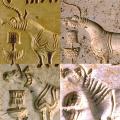
4 Unicorns

Richard H. Meadow at Harvard wrote in response to a question about whether the so-called unicorn seal depicts a mythical animal or a composite: "Some believe the one, some the other. There is no evidence for any unicorn - one horned beast - from the faunal record. A third belief is that it was a wild ox with the horns shown in profile. That is possible, although if so it is idealized and perhaps a conventional depiction. I go for either the depiction being of a mythical animal or of an ox with head in profile produced according to a particular convention - not necessarily an either/or interpr… >

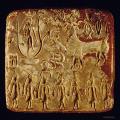
The Pleiades Seal

This seal from Mohenjo-daro contains, perhaps more compactly than any other, what we can tell of ancient Indus beliefs and traditions. Several script signs are interspersed with the figures along the top of the seal and a single sign is placed at the base of the tree. This scene may represent a special ritual sacrifice to a deity with seven figures in procession. The seal has a grooved and perforated boss and the edges are worn and rounded from repeated use. It shows a deity with horned headdress and bangles on both arms, standing in a pipal (sacred fig) tree and looking down on a kneeling… >

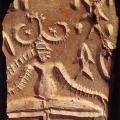
Yogic Deity M-305

"Astronomy, including the use of a star calendar, played an important role in ancient Mesopotamia, and deeply influenced its religion: all the main gods were symbolized by particular stars or planets. In West Asia, one or two "star" symbols placed near the head distinguished divinities in pictorial representations. The practice seems to have been borrowed by the Indus civilization, for a seal from Mohenjo-daro depicts an Indus deity with a star on either side of his head enclosed by a pair of curved horns. (Asko Parpola, The Roots of Hinduism, p. 272). Elsewhere he writes: "Indus signs (in… >

Cracking the Indus Code

A recent VOX Unexplainable podcast featuring Prof. Rajesh Rao (University of Washington, Seattle) offers a broad overview of ancient Indus script research and where we are today. >

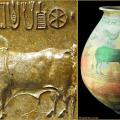
Grand and Rare Zebu Bull Motif

The grand and rare humped zebu (bos indicus) motif on a pot from Nausharo (ca. 2600-2500 BCE) and on a square steatite seal from Mohenjo-daro (ca. 2500 BCE). Note how similar they are. The majestic zebu bull, with its heavy dewlap and wide curving horns is perhaps the most impressive motif found on the Indus seals. Generally carved on large seals with relatively short inscriptions, the zebu motif is found almost exclusively at the largest cities of Mohenjo-daro and Harappa. The rarity of zebu seals is curious because the humped bull is a recurring theme in many of the ritual and decorat… >

An Indus Boat Seal

  • An Indus Boat Seal

An unfired steatite seal and sealing of a boat found at Mohenjo-daro. A close and insightful reading by Ernest J.H. Mackay reads "Seal 30 ... was found in two pieces. It is rectangular in shape and incomplete motif on the back consists of roughly scratched lines that cross one another... The face is nearly complete and it clearly bears a representation of a ship, the first of its kind to be found one a seal from Mohenjo-daro... Why representations of boats and ships are so rare it is difficult to explain, as it is more than probable that the river Indus was largely used for traffic of all kin… >

Two Clay Sealings from Harappa

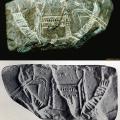
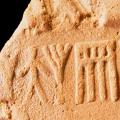
1. A clay sealing from the Harappa Phase levels (2600-1900 BCE) that may have come from a large bundle of goods shipped to the site from a distant region. The clay does not appear to be the same type of clay as found near Harappa and has the impression of two different seals. 2. A clay sealing from the Harappa Phase levels (2600-1900 BCE) that may have come from a large bundle of goods shipped to the site from a distant region. The clay does not appear to be the same type of clay as found near Harappa and has the impression of two different seals. >

Pagination

  • First page
  • Previous page
  • Page 1
  • Page 2
  • Page 3
  • Page 4
  • Page 5
  • Page 6
  • Next page
  • Last page
Blog Posts by Subject (16)
  • Animals
  • Art
  • Children
  • City Life
  • Conferences
  • Crafts and Industry
  • Evolution
  • Excavations
  • Food
  • Homes
  • Media
  • Museums
  • Mysteries
  • News
  • People
  • Seals
© Harappa.com 1995-2026 31