Home

Main navigation

  • home
  • slides
  • essays
  • articles
  • books
  • video
  • q & a
  • blog
Secondary menu
  • about us
    • scholars
    • privacy
    • support
    • image rights
    • credits
    • contact us
  • resources

Seals

Seals and tablets with inscriptions from the ancient Indus Valley Civilization.

Rare White Marble Cylinder Seal from Jiroft

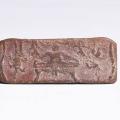
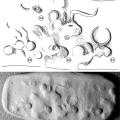
A rare white marble cylinder seal from Jiroft. A brand new paper by Massimo Vidale and Dennys Frenez, Indus Components in the Iconography of a White Marble Cylinder Seal from Konar Sandal South (Kerman, Iran) provides a detailed analysis of this seal found at the recently discovered site of Jiroft . Well used, and apparently worn at the wrist, it testifies to the multiple cultural and trade connections between the Indus civilization and its western neighbors. It also suggests many more discoveries and insights into Indus civilization will come from material found at and connected to Jiroft. … >

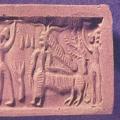
The Harappan Goddess of War?

"The Harappans had a goddess of war connected with the tiger, another large feline that was once native to the Indus Valley. On a cylinder seal from Kalibangan, a goddess in long skirt and plaited hair holds the hands of two warriors in the process of spearing each other." >

Seal with Two-Horned Zebu Bull

  • Courtesy of The Cleveland Museum of Art, J. H. Wade Fund 1973.160.

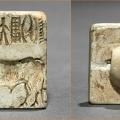
"At their best, it would be no exaggeration to describe them as little masterpieces of controlled realism, with a monumental strength in one sense out of all proportion to their size and in another entirely related to it," wrote Sir Mortimer Wheeler. Seal with Two-Horned Zebu Bull and Inscription, ca. 2000 BCE. As Mark Kenoyer writes "The majestic zebu bull, with its heavy dewlap and wide curving horns is perhaps the most impressive motif found on the Indus seals. Generally carved on large seals with relatively short inscriptions, the zebu motif is found almost exclusively at the largest c… >

Deity Seal

  • Mohenjo-daro seal

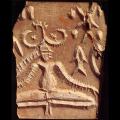
Deity seal from Mohenjo-daro. E.J.H. Mackay writes of what he calls a "deity, seated in what may be a yogi attitude" where, in this case, "the stool is omitted, however, and the figure is apparently seated upon the ground. The headdress consists of two horn-like objects between which there appears to be a spike of flowers. A pigtail hangs down one side of the head which has one face only, in profile, facing to the right. Unfortunately this seal is badly broken, but enough remains to show that the figure was surrounded by pictographs arranged in a somewhat haphazard fashion." (Further Excavati… >

CIPHER WAR After a century of failing to crack an ancient script, linguists turn to machines

An article in The Verge discusses efforts by scientists at the Tata Institute of Fundamental Research and others to use algorithmic analysis to decipher the ancient Indus script. >

Trident Hand Seals

  • Seal fragment of a man with double bun and three fingered hand or trident. Trench 39 North, upper levels, Harappa Phase.

Complete fragment of seal with the trident hand, from Richard Meadow: H98-3505/8347-105 Steatite seal, intaglio. White fired steatite with a white core. Red speckling on interior below glaze level, slightly speckled on surface. Grinding marks visible on surface. Fragment of writing and top of animal motif remain - 2 or 3 signs are partially visible and 1 sign is complete (~”N”). The man with a double-bun hair style may be holding a trident or simply raising his hand. The animal motif is probably a tiger because of the multiple strokes. Anthropomorphic sign and animal direction facing to le… >

Bare Handed Tiger Wrestling Seals

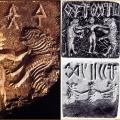
  • Images show a figure strangling two tigers with his bare hands.

In color is a seal, in black and white two seals and corresponding sealings made from them (Joshi and Parpola, Corpus of Indus Seals and Inscriptions, Vol. 1, M 306-8). Mark Kenoyer writes that "discoveries of this motif on seals from Mohenjo-daro definitely show a male figure and most scholars have assumed some connection with the carved seals from Mesopotamia that illustrate episodes from the famous Gilgamesh epic. The Mesopotamian motifs show lions being strangled by a hero, whereas the Indus narratives render tigers being strangled by a figure, sometime clearly males, sometimes ambiguo… >

Three-sided Terracotta Seal

This beautiful three-sided terracotta sealing from 2000 BCE depicts a male cult figure seated in a yogic posture on a throne, a bull-like animal, and five characters in the Indus script. Today, the seal resides in the Ashmolean Museum at the University of Oxford. See also Long Indus Seals. >

An Indus Sign Place Name?

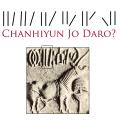
"Following these criteria, at least one Harappan toponym can be isolated with a fair amount of confidence. Altogether 70 Indus insciptions have been recovered from Chanhujo-daro. Eleven of them contain the sign [shown], which is not known from any of the other thousands of Indus inscriptions found at other sites," writes Asko Parpola. >

Multi Animal Seal from Mohenjo-daro

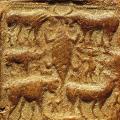
Sealing from Mohenjo-daro depicting a collection of animals and some script symbols. This terra cotta sealing may have been used in specific rituals as a narrative token that tells the story of an important myth. See also Rare Three Animal Seal from Mohenjo-daro. >

Pagination

  • First page
  • Previous page
  • Page 1
  • Page 2
  • Page 3
  • Page 4
  • Page 5
  • Page 6
  • Next page
  • Last page
Blog Posts by Subject (16)
  • Animals
  • Art
  • Children
  • City Life
  • Conferences
  • Crafts and Industry
  • Evolution
  • Excavations
  • Food
  • Homes
  • Media
  • Museums
  • Mysteries
  • News
  • People
  • Seals
© Harappa.com 1995-2026 31