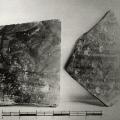
These two pot sherds depict commonly recurring motifs on pottery at Harappa and Mohenjodaro. The sherd on the left has an interlocking circle, while the one on the right has a double-ring with starburst above a band of stripes and triangles. P… >
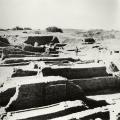
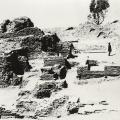
Published in ARASI 1924-25, Plate XXIV (c). Title: ‘Harappa: Mound F, A Large Brick Building Consisting of Two Series of Parallel Walls with an Open Corridor Between Them’ Sahni (note him on extreme right) referred to this photog… >
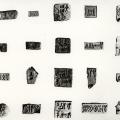
Seven unicorn seals, all but two broken, among other types. Top row Left: Published in ARASI 1924-25 Plate XXVII, No. 8, “A (b) 922” Third from Left: Published in ARASI 1924-25 Plate XXVII, No. 4, “A (i) 16” Fourth from Left:… >
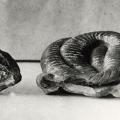
Four terracotta animal figures in a row. Left: possibly an armadillo, find no. Ab 923, found in Mound F in the parallel wall area, and which is published in Vats 1940 (Vol. II) Pl. LXXVII no. 26, and described by Vats: “No. 26 (Ab923) is a fine … >
Mound A-B Trench B: General View from East-South East. This image was published in Vats' monograph as Pl XXX, d. "In the high western part [of mound A-B] (PI. XXX, d, left back-ground) in square P 18/4, Stratum I. Rai… >
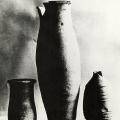
"The pottery found at Harappa is of the light red or brown colour, excepting some specimens which are black. The latter colour is produced by the application of a variety of earth after it has been fired once." >
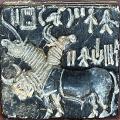
Describing another composite animal seal with the same three animals – short-horned bull or bison, unicorn and goat – Dr. Kenoyer writes (Ancient Cities, p. 194): "Square seal with multiple creatures combined to make a single animal. The rounded… >
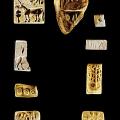
A collection of inscribed objects found along the main street leading to the southern gateway of Mound E at Harappa. The fragmentary seal on the left is the earliest seal found to date, and depicts a bovine carved in a very archaic style. At the top… >
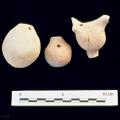
Hollow egg shaped whistles may have been used for making music and for accompaniment to singers, a tradition that is still present in rural areas of Pakistan and India. The bird shaped whistles were probably used to amuse children and may represent … >