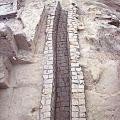
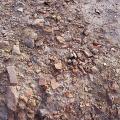
Brick robbing from both directions removed all but the central portion of this drain, but the remaining contents provide an important sequence of Harappan pottery spanning at least 200 years from 2400-2200 BC. >
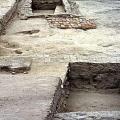
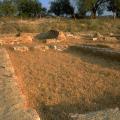
In the South, perimeter wall [250] was preserved to a lesser altitude than in the North. In the very south of the area excavated in 1996, the lower portions of the walls of a mud-brick room were found attached to the inside of the perimeter wall nex… >
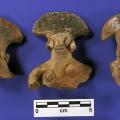
Many of the fan-shaped headdresses were painted black. While the headdress may have been worn as a symbol of distinction, it has been suggested that this type of headdress actually represents black hair stretched over a frame made of bamboo or some … >
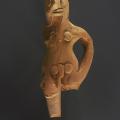
Other male figurines stand with their hands on their hips and their legs pressed together, a common posture for female figurines. Approximate dimensions (W x H x D): 4.0 x 9.7 x 2.8 cm. >
Ram figurines are identified by their large curled horns. Some have incised horns and/or muzzles like the water buffalo figurines and are only distinguished by the curvature of the horns. Approximate height (length): 6.0 cm. >
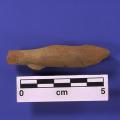
Another aquatic creature represented in the figurine corpus of Harappa is the fish, which has applied fins, incised gills, and a vertical hole through the center of its body. Like the gharial, the fish is also a common motif on tablets as well as in… >
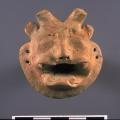
Loosely included under the rubric of terracotta "figurines" are the terracotta masks found at some Harappan sites. One mask clearly has a feline face with an open mouth with exposed fangs, a beard, small round ears and upright bovine horns. It is sm… >
There are no answers to the purpose of this structure; current speculation suggests it may have been a palace for a ruler or a ruling group, or perhaps even a building for priests such as the later Buddhist monasteries. >
Photograph of Mound AB. There also appears to be a smaller mound that is present at the modern Harappa town site. This could be a modern representation of the processes that built ancient Harappa. This is especially noticeable since the surrounding… >