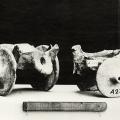
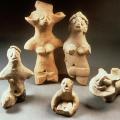
The wheel (A 233) was found inside the large earthen chati unearthed in the first long trench on Mound F. "(21) The only other kind of toy is a cart (Plate X. Photo. No. 2749) consisting of a shallow rectangular basin with rings for the ends of t… >
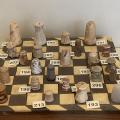
A wide variety of game pieces from Mohenjo-daro on a modern wooden board. Sir John Marshall, one of the earliest excavators at Mohenjo-daro writes in the monumental work summarizing the first finds at the site (Mohenjo-daro and the Indus Civiliza… >
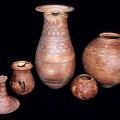
Painted burial pottery from Harappa. The two largest vessels were found in the same burial and are described below. The other smaller vessels were found in an earlier burial and represent an older style of pottery. Tall jar with concave neck and … >
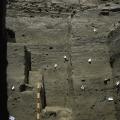
Looking up from the bottom of Trench 39S one can see habitation levels spanning over 500 years from approximately 3300 BCE at the bottom to 2800 BCE at the top. The white arrow pointing north is lying at the edge of a large storage pit dug into natu… >
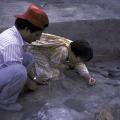
Conservators very carefully excavate and consolidate a necklace of terra cotta beads found in the Ravi Phase levels at Harappa in 1998. On the left is Arif Husain of Karachi University assisting Elizabeth Robertson of the Smithsonian Institution. >
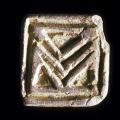
This fired steatite button seal from the Kot Dijian Phase (Period 2, 2800-2600 BCE) shows a unique pattern that may be an early form of the Harappan script sign that may represent "house" or "temple." >
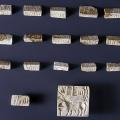
Sixteen three sided tablets (c. 2300 BCE) with incised inscription on each face were found all together in the debris that had been dumped over the curtain wall (54). On one of the three sides is an inscription that is identical to the last two sign… >
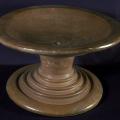
Late Harappan Period Dish-on-stand from Harappa with a hole in the center of the dish that may have been used for a special ritual purpose. The dish is pedestaled on a heavy base with triple ridges. This unique form of vessel was found at the foot o… >
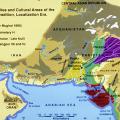
This map shows the major cultural interaction regions c. 1900-1300 BC: Cemetery H in the north, Jhukar in the south and Rangpur in Gujarat. During this period there were still urban centers in the Punjab and Sindh, but there was a breakdown in trade… >