Harappa

Harappa, Punjab ancient Indus civilization excavations, figurines, seals and other objects.

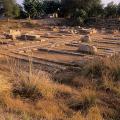
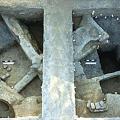
Towards the east, in what was probably a low area, a series of radiating mud-brick retaining walls were built to contain rubble that was used as a foundation for later structures, only fragments of which are preserved. In the rubble were found a gre… >

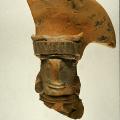
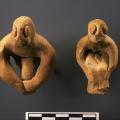
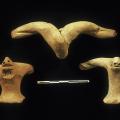
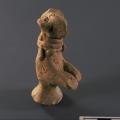
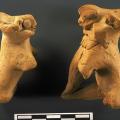
Most male figurines from Harappa sit with knees bent and arms at the sides of the legs or around the knees. Some of these figurines have facial features and even genitalia, and a few have stylized legs joined into a single projection. Approximat… >

In addition to domestic animals, wild animals such as the markhor (wild goat) are represented in the corpus of Indus figurines. The markhor figurines’ distinctive long spiral horns were formed by wrapping the clay around a stick or rod while it was … >

The somewhat schematic "begging dog" figurine on a circular base holds its front paws in front of its body, a posture that is commonly associated with dogs. The figurine wears an elaborate collar that is decorated with applied discs that may represe… >

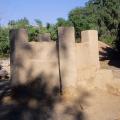
A good counter example to "Great Granary" having been used to store grain is this actual granary popular in the villages surrounding Harappa. Grain is stored in earthen structures, and accessed as needed through a re-sealable hole at the bottom. >

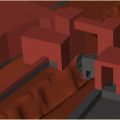
Using interpretations presented in Meadow and others (1995), a reconstruction of the bastion/gateway area was completed in EarthVision. The computer reconstructions were based on an artistic rendering completed by HARP archaeologists. These reconstr… >

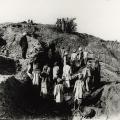
"The excavation of the mounds F and A and B was commenced in the beginning, of January 1921, and continued up to the middle of February. The operations were carried on under my personal supervision . . ." wrote Sahni (p. 9), but it is unclear if tha… >