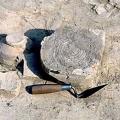
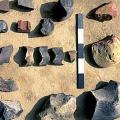
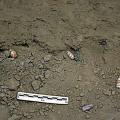
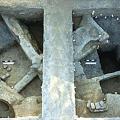
In preparing the basketry impression for removal, large numbers of broken Kot Diji phase ceramic vessels were uncovered, all discarded together into the street along with the basket. >
Different sizes and colors of ringstones from upper Harappa phase levels of Mound AB, Trench 39N. The smaller rings may have been used to make decorative columns while the larger ones were probably column bases. >
Towards the east, in what was probably a low area, a series of radiating mud-brick retaining walls were built to contain rubble that was used as a foundation for later structures, only fragments of which are preserved. In the rubble were found a gre… >
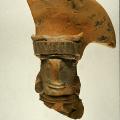
A few female figurines from Harappa have a sort of "tiara" attached to the front of the fan-shaped headdress. Approximate dimensions (W x H x D): 6.0 x 8.7 x 3.9 cm. >
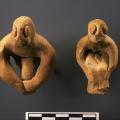
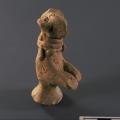
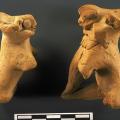
Most male figurines from Harappa sit with knees bent and arms at the sides of the legs or around the knees. Some of these figurines have facial features and even genitalia, and a few have stylized legs joined into a single projection. Approximat… >
In addition to domestic animals, wild animals such as the markhor (wild goat) are represented in the corpus of Indus figurines. The markhor figurines’ distinctive long spiral horns were formed by wrapping the clay around a stick or rod while it was … >
The somewhat schematic "begging dog" figurine on a circular base holds its front paws in front of its body, a posture that is commonly associated with dogs. The figurine wears an elaborate collar that is decorated with applied discs that may represe… >
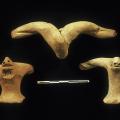
Whether or not the masks/amulets and attachable water buffalo horns were used in magic or other rituals, unusual and composite animals and anthropomorphic/animal beings were clearly a part of Indus ideology. The ubiquitous "unicorn" (most commonly f… >
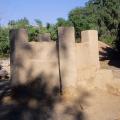
A good counter example to "Great Granary" having been used to store grain is this actual granary popular in the villages surrounding Harappa. Grain is stored in earthen structures, and accessed as needed through a re-sealable hole at the bottom. >