
Marshall's Mohenjo-daro 1922-27
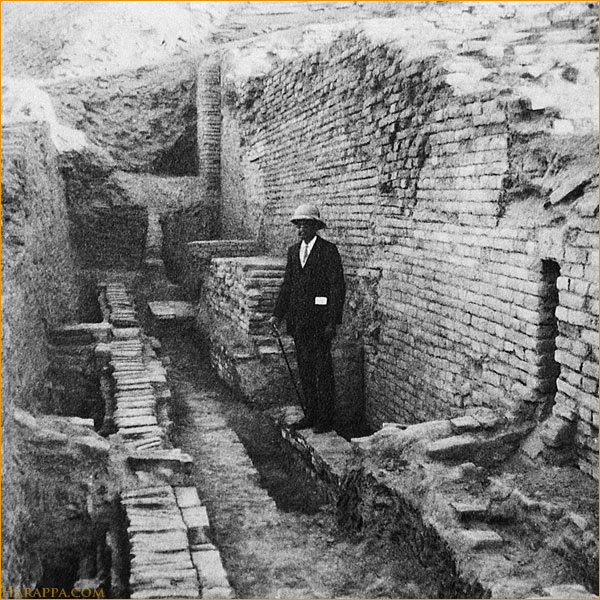
Photographs from Sir John Marshall's classic book Mohenjo-daro and the Indus Civilization (1931) covering the very first excavations at this ancient Indus metropolis.
We will slowly bring more images and commentary from this critical volume in Indus civilization studies online.
Click on the slide below for slideshow mode; click on the title for the image on a white background with longer captions.
|
1. The Excavations of Mohenjo-daro from the air 1920s Photographed between 1922-27 and published in Sir John Marshall, Mohenjo-daro and The Indus Civilization (1931) |
|
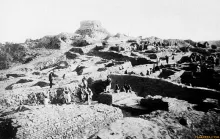
2. Southern Buildings in course of excavation, from south-west [Original 1931 text] "A considerable number of buildings separated from each other by streets and lanes have been excavated in the southern portion of the stupa mound . . .. The terrain here descends… |
|
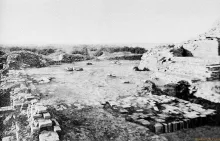
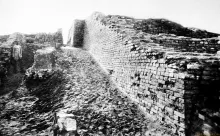
3. Eastern side of courtyard showing remains of Kushan pavement before exploration of Indus remains beneath Photographed between 1922-27 and published in Sir John Marshall, Mohenjodaro and The Indus Civilization (1931). |
|
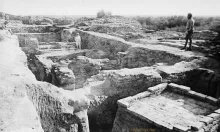
4. North wall of House XXV [Original 1931 text] "Houses XXV and XXVI are built on the foundations of a large structure of the Intermediate I Period, of which onoy the back or west wall has been exposed. House XXV faces towards… |
|
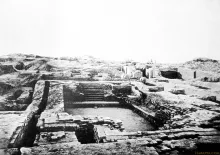
5. Excavation on eastern side of Stupa, showing construction of the Indus period, from the south-west Photographed between 1922-27 and published in Sir John Marshall, Mohenjodaro and The Indus Civilization (1931). |
|
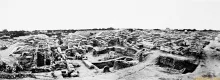
6. The Great Bath, as seen from the south-west [Original 1931 text] "The Great Bath, which I have reserved to the last, was part of what appears to have been a vast hydropathic establishment and the most imposing of all the remains unearthed at… |
|
7. Panoramic view of north-west part of VS Area, from west Photographed between 1922-27 and published in Sir John Marshall, Mohenjodaro and The Indus Civilization (1931). |
|
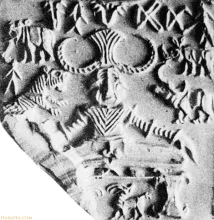
8. Male god, the prototype of the historic Siva [Original 1931 text] "There appears at Mohenjo-daro a male god, who is recognizable at once as a prototype of the historic Siva. He is strikingly portrayed on the roughly carved seal [above], which… |
|
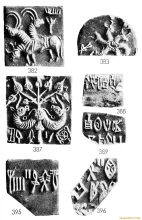
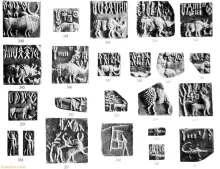
9. Mythological Creatures and Plant Forms Seals [Original 1931 text] "The three-headed beast on seal 382 appears to be a composite of three animals. The heads and horns seem to be those of antelopes and the body of a unicorn. The heads have been… |
|
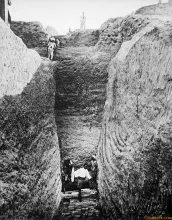
10. Deep cutting near north-west corner of monastery, showing pavement of seventh stratum [Original 1931 text] "To have cleared these remains completely or even to the extent of recovering the main lines of their plans would have meant dismantling the Buddhist buildings above them, and,… |
|
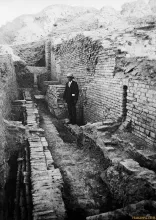
11. Street between Blocks 1 and 2 in SD Area, looking north Photographed between 1922-27 and published in Sir John Marshall, Mohenjodaro and The Indus Civilization (1931). |
|
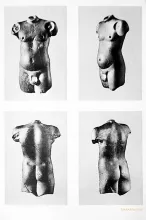
12. Statuette of red stone from Harappa [Original 1931 text] "The treatment of the red stone torso could hardly be simpler or more direct. The pose is a frontal one with shoulders well back and abdomen slightly prominent; but the beauty of… |
|
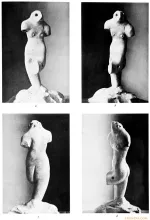
13. Statuette of grey stone from Harappa [Original 1931 text] "It is the figure of a dancer standing on his right leg, with the body from the waist upwards bent well round to the left, both arms thrown out in the same direction, and the… |
|
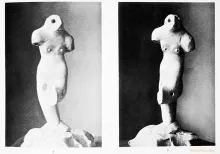
14. Statuette of grey stone from Harappa 2 [Original 1931 text] "And now we come to two small statuettes which are more surprising even than the masterly engraving of the bull . . . .. When I first saw them I found it difficult to believe… |
|
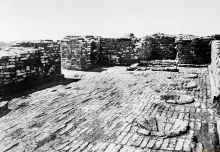
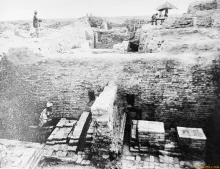
15. VS Area, Section A. Block I, House II: Room 23, showing brick floor with dyeing troughs [Original 1931 caption] "House II. - Rooms 1 to 26, covering a rectangular area of 86 ft. 10 in. by 64 ft. 5 in. to the north of the building just described, appear originally to have belonged to one… |
|
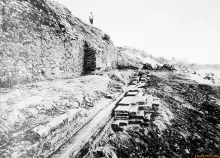
16. Northern end of cutting on east side of Stupa, showing the Indus structures from north [Original 1931 text] "Of the drains which served this building and which belonged to the later reconstruction, one (EE) is carried east and west along the inner side of its northern wall through… |
|
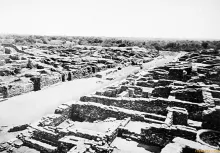
17. Eastern retaining wall of Great Platform, with drains near its foot Photographed between 1922-27 and published in Sir John Marshall, Mohenjodaro and The Indus Civilization (1931). |
|
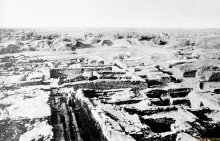
18. View of First Street, between Sections A and B, looking south [Original 1931 text] "The northern part of this street, 145 feet in length, had been dug by Mr. Hargreaves in 1925-26, the rest of the street, some 300 feet in length, was completely exposed by me… |
|
19. Southern Buildings Section. Street between Blocks 1 and 2 in foreground, from north [Original 1931 text] "Blocks 1 and 2. - The total extent of this complex of buildings has not been settled, especially to the north-east (Block 2), as much excavation remains to be done. In the north… |
|
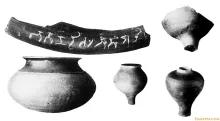
20. Pottery Photographed between 1922-27 and published in Sir John Marshall, Mohenjodaro and The Indus Civilization (1931). |
|
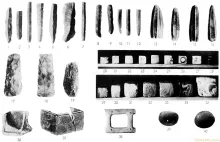
21. Indus Household objects. Flint Implements, Weights [Original 1931 text] "The flint implements found at Mohenjo-daro are of the simplest description, most of them being long flakes that were probably used for cutting up meat and for other household… |
|
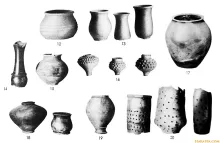
22. Pottery [Original 1931 text] "The ancient pottery of Mohenjo-daro frequently has sand or ime, or both, mixed with the clay, more often in the painted ware than in the plain ware. There seems to have been a… |
|
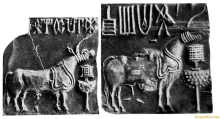
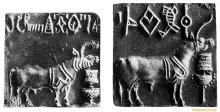
23. The So-called Unicorn [Original text] "The animal most often represented on the seals is the apparently single-horned beast . . .. There is a possibility, I think, that the artist intended to represent one horn behind the… |
|
24. The So-called Unicorn [Original text, 1931] It should, however, be borne in mind that these animals may perhaps represent the dieties of provinces, in exactly the same way as do the 'nome' animals of Egypt, all of which… |
|
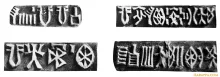
25. Rectangular Seals Photographed between 1922-27 and published in Sir John Marshall, Mohenjodaro and The Indus Civilization (1931). |
|
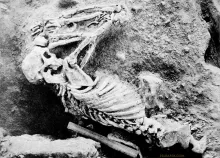
26. Portion of skeleton found above southern wall of Room 74, House V [Original 1931 text] On 29th December, 1925, 1 foot below the surface, part of a skeleton was discovered above what proved later to be the southern wall of Room 74 of House V, Section B. All below… |
|
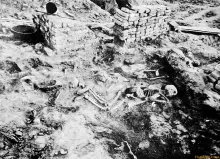
27. Group of skeletons in Room 74, House V. Photographed between 1922-27 and published in Sir John Marshall, Mohenjodaro and The Indus Civilization (1931). |
|
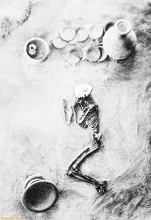
28. A typical burial in the second stratum of Cemetery at Harappa [Original 1931 text] "At Harappa several examples of this mode of sepulture [complete inhumation], which are unquestionably orthodox, have already been expposed in the lower stratum of Cemetery H,… |
|
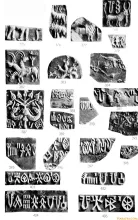
29. Elephant (Elephas maximus). Mythological Creatures and Plant-Forms Seals [Original 1931 text] This animal is on fifteen of the seals, Nos. 362-76. In fact, it may be said to rank next in order of popularity to the bull. On most of the seals it is carefully portrayed, in… |
|
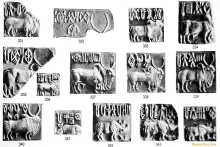
30. Brahmani Bull (Bos indicus) Seals [Original 1931 text] We have certain proof in Nos 327-40 and Possibly No. 542, that this type of bull was known in India in very early times. The characteristic hump on the shoulders allows of no… |
|
31. Rhinoceros (R. unirornis) Seals [Original 1931 text] This animal also rarely appears on the seals, Nos. 341-7 being the only examples that we have as yet. In every case it is the single horned animal that is represented, probably… |