Home

Main navigation

  • home
  • slides
  • essays
  • articles
  • books
  • video
  • q & a
  • blog
Secondary menu
  • about us
    • scholars
    • privacy
    • support
    • image rights
    • credits
    • contact us
  • resources

Harappa

Harappa, Punjab ancient Indus civilization excavations, figurines, seals and other objects.

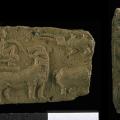
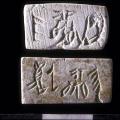
Two inscribed tablets

These two inscribed tablets (c. 2300 BCE) have the same inscription, but it was written in opposite directions. What is even more interesting is that the top tablet is incised with the same "handwriting" as the Group 2 tablets described in (59). The… >

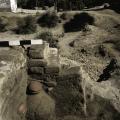
Trench 38

Beneath the Late Harappan wall in Trench 38 is a large globular pot covered with an inverted bottle shaped vessel that was used as a lid. This and the other small bowl protruding from the section were set in the floor of a room earlier than the wall… >

Tablet with man-in-tree and tiger

Molded terracotta tablet (H2001-5075/2922-01) with a narrative scene of a man in a tree with a tiger looking back over its shoulder. The tablet, found in the Trench 54 area on the west side of Mound E, is broken, but was made with the same mold as o… >

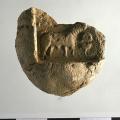
Unicorn sealing

Low fired sealing in terra cotta of a unicorn seal from the Trench 54 area (H2000-4453/2174-192). This type of clay sealing was used to seal bundles of goods for transport. >

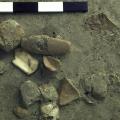
Terra cotta pestle

A terra cotta pestle that may have been used for sanding wooden planks was found discarded along with broken pottery in an early Harappan Period 3B deposit in Trench 54. >

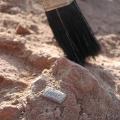
Indus steatite tablets

Fragile steatite tablets are exposed under the skilled hands of trained excavators using small pointed bamboo sticks and brushes. >

Stages of faience tablet manufacture

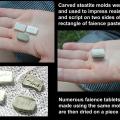
Stages in the manufacture of faience tablets. First it is necessary to make the faience paste and the steatite molds. Then the paste is formed into a rectangle and impressed on both sides by the molds. Finally the molded tablets must be dried slowly… >

Overview of the Harappa "granary" area

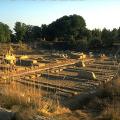
Overview of the "granary" area looking towards the southeast. The walls have been partly restored for conservation purposes by the Department of Archaeology and Museums, Government of Pakistan. >

Hollow baked brick buttresses

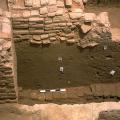
Hollow baked brick buttresses were later built up against the original "granary" structure on top of a shallow mud-brick platform [400] that itself overlies the mud-brick platform of the original "granary". Below these platforms is baked brick wall … >

The upturned rim of a jar

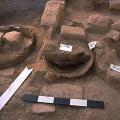
Also in a room encroaching onto the street were the upturned rim of a jar (on left) and two bases (center and right) that were used as hearths (Trench 41NE). The pottery base hearths could have been lifted and moved to different parts of the room th… >

Pagination

  • First page
  • Previous page
  • …
  • Page 34
  • Page 35
  • Page 36
  • Page 37
  • Page 38
  • Page 39
  • Page 40
  • Page 41
  • Page 42
  • …
  • Next page
  • Last page
© Harappa.com 1995-2026 31