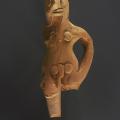
Other male figurines stand with their hands on their hips and their legs pressed together, a common posture for female figurines. Approximate dimensions (W x H x D): 4.0 x 9.7 x 2.8 cm. >
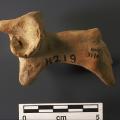
Ram figurines are identified by their large curled horns. Some have incised horns and/or muzzles like the water buffalo figurines and are only distinguished by the curvature of the horns. Approximate height (length): 6.0 cm. >
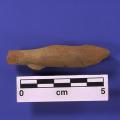
Another aquatic creature represented in the figurine corpus of Harappa is the fish, which has applied fins, incised gills, and a vertical hole through the center of its body. Like the gharial, the fish is also a common motif on tablets as well as in… >
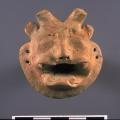
Loosely included under the rubric of terracotta "figurines" are the terracotta masks found at some Harappan sites. One mask clearly has a feline face with an open mouth with exposed fangs, a beard, small round ears and upright bovine horns. It is sm… >
There are no answers to the purpose of this structure; current speculation suggests it may have been a palace for a ruler or a ruling group, or perhaps even a building for priests such as the later Buddhist monasteries. >
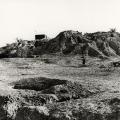
Photograph of Mound AB. There also appears to be a smaller mound that is present at the modern Harappa town site. This could be a modern representation of the processes that built ancient Harappa. This is especially noticeable since the surrounding… >
Next to the excavations on Trench A, Mound F, in 1921 Sahni also cut into Mound AB, under the remnants of a mosque that once stood on top of the mound and the tomb of a holy man which still stands and is visited today. "Of the mound marked A, B, … >
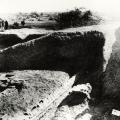
View of Pit I, Mound B, with the long, gabled roof drain. The area of Pit I is marked with a label in the photograph and two men positioned in two areas to show the salient features. One stands near the cell like structures, of bricks. Sahni: “Fo… >
Earthen jar placed inside down along west edge of the southern portion of trench A (e). Is this the same jar as the Large Earthen Jar? Both were found with their mouth (this case, inside) down. Sahni described the jars as “cinerary”: “What the… >